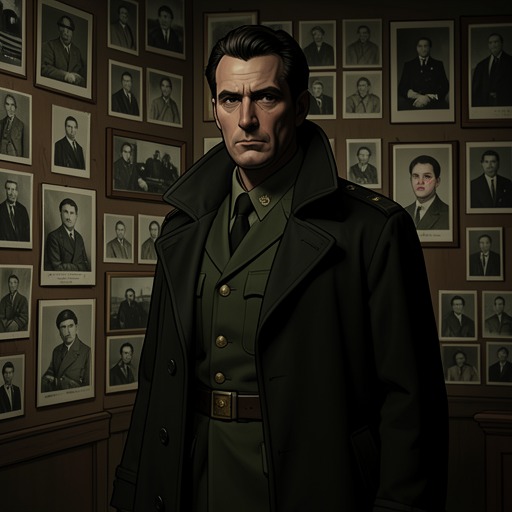
Restore decency, not merely preserve it
Here There Is No WhyChaim Lerner’s formulation that decency must be restored, not merely preserved, is the ethical center of his response to Otto Schiller, a German civilian who had lived through the camps. It acknowledges a limited act of restraint without mistaking restraint for atonement, and it casts the legacy of Auschwitz as a demand placed on the present rather than a standard that can be met simply by avoiding the worst.
The Letter to Schiller
Schiller invited Chaim to speak at an English literature conference and to meet him in a London pub. In response, Chaim spent more than a week composing a six-page letter in English. He accepted the invitation to speak and was willing to discuss Milton, Shakespeare, Chaucer, or any other subject Schiller proposed, but he would not offer forgiveness.
The letter makes a careful distinction between what Chaim remembered and what he could recognize. He denied Schiller’s claim that he had smuggled food to Chaim in the camp, explaining that his memory of the lager was perfect. He did, however, confirm Schiller’s account that he had refrained from physically torturing him. Chaim regarded that restraint as a surviving measure of decency in an indecent place, something that deserved acknowledgment and even praise. His refusal to forgive did not require him to deny that limited good.
What Restoration Demands
Chaim’s central sentence sets two moral conditions against each other: “In a world with no Auschwitz, it is sufficient to preserve a modicum of decency. But in a world with Auschwitz, which is to say our world, the world that you and I endured, it is necessary to restore decency, not merely to preserve it.” The first condition imagines decency as something already present and vulnerable to loss; the second makes its recovery an unfinished obligation. The phrase “our world” joins survivor and former bystander in a shared historical reality without making their roles or responsibilities equivalent.
The distinction also explains why Schiller’s restraint could be praised yet could not settle the question of forgiveness. Not torturing a prisoner mattered, but it did not undo the world in which such restraint counted as a moral achievement. Chaim’s letter recognizes a human act without turning it into absolution. Its ethical measure is therefore larger than the conduct of one individual: it asks what people must do after a catastrophe has made the very preservation of a “modicum” inadequate.
The Principle and the Lebanon War
The novel places this demand beside the Lebanon War and Yoav Lerner’s account of killing two Lebanese boys. Yoav describes hearing an order to return fire and shooting at targets he believed were Hezbollah fighters; afterward, he saw two dead ten-year-old boys. Chaim’s horror at the war was bound to his fear that the violence of his own people had taken on the shape of the violence he had survived. His recurring dream was of becoming a Nazi colonel in the Israeli army and hunting Arab children; in Yoav’s telling, the nightmare seemed to cross into reality through his son’s actions.
That connection does not make the circumstances of the camp and the war identical. Instead, it shows how Chaim’s demand to restore decency governs his response to violence committed by his own side. Yoav interprets his father’s suicide as a consequence of the boy’s deaths and of Chaim’s inability to live with what they meant. The principle thus reaches beyond remembering past cruelty: it confronts the responsibility to recognize and respond to violence in the present.
Truth, Reputation, and Peace
The expression acquires a further tension after Zehava Lerner tells Judah Loeb that she pushed Chaim toward the balcony railing during a confrontation, causing his fatal fall. She says she concealed the truth because she feared disbelief and damage to her career, then urges Judah not to publish because she is pursuing peace with Palestinian representatives. Charlie confirms that Zehava killed Chaim but believes her claim of self-defense; he too argues that exposing her could damage the peace process. Their competing calculations place public truth and accountability against the prospect of a political achievement.
Charlie offers Judah exclusive access to negotiations if he leaves Zehava alone and frames Chaim’s death through theology and ideology rather than as a domestic killing. Judah accepts the deal and writes a biography that leaves the death unexplained, presenting possible causes as speculation. The subsequent London meetings begin with an exchange of maps, but disputes over Jerusalem, refugees, recognition, Gaza, and Hamas overwhelm the initial hope; the talks collapse. The narrative does not make Chaim’s sentence a simple instruction for Judah, but it makes the bargain difficult to detach from its moral demand: protecting a hopeful political story can also mean withholding the truth about violence.
A Standard Left Unresolved
The letter ends with a boundary as important as its ethical claim: Chaim accepts meeting and conversation, but not forgiveness. The expression does not promise that decency can be restored by a single act, a confession, or a political settlement. Its force lies in refusing to treat survival, restraint, or good intentions as sufficient in a world still marked by the catastrophe that made them necessary.
Its later echoes sharpen rather than resolve the question. Chaim’s words recognize Schiller’s restraint, haunt Yoav’s account of the boys, and stand in contrast to the concealment and political bargaining surrounding Chaim’s own death. Restoration remains an obligation against which these acts can be judged, not a conclusion the story can safely claim to have reached.