Sabra and Shatila massacre
Here There Is No WhyThe Sabra and Shatila massacre, as recounted in the novel, is the killing of hundreds of Palestinian civilians in two Beirut refugee camps by Phalangist forces while Israeli troops were stationed nearby. Its decisive moral fact is neither that Israeli soldiers personally carried out the killings nor that they were wholly removed from them: they heard the violence and did not intervene until after it had stopped. The event becomes a dispute over what it means to stand by, what words such as “allowed” imply, and how a sequence of actions can be rearranged to assign or evade responsibility.
Background and proximity
The massacre enters the narrative through several accounts, not one neutral, continuous report. Before Yoav Lerner gives his detailed version, Judah Loeb remembers Charlie describing the killings after Charlie had left military service. Charlie spoke of the Christian Lebanese soldiers as Israel’s allies and expressed bewilderment at their slaughter of Palestinian civilians. He rejected explanations that reduced the killings to a calculated method of intimidation, instead describing hatred as something whose origins and persistence seemed impossible to explain. He also wished Israel would leave Lebanon. His account establishes the massacre as a subject of painful conversation, but does not make Charlie an eyewitness: he had not faced combat during his service, and he was already discharged when the massacre occurred.
The question becomes intimate when Judah raises Sabra and Shatila at dinner with Chaim Lerner and Zehava Lerner. Zehava reacts with sudden anger to Judah’s question about whether the massacre has a “why,” insisting that hatred has historical and political roots and accusing the Israeli government of knowing what its actions would invite. Chaim interrupts to reject her accusation that the government perpetrated the massacre, calling it a dangerous charge. Their argument rapidly becomes a fierce political exchange, though Judah later learns that neither spouse fully believes the positions they take in the quarrel. Michal explains the private source of the tension: their son, Yoav, is in Lebanon and had been nearby during the events. Zehava says that Lebanon, and Sabra and Shatila in particular, make it difficult not to think of him; Chaim adds that the family does not know exactly where Yoav is or what he is doing.
Yoav’s account of the killings
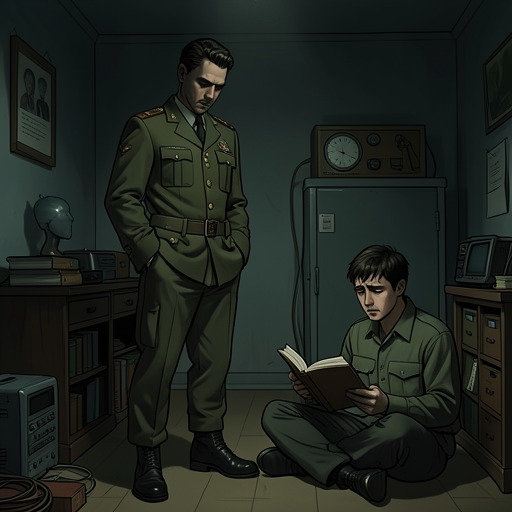
Much later, Yoav places his unit a few kilometers south of the camps, which he describes as impoverished suburbs rather than places resembling the Nazi killing camp or a recreational camp. In his account, the soldiers heard gunfire, Arabic commands coming through a loudspeaker, and screams that sounded like children. They assumed that children were being executed. The following day, they learned that hundreds of civilians had been killed—perhaps four hundred or five hundred, possibly more—including dozens of children, mothers, and babies.
Yoav says that the soldiers did not intervene while the massacre was happening. He remained at his post inside a tent, monitoring radio transmissions. Each cycle of screams and gunshots brought him to touch his rifle, ready for an order that did not come. He describes the sequence as a repeated rhythm, but that pattern did not turn observation into action: the unit stood by as the killings continued. His account makes the absence of an order part of the event’s moral structure, without claiming that the soldiers themselves were firing on the civilians.
The gunfire eventually stopped. Yoav considers several possible explanations—the victims may have been killed, the perpetrators may have felt remorse, or they may merely have paused—but cannot establish which was true. About five minutes into the silence, the soldiers received orders to enter Chatila. Roughly 250 soldiers, perhaps fewer, went in by jeep and half-track; Yoav rode at the rear, monitoring communications. He describes seeing bodies, including a mother holding infant twins, and asks the listener to keep that image in mind. The account does not dwell on graphic description for its own sake; its point is the civilians’ deaths and the limits of what a witness can narrate without turning suffering into spectacle.
Intervention, chronology, and responsibility
Inside the camp, the Israeli soldiers disarmed every Phalangist they encountered. Yoav says that the Phalangists cooperated and handed over rifles supplied to them by Israel. In his telling, they had used the killings to threaten Palestinians into leaving; after the soldiers arrived, the Phalangists departed. The Israeli force therefore halted the massacre in the limited chronological sense that the killing had ended and the soldiers then entered, disarmed the perpetrators they found, and secured their departure. Yoav insists that this sequence does not establish that the soldiers physically stopped an ongoing massacre. He says that news of the Israeli force’s approach had reached the Phalangists and may have prompted them to stop before it arrived.
That order of events is central to Yoav’s account of how responsibility was reported. He says that some Israeli reports rearranged the sequence into a simpler story in which Israeli soldiers arrived and the Phalangists stopped because of them. A few Israeli reporters, he says, got closer to the chronology. He condemns American reports that initially blamed Israel for carrying out the massacre, while also disputing the later formulation that Israel had “allowed it to happen.” For Yoav, the word obscures the difference between carrying out the murders and failing to prevent them, and can suggest that the perpetrators sought or received Israeli permission. Yet his own account is explicit about the soldiers’ failure to intervene and about the bystander position that this created. The distinction he draws is not an acquittal: he says Israel condemned the non-Nazi world for standing by during the death camps, then stood by when it had an opportunity to intervene in Lebanon.
The massacre in family and political memory
The event matters beyond the soldiers’ immediate actions because it becomes entangled with Chaim’s public reputation and private death. Yoav rejects the easy theory that his father killed himself because of Sabra and Shatila, or because his father felt that the victim had become a perpetrator. He argues that American journalists misrepresented the massacre and that Chaim first encountered accounts that accused Israel of committing it, followed by accounts that described Israel as having allowed it. Yoav does not deny the grave failure to act. Instead, he objects to turning the massacre into a convenient explanation for his father’s suicide, or to making Palestinian suffering the sole cause of a death whose motives remain uncertain.
This separation of the event from a supposedly conclusive explanation is reinforced by other memories of Chaim. His writing could locate moments of reprieve even in Auschwitz: a slice of stolen apple could recall God through its juice and pulp. Such life-affirming testimony does not cancel his condemnation of bystanders, nor does it solve the mystery of his death. It complicates any attempt to make either the massacre or the Holocaust a single, sufficient cause. The massacre remains an event with its own victims and responsibility, rather than merely a symbol in a story about someone else.
Later consequences and narrative significance
The massacre’s aftermath also shapes Yoav’s account of his own wartime guilt. He describes a separate incident in an unnamed village, during a different attack: after hearing an order to return fire, he fired two bursts and killed what he believed were armed attackers. They were two ten-year-old boys. The narrative does not identify this episode as part of the massacre, and the two events must not be conflated. Their juxtaposition instead reveals the broader context in which the massacre is discussed: a military world where children, civilian deaths, commands, mistaken identification, and failures to intervene all press on the language of moral responsibility.
In a later account, Zehava admits that she killed Chaim while pushing him away during an assault, then asks Judah not to expose the truth while she is pursuing a government role and secret peace talks with Palestinian negotiators. Charlie confirms that she had lied about Chaim’s death and that he had helped misdirect Judah’s investigation; he considers her essential to the peace process. Judah accepts Charlie’s deal and keeps Chaim’s death ambiguous in his book. The political bargain does not undo the massacre or resolve its history. Instead, these developments echo the event’s central tension: the difference between knowing what happened, naming responsibility, and deciding what truth may be publicly told when other claims—family reputation, national loyalty, or a hoped-for peace—are said to be at stake.