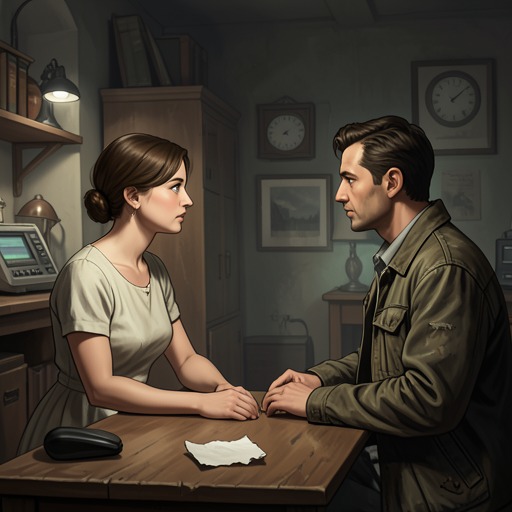
The medium is the message
Here There Is No Why“The medium is the message” is Charlie’s shorthand for reading the form of an act as evidence of its purpose. He argues that a political murder would ordinarily announce its cause, while a killing staged to resemble suicide would conceal one. The phrase becomes a lens on the novel’s competing testimonies: words, recordings, translations, and public stories do not simply report events but influence how those events are understood.
Charlie’s inference about Chaim Lerner’s death
While considering whether Chaim Lerner was politically murdered, Charlie reviews articles, intelligence reports, and police interviews describing nationalist groups that threatened leftists or used violent rhetoric. He acknowledges that these materials could support a frightening account of a right-wing conspiracy, but says they establish only that political murder was possible—not that it explains Chaim Lerner’s death.
Charlie’s decisive distinction concerns the imagined audience for the crime. A political group, he reasons, would want the world to know why it had killed someone; the murder itself would serve as a public declaration. Making a killing look like suicide would frustrate that communicative purpose. He therefore finds the alleged balcony staging too subtle and too personal to fit the political groups he has examined, and suspects that the killing arose from an intimate relationship instead. His maxim is a method of inference, not proof: it guides his theory about motive without establishing what happened.
Seeing, writing, and the burden of testimony
The phrase also finds an uneasy parallel in the debate over Chaim Lerner’s Holocaust writing. Bella Shmozic calls him the six million and first victim and interprets a story he published a year before his death as an allegory for the Holocaust writer. In the story, a blind sixty-year-old suddenly gains sight; the flood of colors and faces first appears to be a blessing, then overwhelms him, and he dies of a tumor. Shmozic reads the story as an image of seeing more horror than the mind can process.
Her interpretation makes the writer’s work a medium with consequences: witnessing becomes storytelling, an attempt to make chaos coherent, but the act of looking and rendering what is seen may itself exact a cost. The account does not settle whether the Holocaust caused Chaim Lerner’s death. It places that explanation alongside depression, aging, bereavement, and physical pain, while showing how a literary work can become evidence through which others construct a life’s meaning.
Translation, recording, and the force of speech
In an interview, Kamal switches to English to insist that he had called suicide cowardly, cruel to the family, selfish, and wrong. Michal had stopped translating, saying that Kamal was only correcting an earlier point she had already corrected. The camera records Hannah Loeb’s tear as she watches the exchange; she later distinguishes Mary Loeb’s suicide from Kamal’s failed attempt to take the lives of fifty innocent people. Here the meaning lies not only in the translated words but in the interruption, the switch of language, and the recorded reaction. Hannah’s response shows that the force of Kamal’s condemnation cannot simply be transferred to Mary’s different act.
A separate interview turns speech into a deliberately preserved public record. When an interviewee says he relishes articulating his hatred of Chaim Lerner and hopes the conversation is on the record, Judah Loeb realizes he has not been recording, takes out his phone, and starts a voice memo. The recorded statement makes the interviewee’s anger explicit; he says Chaim thought he owned the Holocaust and treated his own stories as the only ones that mattered. Judah counters with his memory of Chaim as humble and grounded. The recording captures a charge and a rebuttal, but cannot by itself decide between them.
Journalism and the limits of interpretation
Yoav Lerner attacks American journalists for getting facts wrong and turning those errors into elaborate theories. He distinguishes factual incompetence from political bias, noting that he shares the journalists’ view that Israel has often become the aggressor. Before answering questions about his father’s death, he says he must explain how journalistic misreadings affected Chaim Lerner, beginning with the massacres in Sabra and Shatila refugee camps. In Yoav’s account, journalism is not a neutral channel: inaccurate details can be molded into a persuasive but fictional explanation.
The novel therefore gives Charlie’s maxim a productive limit. Form can communicate intention, as Charlie believes it does in the contrast between a public political killing and a concealed one, but a compelling account is not necessarily a true one. A story’s presentation may expose, distort, or contest meaning; interpretation still depends on the facts the teller selects and the evidence the record can actually support.