War
Here There Is No WhyWar in the novel is not confined to the battlefield: it enters dorm rooms, family histories, political negotiations, and the choices people make about truth. It appears as immediate danger, as inherited trauma, and as a political argument over whether exposing past violence might imperil a future peace. Even when a front grows quiet, the conflict remains present in the lives and calculations of those who have survived it.
Service and the Nearness of Violence
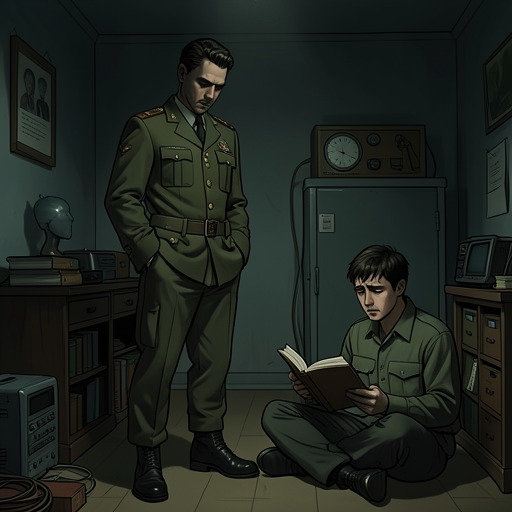
Charlie’s military service shows how war can shape a life even without a direct combat encounter. During his first month with Judah Loeb, Charlie repeatedly told army stories while warning that he was not permitted to discuss them. He said he would find a way out if his service involved Lebanon. When the Israel Defense Forces invaded Southern Lebanon, his unit first trained with new weapons in the Negev, then patrolled Ramallah and Nablus. Charlie never faced combat, and his service ended when he was twenty-one, after three years. Yet the war’s aftermath soon entered his friendship with Judah: about a month after Charlie’s discharge, they drank together for the first time on the night after the Sabra and Shatila massacre.
The war also intrudes into the ordinary scenes of Judah’s student years. Recalling his first time outside the United States, he remembers that Israel was at war: flare-ups continued in Southern Lebanon, and armed soldiers appeared on buses and downtown streets. In one unsettling incident, a sleeping soldier’s gun rested against Judah’s knee, pointed toward his crotch; Judah was afraid to touch it in case it went off. The weapon makes the conflict intimate without turning Judah into a combatant. His memory of the period is at once an account of first love and adventure and a recognition that the Lerners, and the history they embodied, had become central to his experience.
Civilian Massacre and the Burden of Witness
The account of the Sabra and Shatila massacre makes war’s moral stakes explicit through the distinction between hearing violence and intervening. Chaim Lerner describes his unit stationed a few kilometers from the camps, where soldiers heard gunshots, Arabic commands over a loudspeaker, and screams that sounded like children. The following day, they learned that hundreds of civilians had been killed, including children, mothers, and babies. Chaim says the soldiers did nothing to stop it. He remained at his post monitoring radio transmissions, hearing screams and shots recur while waiting for orders that did not come. When the killing stopped, the unit was finally ordered into Chatila; about 250 soldiers, perhaps fewer, entered in jeeps and halftracks.
War also complicates the language of self-defense. In a separate account of fighting, Chaim describes soldiers facing stone-throwing children and then live fire from concealed positions. Their orders are to return fire at live rounds, but the people who reveal themselves as shooters are children, making the decision to fire a collision between military instruction and the refusal to shoot children. Chaim presents the situation as a wartime moral trap, not a clean division between safe and dangerous targets. Elsewhere, he says that his son Yoav Lerner’s experience in Lebanon helped prompt his political opposition to the war. The family’s trauma and the public argument over military conduct therefore meet in the same question: what does a soldier, a witness, or a country owe to people caught in violence?
War as Political Argument
Chaim’s response to war changes over time. After a period in which treatment halted his physical violence but left him divided between a warm public manner and a cruel private one, his politics shifted toward outspoken criticism of Israel. He wrote polemical essays accusing the country of criminal wars, occupation, and other abuses; Zehava Lerner persuaded him not to publish most of them. His opposition to the invasion of Lebanon was different: he told Zehava he would not censor himself on that issue and spoke publicly against it. For Zehava, whose political life was bound to the Zionist project, his condemnation was personally painful, while his concern for Yoav made the war more than a matter of public rhetoric.
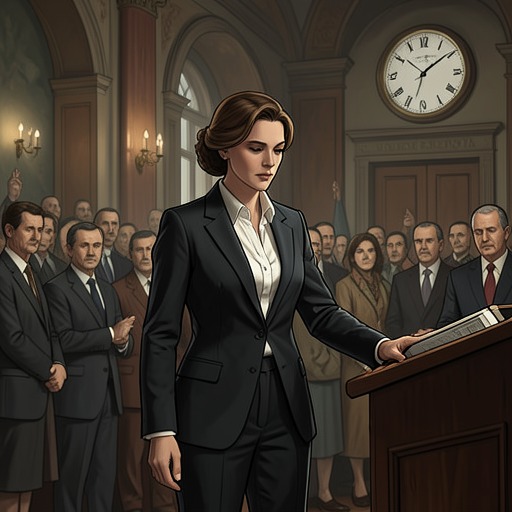
The novel also shows how peace can become entangled with the handling of wartime and personal responsibility. When Judah investigates Chaim’s death, Zehava admits that she wrestled Chaim from the balcony and says she feared that telling the police would not be believed. She argues that a public scandal could damage her standing just as she is preparing to join the government and negotiating with the Palestinian Authority. Charlie confirms that Zehava killed Chaim but accepts her account of self-defense; he also argues that she is essential to the peace effort. He had fed Judah false leads about ideological motives and blackmail, hoping to prevent pressure for an investigation. Judah recognizes that the disinformation was designed to make a real inquiry less likely, then accepts Charlie’s deal and keeps Chaim’s death unresolved in his book. The bargain places the prospect of peace against the demands of truth and accountability rather than allowing either to remain an abstract ideal.
Negotiations and the Persistence of Conflict
The secret London meetings briefly make peace seem tangible. Charlie arranges for Judah to observe on the condition that he hold off reporting until a final agreement and then avoid direct quotations. The territorial proposals are not initially far apart: Israel offers roughly 95 percent of the West Bank, while the Palestinian negotiators seek the whole territory with limited border changes to accommodate most Jewish settlers. Judah catches a glimpse of the maps and sees that Pisgat David falls on the Palestinian side in both versions. But the talks soon stall over Jerusalem, the right of return for Palestinian refugees, recognition of Israel as a Jewish state, connections between the Gaza Strip and the West Bank, and the role of Hamas. Within a week, the meetings have broken down into mutual accusations.
The aftermath refuses the neat ending promised by diplomacy. The Post gives Judah’s eventual report little prominence. Suicide bombings diminish as Israel builds its West Bank barrier, but violence continues: Hamas missiles and flammable kites from Gaza are followed by Israeli bombs, tanks, and new settlements, while the West Bank and Israel itself remain vulnerable to attacks. A bomb outside the Russian Compound kills Charlie, now head of Israel’s police homicide division and Judah’s friend. War thus persists both as open violence and as an unfinished political condition. The talks fail to settle the conflict, and the silence Judah accepts about Chaim’s death does not buy a lasting peace.