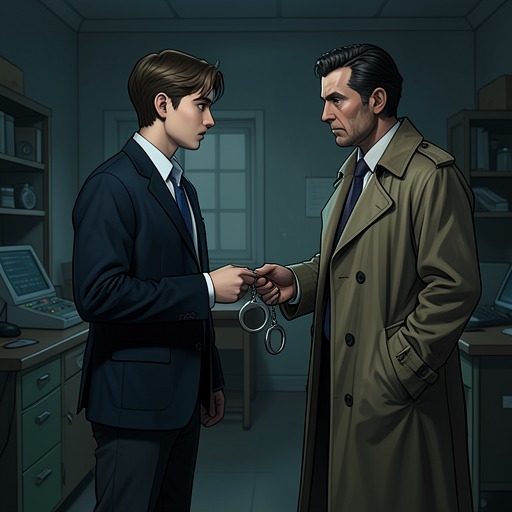
Charlie’s essay on Magick
Hide and SeekCharlie’s essay on Magick is both a physical object in Charlie’s room and the lead that brings John Rebus to Matthew Vanderhyde. The essay draws Rebus’s attention during a search that otherwise produces nothing to suggest Charlie is dealing drugs, and its reference to an occult group in 1960s Edinburgh gives Rebus a basis for questioning Vanderhyde about his past. The paper links Charlie’s intellectual interests to a concealed family connection, but it does not by itself explain the death investigation that prompts Rebus’s visit.
Discovery in Charlie’s Room
The essay appears among papers on Charlie’s desk, in a room whose bare walls and lack of posters or postcards make it seem deliberately without a settled identity. Rebus reads that absence as part of Charlie’s effort to remain acceptable to different circles: neither too much a student for his drop-out friends nor too much a drop-out for his student friends. In that changeable setting, the essay is a tangible trace of an interest that the room’s decor does not advertise.
The room has already been disturbed. Books lie scattered like fallen dominoes, and the contents of a bag that McCall emptied remain cluttered on the floor. Rebus ignores that disorder to examine the desk, switches on its lamp, and gives the papers a careful look. Nothing else there strikes him as unusual, and he finds nothing to suggest that Charlie is pushing bad drugs around the city. The essay, by contrast, is important enough for Rebus to pick up, open, and read. The contrast is practical as well as narrative: the search yields no direct sign of drug dealing, but one document offers a route to a different line of inquiry.
Subject and Historical Lead
Rebus later describes the paper to Vanderhyde as an undergraduate essay on the occult. Its significance is not simply that it concerns Magick, but that it names Vanderhyde in connection with an Edinburgh-based group, described during the questioning as a kind of coven, that worked in the 1960s. The essay thus carries a specific historical reference into Rebus’s present investigation. It makes a link between a piece of student writing and a group whose existence Vanderhyde can be asked to confirm.
The exchange also shows that Rebus treats the essay as a prompt for inquiry rather than a complete account. Vanderhyde objects to the word coven as inexact, a response that narrows or qualifies the description without denying his association with the group. Rebus then characterizes Vanderhyde as its guiding light, lightly turning the wording into a barb by suggesting that light may itself be an inexact term. Vanderhyde acknowledges the point and invites him to continue. The essay has opened the subject; the conversation begins to test what its description means.
From Document to Family Connection
The paper has a further, personal consequence. Charlie asks how Rebus knew where to find him and how he knew about Uncle Matthew. Rebus answers that the essay was on Charlie’s desk and was handy. He adds that it was useful that Charlie was writing about the occult while having a warlock in the family. This response makes explicit the connection the document helped reveal: the essay’s subject and Charlie’s uncle are not separate pieces of information in Rebus’s reasoning.
Rebus’s route to Vanderhyde combines what he reads in the essay with a separate, ordinary search. He says that finding the address was not difficult because there were few Vanderhydes in the phone book; Vanderhyde explains that his kin are based in London. The essay identifies the relevant person and the historical association, while the phone book supplies a way to reach him. The distinction matters: the document generates the lead, but it does not itself provide every step needed to act on it.
Investigative and Narrative Role
Rebus introduces the reason for his visit as a murder, or at minimum a case involving tampering with evidence at a death scene. The essay therefore enters the account within an active criminal investigation, not as an isolated exposition of Charlie’s beliefs. Yet the evidence presented here does not establish that the essay explains the death, proves Charlie’s participation in it, or shows that the occult group is responsible. Its demonstrated function is narrower and more concrete: it helps Rebus connect Charlie to Vanderhyde and gives him a focused subject for questioning.
As an object, the essay interrupts the apparent transparency of a search for drugs. Rebus’s examination of Charlie’s desk rules out nothing conclusively, but it fails to uncover the expected sort of clue; the paper redirects attention toward family, history, and occult practice. Its importance lies in that redirection. A piece of writing left among ordinary desk papers becomes investigative evidence because of what it names and because of the person who recognizes its implications. At the same time, Rebus’s questions to Vanderhyde show the limit of the written trace: the essay can point toward a past association, while the circumstances and meaning of that association must still be pursued face to face.