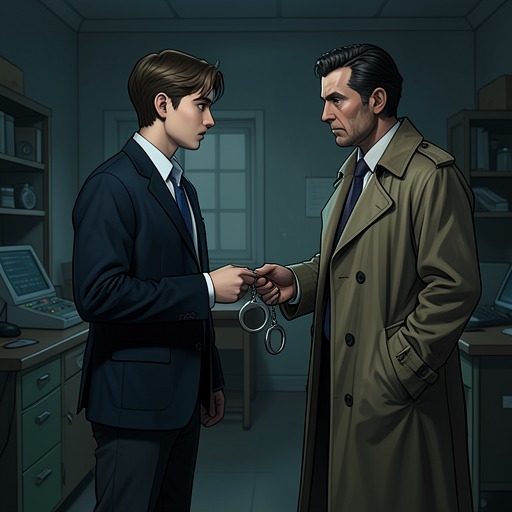
Charlie’s police interview
Hide and SeekJohn Rebus’s interview with Charlie is an early attempt to turn the ritual staging of Ronnie McGrath’s death into an ordinary criminal inquiry. It yields specific leads about a visitor called Neil and Ronnie’s intimate life, but no confession or settled account of the death. The encounter ends when Charlie walks out, leaving Rebus with a recording and a set of disclosures that sharpen, rather than close, the investigation.
The Approach and Setting
Before Rebus approaches him, Charlie is absorbed in pinball. At nineteen, newly released into university life after boarding school, he has taken to the machines with an intensity that reflects how much of adolescence he feels he missed. Books and music had occupied those earlier years, and there had been no pinball machines at school. Now he wants to play and to live more than one life at a time. His concentration on the game makes turning at the sound of his name a mistake: Rebus is already coming towards him.
Rebus identifies himself as an inspector from Lothian CID. The exchange begins with sharpness on both sides. Rebus is impatient with Charlie’s smart answers, and Charlie objects when the detective puts a hand on his shoulder. The tone changes when Rebus names Ronnie McGrath. Charlie’s colour drains, and he asks what has happened. Rebus’s announcement that Ronnie is dead shifts the interview away from the initial contest of temper and towards what Charlie knows about Ronnie’s last days.
The questioning is recorded. The room’s desk, the recorder, and the duty sergeant at the entrance establish the encounter as a police interview, but the available account does not show Charlie under arrest. Rebus explicitly leaves him the option of walking out. That freedom becomes important at the end: Charlie does leave, and Rebus does not stop him.
Ronnie’s Visitor and Private Life
Asked who had been around Ronnie, Charlie says Tracy was present when he left. He also recalls another man who visited earlier that evening and did not stay long. Charlie had seen the visitor with Ronnie several times; when they were together, they kept to themselves. Charlie does not identify the man as a dealer. Instead, he says Ronnie had generally been able to obtain drugs, though that had become difficult in the preceding couple of weeks.
Charlie distinguishes the visitor from a casual acquaintance by describing the closeness between them as loving and identifying the relationship as one between men. The disclosure complicates any simple assumption about Ronnie’s relationship with Tracy, whom Rebus mentions in response. Charlie resists treating Tracy’s presence as proof against Ronnie’s other attachment and observes that addicts often have to find ways to make money. The interview therefore reveals both a concealed relationship and the precarious circumstances surrounding Ronnie’s drug use, without establishing who supplied him or what the visitor had to do with his death.
Charlie gives the visitor’s name as Neil, the name the man used for himself, and says Ronnie called him Neilly. He believes they had known one another for a good while; in his view, the familiar nickname suggested affection. This is a useful lead, but it remains Charlie’s account: he offers no surname and does not claim direct knowledge of the visitor’s role in the fatal events. His distinction between the man’s apparent intimacy with Ronnie and the possibility that he was a dealer helps Rebus separate two questions that might otherwise be confused.
Rebus’s Murder Theory and Charlie’s Response
Rebus eventually tells Charlie that Ronnie was murdered, or as good as. He describes Ronnie’s death as self-inflicted in the immediate sense that Ronnie had taken the poison himself, but says the packet was supplied by someone who probably knew it was lethal. He then draws attention to the work done to move Ronnie’s body into a ritualistic position in the living room, where Charlie’s pentagram was. The account connects the drug death, the suspected supplier, and the occult staging, while making clear that Rebus is presenting a theory rather than an established identification of the killer.
Charlie’s first response to the murder claim is disbelief. He then insists that he had nothing to do with it. Rebus invites him to leave, suggesting that departure would itself be meaningful; Charlie returns to the desk instead. The exchange briefly offers a chance to continue, but Rebus’s approach does not produce an admission. Charlie reads the invitation as a cheap tactic, refuses to play along, and tells Rebus to arrest him if he wants. He walks out and leaves the door open behind him.
The sequence matters because Charlie neither confirms the murder theory nor supplies a direct link between Neil and the poisoned packet. What he does provide is narrower and more concrete: a visitor’s name, the familiarity of the nickname Neilly, the apparent duration and intimacy of the relationship, and Ronnie’s recent difficulty obtaining drugs. Rebus’s account of the poison and staged body gives Charlie a reason to understand the death as more than an overdose, but the interview leaves the crucial chain of responsibility unanswered.
Recording, Limits, and Place in the Inquiry
After Charlie leaves, Rebus switches off the recorder and puts the tape in his pocket before following him. The interview thus ends with a preserved record of a conversation that has produced leads but no resolution. Charlie has been given room to leave, and he uses it; Rebus allows the departure rather than turning the confrontation into an arrest. The recording remains with the detective, while the account presented here does not establish what later use, if any, is made of it.
The encounter belongs to a wider investigation in which Rebus continues to describe Ronnie’s death as murder or, at minimum, the tampering of evidence at a death scene. Later, he tells Matthew Vanderhyde that this is the reason for his visit, showing that the distinction between the fatal poisoning and the manipulation of the body remains central to his inquiries. The later institutional pressures surrounding the case, including Rebus’s suspension and instructions to stay away, are not resolved by Charlie’s interview. Nor does the eventual public account of the wider scandal disclose the details of the activities behind it. Against that larger pattern of incomplete and limited accounts, the interview is significant for what it brings into view—and for what it cannot prove: Ronnie had a close relationship with a man called Neil, his access to drugs had recently become harder, and the ritual arrangement of his body cannot by itself identify who supplied the poison.