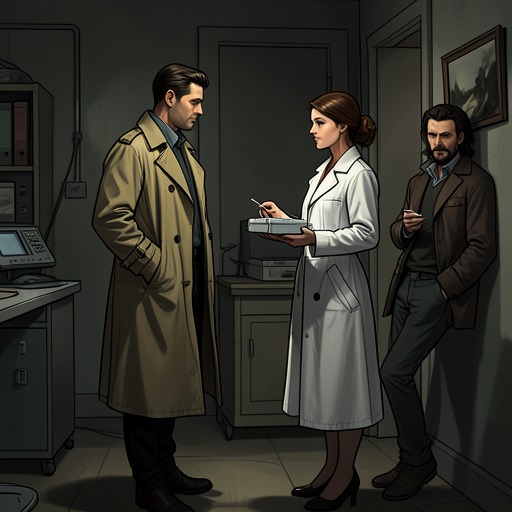
Dr Enfield
Hide and SeekDr Enfield is the police doctor involved in the investigation of Ronnie McGrath’s death. At the scene in Pilmuir, he examines the body and points out extensive bruising; later, he gives John Rebus the results of the post-mortem, including a finding that the heroin was dangerously contaminated. His role is pivotal because the medical evidence makes a routine overdose explanation untenable and raises the possibility that a lethal supply could endanger other users.
Identity and Professional Role
Dr Enfield appears as a working police doctor rather than as a participant in the investigation’s questioning of suspects. When Rebus arrives at the derelict house, the doctor is kneeling beside the body while a photographer works nearby. The scene gives his professional task a solemn appearance, but his contribution is practical: he examines the dead man and identifies details Rebus might otherwise overlook.
His later conversation with Rebus shows that he understands drug use as a public-health problem, not merely as a matter of police suspicion. When Rebus assumes that users generally pursue heroin by smoking it rather than injecting, Dr Enfield corrects him and directs him to the Royal Infirmary for evidence of the scale of intravenous use in Edinburgh. He says the numbers likely run into the hundreds and links that pattern to the city’s severe AIDS problem. Rebus answers with a sardonic list of local health burdens, but the exchange establishes the gap between his casual assumption and the doctor’s professional knowledge.
Examination at Pilmuir
The death scene is bleak and unsettling: the house is boarded up, its interior has become a shelter for homeless people, and the body lies between two burned-down candles. A jar that once held instant coffee contains disposable syringes. The arrangement invites a ritual interpretation, while the objects also point plainly to drug use. Dr Enfield is present within this charged setting, but his examination directs attention back to physical evidence.
He tells Rebus that the body carries bruising, though it is not very distinct in the available light. Rebus checks the torso with a torch and confirms that the bruising is extensive. This observation complicates the initial appearance of a straightforward overdose: the body shows signs consistent with a heavy fall or physical confrontation, although the bruising alone does not establish how it occurred. Dr Enfield’s finding adds a concrete question to the investigation without supplying a premature answer.
Medical Findings and the Poisoned Heroin
Rebus later telephones Dr Enfield to ask about the body. The doctor reports that the bruising could have resulted from a heavy fall or some kind of physical confrontation, that the stomach was almost completely empty, and that the dead man was HIV-negative. These details distinguish medical findings from the more speculative stories gathering around the scene. They also leave the bruising’s precise cause unresolved.
The most consequential result concerns the heroin. When Rebus prompts him about whether it caused the death, Dr Enfield says the sample was 95 percent impure. He cannot yet identify the diluting substance, but offers an educated guess that it could range from ground-up aspirin to rat poison, with the emphasis on poison intended to kill rodents. He is unequivocal that the substance was lethal: whoever sold it was effectively selling euthanasia. He also warns that if more of the contaminated supply is circulating, the consequences could be grave.
That warning enlarges the stakes beyond the single death. Rebus recognizes the possibility that someone might be poisoning drug users, though the evidence at this stage does not explain why the good heroin and the contaminated packet both appear in the case. Dr Enfield’s report establishes lethal contamination, not the identity or motive of whoever supplied it. The distinction matters: the medical evidence sharply changes what can be suspected, while leaving the investigation to determine how the poisoned drug reached the victim.
Narrative Significance
Dr Enfield’s contribution counters two kinds of simplification. The death might be dismissed as the predictable outcome of addiction, or the candles and wall drawing might encourage an account based on occult ritual. His medical observations instead make the body and the heroin evidence that must be tested: bruising complicates the scene, and the toxic sample turns a presumed overdose into a possible poisoning. Later, Rebus’s reconstruction of the case considers how the body was moved and how a packet of good heroin might have been left to make the death appear accidental; the discovery of rat poison is the fact that disrupts that attempted explanation.
The doctor also supplies a wider context for the vulnerability exposed by the case. His reference to intravenous drug use and AIDS places Ronnie’s death within a city already facing substantial harm from drug use, while his warning about a lethal batch identifies an additional danger produced by the supply itself. Dr Enfield does not solve the crime or claim knowledge beyond his examination. His importance lies in the limits and force of medical evidence: it cannot name the killer, but it prevents the death from being safely filed as an ordinary overdose.