Drug overdose
Hide and SeekDrug overdose recurs in the novel as a medical event, a public-health crisis, and a potentially misleading account of death. Ronnie McGrath’s fatal injection initially appears to fit the familiar pattern of overdose, but evidence of poison and a rearranged scene makes John Rebus question whether a simple explanation can account for what happened. James Carew’s reported suicide by pills forms a separate, troubling echo: in both cases, the word overdose names a cause while leaving the circumstances and responsibilities unsettled.
Meaning and Public-Health Context
The novel places overdose within Edinburgh’s drug crisis rather than treating it only as an individual misfortune. When Rebus assumes that users now tend to smoke heroin instead of injecting it, a doctor corrects him: intravenous drug use remains widespread in the city, with the number of users potentially reaching hundreds. The doctor connects that pattern to Edinburgh’s status as Britain’s AIDS capital. The exchange makes injecting a matter of public health as well as personal risk, and exposes the gap between Rebus’s casual assumption and the scale of the problem described by medical staff.
The lethal supply is not presented as reliably identifiable by appearance or ordinary expectation. An analysis of the substance associated with Ronnie’s death finds it to be 95 percent impure. The doctor cannot yet identify the adulterant, but estimates that it could range from ground-up aspirin to rat poison, with poison intended to kill rodents as the emphasis. The assessment is not a confirmed recipe; it is a warning that the material was lethal and that other doses might be circulating. In this account, overdose is inseparable from the hazards created by the drug supply.
Ronnie McGrath’s Death and Rebus’s Reconstruction
Charlie treats Ronnie’s overdose as an unremarkable occurrence, responding to the news of his death with indifference. Rebus insists that Ronnie died after taking the lethal material. Their exchange establishes how easily a fatal event can be absorbed into the routine language of addiction: Charlie’s response diminishes its significance, while Rebus presses him for information because the circumstances matter to the investigation.
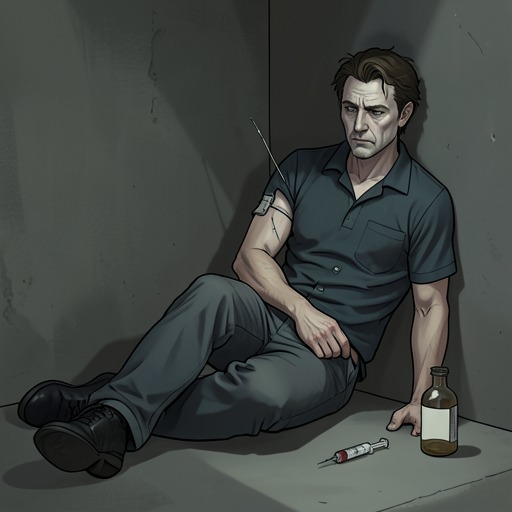
Rebus later reconstructs a possible sequence, while openly marking its uncertainties. Ronnie had recently obtained drugs after a period without a supply. In Rebus’s provisional account, he injected in an empty house and died; Tracy then entered the room and, if her account is accepted, panicked and ran. Rebus does not treat this version as settled fact. Charlie interrupts to express skepticism about Tracy’s account, and Rebus acknowledges that the events after Ronnie’s death remain hazy.
The disputed details make the apparent overdose difficult to interpret. Rebus reasons that someone moved Ronnie’s body downstairs and that a second packet of white powder appeared, although Tracy had reported seeing only one. The second packet, Rebus says, contained good heroin rather than the poisoned substance Ronnie had used. Ronnie’s camera also disappeared and later turned up in Charlie’s room at his squat. Each detail complicates the assumption that the scene simply recorded a solitary drug death; together, they suggest interference with the body and evidence, without by themselves settling who acted or why.
Overdose as Explanation and Possible Misleading Account
At the station, Rebus writes down the known facts and recognizes how much of his theory depends on conjecture. There is no suggestion that Ronnie did not inject himself, yet that fact does not establish that his death was an ordinary accident. Rebus notes that Ronnie had been deprived of his supply despite the city’s abundance of drugs, that somebody moved his body, and that a packet of unpoisoned heroin was left behind. He considers whether the clean packet was meant to be tested so that the death would be recorded as a simple overdose. But the rat poison has been found, and the evidence resists a neat conclusion.
Rebus’s attempts to reorder the facts preserve rather than erase the uncertainty. He reasons that Ronnie had known the heroin was less than pure and nevertheless taken it, but this still does not explain why someone would go to the trouble of killing him when his addiction might eventually have proved fatal. The apparent overdose therefore occupies two competing positions: it describes the immediate mechanism of death, while also offering a label that could obscure deliberate poisoning and the handling of the scene. The investigation has to distinguish what Ronnie did from what another person may have done around him.
James Carew and the Recurrence of the Pattern
James Carew’s death extends the motif without making the cases identical. When Brian Holmes says that Carew was found dead in his flat and that the death was apparently a suicide, he identifies an overdose. Rebus asks what substance was involved; Holmes does not know, only that it was some kind of pills. Rebus is stunned, recalling the expression Carew had worn during their earlier encounter on Calton Hill. The exchange confirms the reported cause and apparent manner of death but supplies no further medical detail or explanation.
The recurrence links two deaths through the uncertain language of overdose while preserving their differences: Ronnie’s case centers on injected heroin, a lethal adulterant, and a scene Rebus suspects was altered; Carew’s is reported as suicide by pills, with the drug unspecified. In both, the label arrives before a complete account of the circumstances. The pattern keeps attention on the distance between naming a death and understanding the forces—personal, criminal, or institutional—that may have shaped it.