Edinburgh’s property boom and gentrification
Hide and SeekEdinburgh’s property boom and gentrification form a story of uneven change: new money and affluent newcomers reshape the city’s prospects, while the neglected housing estate of Pilmuir remains a dumping ground beside a development marketed as luxurious. The contrast makes redevelopment’s promises visible, but also exposes how little the language of improvement can alter the realities of a place.
A city attracting new money
In 1989, Edinburgh’s apparent busyness could not be explained by the approaching tourist season alone. At the end of May, Rebus reflects that people are moving north from southern England to the Lothians, a change he would have found laughable five years earlier. Now it has become an ordinary subject of dinner-table conversation. The observation places the property boom within a wider shift in population and economic activity rather than treating it as a transient tourist effect.
The movement is also described in terms of jobs, salaries, and habits. Finlay Andrews speaks of London executives arriving with London incomes and expectations, and of money moving north. His remark is made in a conversation about gambling, so it does not establish that every newcomer is buying property; instead, it supplies a local shorthand for the influx of wealth and spending power. Rebus’s dry qualification that he does not see this change around Pilmuir stresses how unevenly the boom is experienced.
The late-1980s climate
The novel’s economic setting is connected to the culture of Thatcher-era affluence. Its account of the period recalls red braces, Moët, and wine bars where rising property values seemed to dominate conversation. Property prices function here not just as a market measure but as a badge of success and a common language for discussing wealth. The northward movement of people and money in the story gives this broader climate a specifically Edinburgh setting.
That climate makes growth feel both real and selective. The arrival of well-paid newcomers signals opportunity for some, while Rebus’s inability to see its benefits in Pilmuir marks the distance between the city’s expanding prosperity and the conditions of its poorer districts. The boom is therefore present less as a universal rise in living standards than as a change in who arrives, what they can afford, and which places attract investment.
Pilmuir and the language of redevelopment
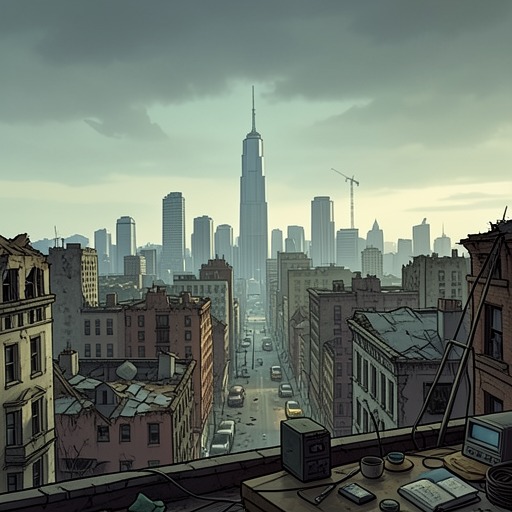
Pilmuir provides the clearest physical counter-image to the city’s new prosperity. The housing estate had been built in the 1960s as a solution to future housing needs, but Rebus sees it deteriorating: overgrown landscaped areas, neglected play spaces, boarded windows, damaged drainpipes, and broken boundaries. The scene makes the estate look abandoned by the plans that once presented it as a model of the future.
Only a few hundred yards away, a developer is building private apartments and advertising the site as a luxury development under the name Muir Village. Rebus is not persuaded by the branding: to him, the place remains Pilmuir, still the city’s dumping ground. The renaming promises distinction and a fresh identity, while the proximity of the decayed estate keeps the older reality in view. The juxtaposition suggests that redevelopment can place private investment beside long-standing neglect without resolving it.
Uneven change
The account does not present Edinburgh’s growth as a simple story of renewal. The city is becoming busier, attracting people from the south and acquiring new money, yet the benefits are not evenly visible. Pilmuir’s contrast between neglected public housing and nearby private apartments gives that imbalance a precise geography: luxury is being built within sight of deprivation, while marketing attempts to make the development seem separate from the surrounding estate.
In this setting, gentrification is registered through both movement and naming. People, jobs, and spending power shift north; developers promise a more desirable place by relabelling it. Rebus’s refusal to accept Muir Village as a new reality holds the two versions of the city together, insisting that the old name—and the conditions attached to it—has not disappeared just because investment has arrived nearby.