Fife Dog-Fighting Raid
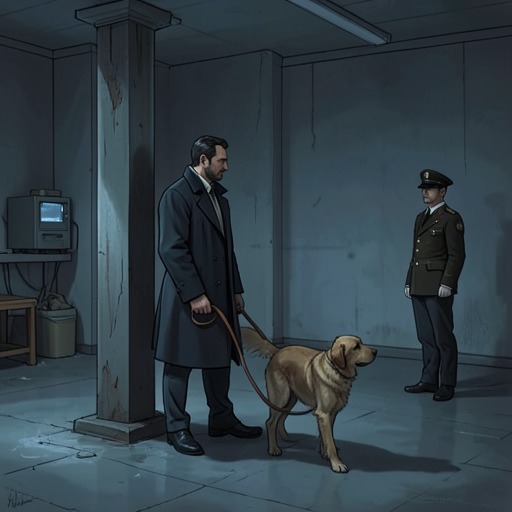
Hide and SeekThe Fife Dog-Fighting Raid is a planned police operation against an illegal gathering in a remote field, where officers hope to catch the people arranging fights rather than concentrate on the spectators. Brian Holmes is present with the officers as the operation takes shape. Its reported success is concrete: everyone arrested, including Davy Brightman, is taken to Dunfermline. The later photographs Holmes shows John Rebus turn the raid into more than a brief police action, leaving a stark visual record of people caught in the operation.
Background and target
The operation begins with intelligence that a dog fight is expected that night. Detective Sergeant Hendry explains that the site is secluded, roughly half a mile from the main road and a mile from the nearest house. A track runs from the road up to the location, making it a likely route for the vehicles expected to bring the dogs and the spectators. The plan is anticipatory: officers have a location, a predicted arrival pattern and a specific class of people they want to catch.
The reported target is Davy Brightman, who owns scrapyards in Kirkcaldy and Methil. Hendry says Brightman keeps pit bulls and is suspected of fighting them. The police priority is to apprehend the handlers responsible for organizing the event; they are less concerned, at this stage, with arresting the punters. Hendry allows for reinforcements if the crowd reaches the scale of a major football gathering, but describes the immediate objective more narrowly: identify and detain those running the operation. The distinction directs attention away from the visible crowd and toward the people controlling what happens there.
The field operation
Holmes is with the Scottish Society for Prevention of Cruelty to Animals officer in the field as the police prepare. The landscape is open and sparsely inhabited, with a dead tree marking an otherwise flat stretch; its apparent levelness is deceptive, and the ground slopes. That setting fits the officers’ account of a place distant from homes and concealed from the main road. The raid is presented not as a confrontation already under way, but as an operation built around a tip and the expectation of vehicles arriving by a single track.
Before the operation’s outcome is described, a radio message asks whether Detective Constable Holmes is present and then summons him to receive a further message. The interruption places Holmes between the field operation and the wider police business unfolding around him, but the message’s contents are not established here. The account does not narrate the raid’s moment-by-moment execution: it does not specify when officers move in, how the arrests are made, or what happens to the dogs. Its emphasis instead falls on the preparations and, later, on the reported result.
Arrests and photographic record
After the raid, Holmes brings Rebus a large envelope containing black-and-white photographs from the previous night. The ten-by-eight prints show blurred figures scrambling over waste ground; the available light has rendered the men in stark contrast, with pronounced shadows and faces caught in expressions of shock and surprise. These images convey the disorder of the arrests without supplying a complete account of how the operation unfolded. Rebus asks where Holmes obtained them, treating the pictures as material worth examining rather than as a casual souvenir.
The outcome is reported plainly: everyone arrested has gone to the police station in Dunfermline, and every ringleader has been caught, Brightman included. Rebus confirms Brightman’s identity as the scrapyard owner already named in the briefing. The report closes the gap between suspicion and immediate police action: Brightman, described beforehand as the suspected organizer, is among those apprehended. It does not establish a later prosecution, conviction or sentence, so the raid’s documented result remains the arrests and transfer into custody.
Narrative significance
The episode gives the dog-fighting operation both a rural setting and a practical police structure. The remoteness of the site, the anticipated vans and cars, and the focus on handlers make clear how officers expect the gathering to work, while the photographs return its aftermath to Rebus in a portable form. Their blurred figures do not explain every role or action, but they make the arrests visible and preserve a record of the scene Holmes attended.
Holmes’s presence also connects animal-welfare expertise with police enforcement: an officer from the Scottish Society for Prevention of Cruelty to Animals guides him through the field, while Hendry explains the police objective. The operation’s success is measured according to that objective, not by the number of spectators detained: the reported capture of all the ringleaders, including Brightman, is the decisive result. In the larger narrative, the raid is a distinct strand of police work, with its own intelligence, target and outcome; the evidence does not show that it resolves the separate investigation Rebus is pursuing.