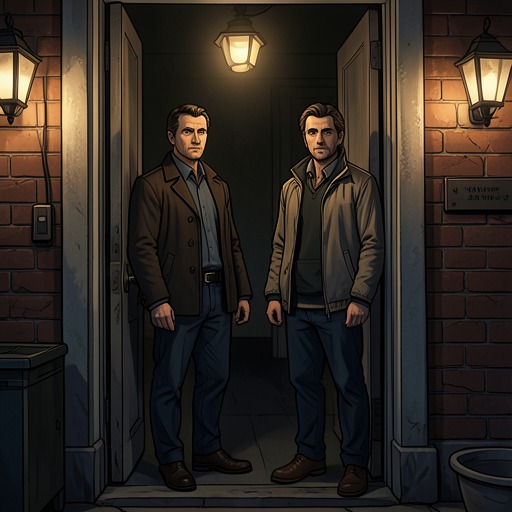
Finlay Andrews—Tony McCall coercive relationship
Hide and SeekFinlay Andrews’s coercive relationship with Tony McCall is built on a photograph, a request for a favor, and the promise of entry into a more powerful social world. Andrews uses an image to pressure Tony into placing a packet of heroin beside Ronnie McGrath’s body, helping to make the death look like an overdose. Tony’s account reveals how the leverage works: fear of exposure makes an apparently small act of assistance part of a larger criminal cover-up.
The photograph as leverage
Tony’s vulnerability begins with his connection to Hyde’s Club. He tells John Rebus that Tommy McCall took him there once. Tony found the experience disturbing and did not stay, but he fears that photographs of him may nevertheless exist. The possibility is enough to make the club’s hidden records a continuing threat; he does not know what images Andrews holds or who else might have seen them.
When Rebus asks why Tony broke into the squat and planted powder beside Ronnie, Tony initially reacts with fear rather than surprise. Rebus presses him by pointing out that Andrews, facing consequences, has no reason to keep other people’s names secret. Tony then lets fragments of a photograph fall into an ashtray and sets them alight. The gesture gives the image a material presence in the confession: it is evidence of the pressure, but destroying the fragments cannot undo what Tony did under that pressure.
The exact origin and contents of the photograph are not fully explained in Tony’s account. What is clear is the imbalance it creates. Andrews has an image that Tony believes can damage him, while Tony has little protection against Andrews’s influence. The relationship therefore operates through uncertainty as well as exposure: Tony fears what may be recorded and what Andrews may do with it.
A favor in Pilmuir
Andrews’s demand takes advantage of Tony’s position as a police officer whose beat is Pilmuir. The two men had met through Tommy, and Andrews approached Tony for what he called a favor. Tony says that placing a packet beside Ronnie’s body was all he had to do. According to Tony, Ronnie was already dead when he arrived; the act was meant to shape how the death would be understood, not to cause it.
Rebus’s reconstruction gives the favor its larger consequence. Ronnie had been deprived of his usual supply, and someone left good heroin at the scene in the hope that it would be tested, found clean, and support a finding of death by misadventure. But investigators found rat poison in the heroin that had killed him. Tony’s placement of the packet helped supply a misleading explanation for a death that Rebus was investigating as murder. The distinction matters: Tony describes his own task as small and limited, while its function was to reinforce a false account of Ronnie’s death.
Tony also presents Ronnie as a person easily dismissed. He justifies helping Andrews by treating Ronnie as a junkie and as someone already dead, and by reducing his own part to placing a packet. That minimization makes the favor easier to accept, but it does not remove its consequences. Tony’s police role gave the act particular weight: he was not merely connected to Pilmuir through his beat but used that position to assist in concealing what had happened there.
Membership and ambition
The leverage did not work by fear alone. Andrews offered Tony membership at Hyde’s Club, which Tony understood as a chance to become familiar with powerful men. He had begun to imagine career advancement after a period in which he had not expected much progress. In his account, the offer makes him feel that he might move beyond the limits of being a minor officer in a small local world and gain access to people with greater influence.
Andrews’s own description of the club clarifies the promise. He says that its members include people who might otherwise be expected to judge or prosecute him, and that they attend seeking a more dangerous edge to their leisure. He presents information as his advantage and membership as a privilege. His words reveal a system in which shared secrets can inhibit accountability: the men with the standing to act against him may also have reasons to protect the club and themselves.
For Tony, the offer converts coercion into apparent opportunity. He knows the photographs make him vulnerable, but he also sees membership as a route to recognition and advancement. His explanation does not erase his choice: he admits that he was willing to carry out the favor. Instead, it shows how Andrews combines threat and inducement, making Tony’s fear of exposure inseparable from his hope of belonging.
Confession and consequence
Tony’s admission comes after Rebus asks for his help. Earlier, Tony had disclosed that Tommy took him to Hyde’s and that he feared photographs might exist; Rebus accepted the warning but continued with his investigation. When confronted with the planting of the packet, Tony’s fear and his destruction of the photograph fragments accompany a fuller account of Andrews’s request, the promised membership, and his own participation.
The relationship exposes a chain of complicity rather than a simple exchange between a powerful criminal and a wholly passive victim. Andrews controls the damaging image and chooses how to use it; Tony faces pressure, but also acknowledges his appetite for the access and advancement offered in return. His act helps obscure the circumstances of Ronnie’s death, while his later confession gives Rebus a clearer account of how Andrews enlisted him. The photograph can be burned, but the favor it secured remains part of the evidence against Andrews and a measure of how far his influence reached.