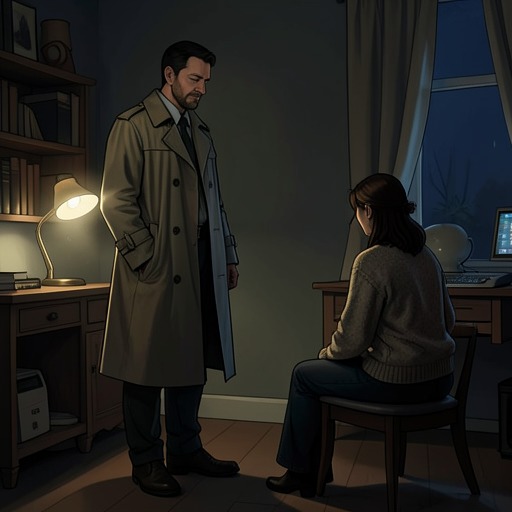
John Rebus—Tracy relationship
Hide and SeekThe John Rebus—Tracy relationship develops through brief but consequential encounters in which danger makes protection immediate and personal. Tracy has already run to Rebus while being followed, and later he finds her abducted and incapacitated at Hyde’s Club. Their connection is not presented as a settled alliance: it takes shape in moments when Tracy is vulnerable, Rebus reaches her, and her own actions alter the danger facing them both.
Identity and Initial Connection
The relationship’s clearest early sign is not a declaration of closeness but Tracy’s decision to run to Rebus when she recognizes that she is being followed. At the hospital, she remembers that the same two men who seized her at the side gates had followed her on Princes Street on the day she ran to him. The recollection connects the earlier appeal for help to the later abduction, making Rebus a person Tracy had sought out when she felt threatened, even though the available account does not describe what passed between them during that first encounter.
That boundary matters: the relationship is shown through action rather than through an extended account of their history. The evidence establishes Tracy’s approach to Rebus in a dangerous moment and his later physical intervention on her behalf, but does not establish a domestic bond or an ongoing arrangement between them. Their connection is therefore best understood as an emergent relation of protection under pressure, with trust suggested by Tracy’s earlier appeal and tested by the circumstances in which Rebus finds her again.
Tracy’s Vulnerability and the Abduction
Tracy’s visit to Nell Stapleton helps explain why the hospital becomes the setting for her capture, while also showing that her attention is not confined to her own immediate safety. She cannot explain why she visited Nell or told her what she did, but feels a bond with her, associated with a kindness and wisdom Tracy says she has lacked. That attachment makes leaving difficult: she walks the hospital corridors, drinks coffee across the road, wanders into Casualty, X-Ray, and a diabetes clinic, and even walks as far as the city’s art college before turning back toward the hospital.
As she enters the side gates, two men approach and ask her to come with them. They sound like security men, perhaps even policemen, and she does not resist. She imagines that Nell’s boyfriend may want to punish her, and says to herself that she does not care. The men lead her toward the entrance, reinforcing her mistaken sense that she is not yet in immediate danger. Only at the last moment do they turn her and push her into an ambulance.
The vehicle’s appearance conceals its purpose. Its doors lock behind Tracy; the interior is hot and dim, its windows boarded over, and a metal panel separates her from the driver. It is an old ambulance stripped of its original fittings and used as a van. Tracy pounds on the doors and then the partition, but the vehicle is already moving. As she is thrown against the doors and onto the floor, she recognizes her abductors as the men who had previously followed her and from whom she had run to Rebus. That recognition gives her fear a specific history: the danger has returned, and the earlier refuge she sought in Rebus has not prevented the men from finding her.
Rebus Finds Tracy at Hyde’s Club
The later encounter at Hyde’s Club reverses the earlier pursuit: this time Rebus reaches Tracy, finding her standing hesitantly in the middle of a boxing ring. Malcolm Lanyon warns him that heroin can make her unable to hear. Rebus sees that her eyes have narrowed to pinpoints and climbs into the ring to hold her. Her body is limp and compliant, her hair damp with sweat; the comparison to a life-sized rag doll conveys how thoroughly the drug has stripped her of visible capacity to respond.
Yet the embrace is not simply an image of Rebus acting while Tracy remains absent. When he holds her face so that she must look at him, her eyes glimmer and her body twitches. The response is slight, but it gives the encounter a point of contact: Rebus tries to reach her through touch and eye contact, and the signs of recognition come from Tracy herself. The scene does not claim that she is fully conscious or safe; it shows a momentary response amid her profound impairment.
Protection, Agency, and Reversal
Rebus’s protective role does not erase Tracy’s agency. While Lanyon speaks and Rebus watches her, Tracy’s hands slowly close into fists. When a man returns to report that Finlay Andrews is badly hurt, Lanyon turns away. Tracy then launches herself from Rebus and strikes Lanyon between the legs. The blow is forceful enough to make him crumple, but the effort also exhausts her: she stumbles and falls onto the canvas.
The action changes the balance in the ring. Rebus seizes Lanyon and restrains him, while the two other men hesitate; after a brief standoff, they flee. Tracy’s attack does not make her condition disappear, and Rebus still has to control the immediate threat. But she is more than the passive object of his rescue. Her sudden intervention creates the opening that allows him to hold Lanyon, turning a scene of apparent helplessness into one in which her action has direct consequences.
The Relationship’s Significance
These episodes give the relationship its particular shape: Tracy seeks Rebus when pursued, and Rebus responds physically when he finds her in danger, but neither moment proves a stable or fully articulated bond. The hospital sequence shows how the earlier appeal to Rebus remains in Tracy’s memory as she recognizes the men who have tracked her. At Hyde’s Club, Rebus’s embrace offers immediate protection, while Tracy’s brief physical response and attack on Lanyon show that protection cannot be equated with passivity.
The connection is therefore defined by an uneven but reciprocal crisis dynamic. Rebus can reach Tracy and confront the men around her; Tracy, even under the effects of heroin, can still alter the confrontation through her own choice to strike. The narrative places vulnerability and initiative side by side: she may be captured, concealed in a converted ambulance, and found barely responsive, yet she is also the person whose blow precipitates Lanyon’s defeat. Their relationship matters less as a conventional partnership than as a sequence of recognitions and interventions in which each encounter changes what the other can do.