Matthew Vanderhyde
Hide and SeekMatthew Vanderhyde is a blind older man whose expertise in occult practice helps John Rebus test the apparent meaning of a staged death. Rather than confirming the suggestion of human sacrifice, Vanderhyde points out how poorly the evidence fits that explanation, shifting attention from ritual to the possibility that someone arranged the scene to mislead the police.
Identity and Introduction
When Rebus visits, Vanderhyde answers the door wearing dark green glasses; his sightless eyes are visible behind the lenses. Blindness is a concrete part of how he moves and interacts: he can hear Rebus well, and later walks unerringly to a bookcase. The account presents these abilities without suggesting that blindness gives him supernatural insight; his authority in the conversation rests instead on his knowledge of occult practice and his capacity to reason from the details Rebus supplies.
Vanderhyde is also an older man with a bookcase and a room where Charlie brings tea. During the visit, Charlie guides his hand to the mug’s handle, addressing him as Uncle Matthew. Their exchange establishes a family relationship, while the practical assistance offered with the cup shows one specific way Charlie accommodates Vanderhyde’s blindness.
Rebus’s Inquiry
Rebus tells Vanderhyde that an undergraduate essay on the occult had mentioned him in connection with an Edinburgh-based group active in the 1960s. The essay’s reference places Vanderhyde within Rebus’s inquiry into occult activity, but the available exchange does not establish that he confirms being involved. When the term coven arises, Vanderhyde observes that it is inexact, a small correction that signals caution about treating occult groups as interchangeable or describing them loosely.
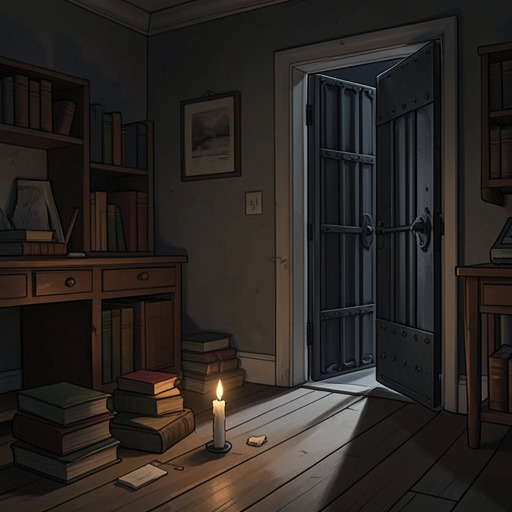
The immediate question is whether the dead man’s arrangement indicates a sacrifice. The body had been placed with outstretched arms between two burned-down candles, and a carefully drawn five-pointed star enclosed by two concentric circles appeared on a nearby wall. These details supply the apparent ritual pattern that Rebus brings to Vanderhyde for assessment; they do not, by themselves, settle what caused the death or who arranged the scene.
Assessment of the Apparent Sacrifice
Vanderhyde accepts that the death was caused by an overdose, then questions whether that method makes sense as a sacrifice. He explains that few Satanists would contemplate human sacrifice and distinguishes murder subsequently excused as ritual from a sacrifice carried out as such. In his account, sacrifice requires blood, whether symbolic or real; an overdose without blood would therefore be an unprecedented means of performing one.
That distinction gives Rebus a competing interpretation of the scene. Vanderhyde considers it more plausible that someone muddied the evidence after the man had died, making the overdose and the ritual-like arrangement point in misleading directions. His analysis does not identify the person responsible or prove how the body was staged, but it challenges the simplest occult reading and keeps the possibility of deliberate deception in view.
Character and Narrative Significance
Vanderhyde’s role is limited to the consultation, but its value lies in the difference between theatrical appearance and evidential plausibility. The candles, the body’s pose, and the wall drawing invite a ritual explanation; Vanderhyde tests that invitation against what sacrifice would require. His response redirects Rebus from treating the scene’s symbols as an answer toward asking whether they were added to confuse the investigation.
The encounter also locates Vanderhyde at the intersection of Rebus’s inquiry and Charlie’s family life: Charlie brings him tea and addresses him as an uncle while Rebus questions him. Vanderhyde contributes neither a confession nor a solution. Instead, he supplies a reasoned limit on what the visible signs can establish, making skepticism itself his decisive contribution to the investigation.