Ronnie McGrath’s camera
Hide and SeekRonnie McGrath’s camera is at once the clearest material sign of his hoped-for life as a photographer and a missing possession whose journey complicates the investigation into his death. Its importance rests on a sharp contrast: Ronnie guarded it even when his heroin habit gave him reason to pawn valuable belongings, yet after he died it vanished from his room and turned up among Charlie’s things. The camera links ambition, poverty, betrayal, and uncertainty, becoming evidence that helps John Rebus reconstruct events without resolving every question about who moved it or why.
Identity and Background
Ronnie had set his heart on photography after leaving school. Tracy told John Rebus that she did not know whether Ronnie had ever held a job, but remembered that he had talked about becoming a photographer. The camera was the possession he would not pawn, even to pay for his habit. She described it as something for which Ronnie had saved every penny from his social security, and as having cost him a small fortune. These details make it more than an ordinary household object: its acquisition represented sustained effort in a life otherwise shaped by limited means and addiction.
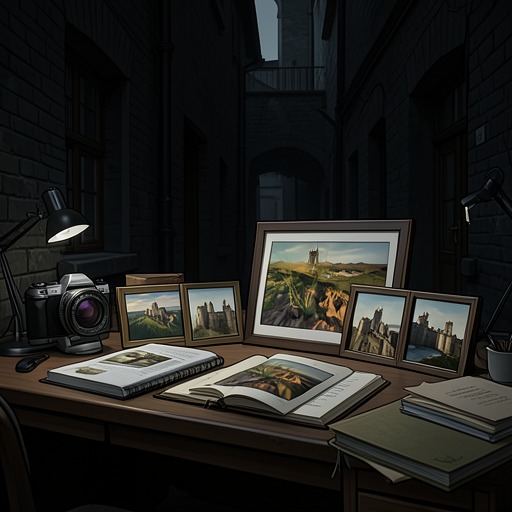
Ronnie’s ambition had not developed into a reliable career. Charlie dismissed the photographs on Ronnie’s wall as attempts to make tourist postcards and said that, like many of Ronnie’s schemes, the plan did not last. He nevertheless acknowledged that the camera was a good one and that Ronnie had been proud of it. The combination of mockery and recognition is revealing: Charlie could belittle the ambition while still understanding that the equipment mattered deeply to Ronnie. The camera retained personal value even when the hoped-for profession remained unrealized.
Ronnie’s pictures included views of Edinburgh Castle, which John Rebus recalled while asking Charlie about the “real” Edinburgh. Charlie’s description of the images as tourist photography contrasts with the larger question Rebus was pursuing: what lay beneath the familiar public image of the city. The camera therefore connects Ronnie’s small-scale photographic enterprise to the investigation’s wider attention to appearances and hidden realities, though the evidence does not establish that Ronnie’s work itself exposed anything beyond his ambitions and circumstances.
Personal Value and Photography
The camera’s price is discussed through a distinction between cost and worth. Tracy initially cautioned that what an object had cost its owner did not necessarily measure what it meant to him. She then clarified that Ronnie’s camera had cost about £150. That figure sits alongside her recollection that he had saved for it from social-security payments, giving the purchase a concrete economic scale as well as emotional significance. Its worth to Ronnie was not simply its resale price: it embodied the one career he had imagined for himself and a commitment he maintained even while struggling with addiction.
Tracy also remembered Ronnie as a capable photographer with a good eye, though she believed he had not received the opportunities he needed. She disclosed that he had wanted to sell photographs of her, a proposal she refused because she did not want the images circulated in magazines. Her account adds a complicated dimension to the camera’s history: it had been used in an effort to make money, but the proposed use of the photographs crossed a boundary Tracy would not accept. The evidence does not establish what became of those particular images or whether they were ever sold.
John Rebus’s questions about the camera’s value come during conversations in which he is also trying to understand Ronnie’s photographs and Tracy’s connection to them. When Tracy discusses the proposed sale, Rebus is embarrassed by the subject, but returns to the camera’s price. The shift shows how the object functions within his inquiry: personal memories and uncomfortable disclosures are not separate from the search for a missing possession, because both help establish what Ronnie owned, what it meant to him, and who might have handled it.
Disappearance and Recovery
When Tracy first explains that the camera was Ronnie’s prized possession, John Rebus realizes that none was visible in Ronnie’s bedroom. He adds robbery to the possibilities he is considering. Its absence matters precisely because Tracy has described how reluctant Ronnie was to part with it: a camera he would not pawn was missing from the room where it should have been. The discrepancy changes the object from biographical detail into a question of evidence.
Later, at the squat, Tony McCall empties a large supermarket carrier bag onto the floor. Among its assorted contents is a camera, which he identifies by inspection as a good-make, thirty-five-millimetre SLR. John Rebus takes it using a handkerchief, avoiding direct contact, and Tracy confirms that it is Ronnie’s. He then places it in the carrier bag so it can be handled as evidence. The recovery gives the investigation a specific object to trace, while the careful handling marks a change in status: the camera is no longer merely Ronnie’s cherished tool but potential physical evidence associated with another location.
Its discovery also creates a question about the circumstances in which it arrived there. John Rebus later asks Tracy whether she planted it in Charlie’s squat. She denies doing so, and he considers the possibility that Charlie took it or that someone else placed it there for the police to find. He notes that Tony McCall had found the camera very easily, as he had earlier found drugs in a sleeping bag, and wonders whether the ease of those discoveries might indicate access to inside information. This is Rebus’s suspicion, not a confirmed explanation: the camera’s recovery raises doubts about how evidence was located without proving that it was planted or identifying an accomplice.
Charlie’s Admission and the Camera’s Significance
In reconstructing Ronnie’s last hours with Charlie, John Rebus lays out a provisional sequence. Ronnie injects himself with a lethal packet of powder; Tracy later finds him and runs away. At some point afterward, someone moves Ronnie’s body downstairs, a second packet of powder appears, and the camera disappears before turning up in Charlie’s room inside a black polythene bag. Rebus explicitly treats parts of this sequence as uncertain and asks Charlie to help clarify what happened. The camera’s movement is thus embedded in a disputed chronology rather than offered as a complete account of Ronnie’s death.
Charlie eventually admits that he took the camera. He explains that it was the only thing Ronnie owned that was worth money, and acknowledges that he lifted it before leaving. He went straight back to his squat after hearing that Tracy had come looking for him in distress; he assumed she already knew about Ronnie. His admission resolves the basic question of whether Charlie took the camera, while leaving the broader question of how it was later found in his room within the investigation’s uncertain chain of events.
The camera’s narrative function depends on these changes in ownership and meaning. First it marks Ronnie’s unrealized aspiration and the effort he invested in it; then its absence suggests theft; its recovery connects Ronnie’s room to Charlie’s squat; finally, Charlie’s admission gives the disappearance a personal explanation. Yet recovery does not make the surrounding sequence fully transparent. The object offers a firm point of contact with Ronnie’s life, but its appearance in the squat also sustains Rebus’s concern about planted evidence and information reaching the police. In that tension between what the camera proves and what it cannot prove, the prized possession becomes a compact record of the case’s entanglement of affection, exploitation, and suspicion.