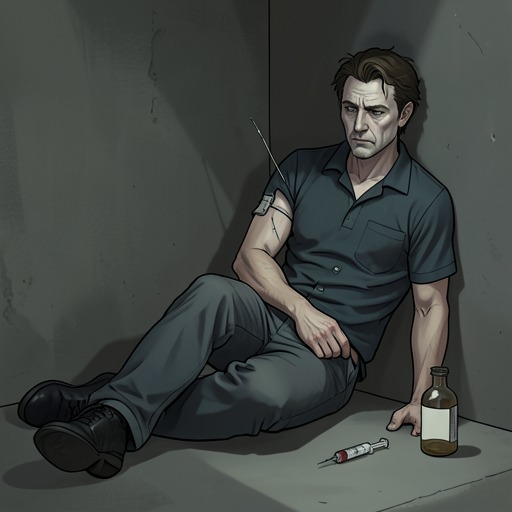
Ronnie’s fatal heroin poisoning
Hide and SeekRonnie’s fatal heroin poisoning turns an apparent overdose into the central murder question of the investigation. The scene initially offers a persuasive picture of drug death: Ronnie is found in a derelict house among syringes, with heroin packets present, and the first medical assessment identifies an overdose. Laboratory and post-mortem findings overturn that simple account. One packet appears usable, while the heroin associated with Ronnie’s death is found to be overwhelmingly impure and likely contaminated with poison. The contrast makes the difference between an addict’s private risk and a potentially deliberate killing impossible to ignore.
Setting and Initial Account
The death is discovered in a house in Pilmuir, within a housing estate John Rebus sees as abandoned and deteriorating. Its boarded windows, broken surroundings and neglected interiors make the building a makeshift refuge for homeless people. Nearby, a development advertised as luxury housing sharpens the contrast between investment in private apartments and the disrepair of the estate. The setting places Ronnie’s death amid visible deprivation rather than apart from it: this is a place where people without secure shelter have made their den, and one of them has died there.
Inside, two large candles have burned down on the bare floor, and Ronnie’s body has been arranged between them with his arms outstretched. A jar that once held instant coffee contains disposable syringes. The unusual arrangement suggests a ritualized scene, but does not by itself establish how or why Ronnie died. At first, the visible drug paraphernalia gives the scene an ordinary explanation. The police doctor calls it a heroin overdose and points to the sachet contents, as well as another full packet in Ronnie’s hand. For Rebus, the account is plausible enough to start with; the scene’s arrangement and the doctor’s first conclusion have not yet been joined to proof of murder.
Medical and Laboratory Findings
The initial laboratory report complicates the assumption that the drug was unusually dangerous. The heroin is described as not especially pure, but also as clean, diluted in a way the laboratory considers common and apparently suitable for use. That result matters because it seems to exclude the simplest explanation for a fatal overdose: that Ronnie took a batch so strong or contaminated that it killed him. It also leaves the investigators with an unsettling mismatch between the expected effect of the tested sample and the fact of Ronnie’s death.
Dr Enfield’s subsequent findings change the meaning of the evidence. Ronnie has extensive bruising, assessed as consistent with a heavy fall or some kind of physical confrontation. His stomach is nearly empty, and the post-mortem test establishes that the heroin implicated in his death is 95 percent impure. The substance used to dilute it has not yet been identified, but Dr Enfield’s educated assessment points to a poisonous adulterant, with rat poison as the leading possibility. He warns that whoever sold the material was effectively selling a lethal product and that its presence elsewhere would pose a wider danger. The findings turn a question about Ronnie’s personal drug use into a question about who supplied a potentially poisoned batch and whether others might encounter it.
From Overdose to Suspected Murder
The decisive clue is not simply that heroin was involved, but that the evidence appears to distinguish between a lethal packet and a clean one. Rebus recalls that one packet was apparently good while the other was disastrously adulterated. The clean sample could make the death look like an ordinary overdose if investigators tested the wrong material and concluded that the drug itself was safe. Rebus considers the possibility that the clean packet was left to encourage precisely that conclusion. This remains a hypothesis, not an established account of the killer’s actions, but it gives the apparently incidental packet a new role: it may have been part of an effort to conceal the poisoning.
Other details deepen the suspicion without resolving it. Ronnie’s bruising is compatible with physical confrontation, while the body has been moved and arranged after death, according to the facts Rebus later sets down. At the same time, there is no suggestion that Ronnie did not inject the drug himself. Those points do not settle whether he was physically forced to take it; instead, they make the act of injection insufficient to explain the death as accidental. The scene can be read both as an overdose tableau and as a construction intended to encourage that reading.
Consequences for the Investigation
Rebus concludes that Tracy was right that Ronnie had been murdered, though the identity of the people responsible remains unknown. His attention shifts from the visible syringe and the mechanics of drug use to the dealer, the supply, and the reason Ronnie was selected. He wonders whether Ronnie knew the substance was dangerous before taking it, and whether he understood that the person supplying it wanted him dead. The evidence does not answer those questions. Rebus’s changing interpretation instead exposes the central uncertainty: even a deliberate poisoning does not yet explain why Ronnie accepted the fatal dose or who arranged the circumstances around his death.
The case also resists being reduced to individual recklessness. Rebus’s later review notes that Ronnie had been deprived of his supply despite there being no shortage of drugs in the city; someone had moved his body; and a clean packet might have been left to make death by misadventure seem credible. He recognizes that these propositions include conjecture, and deliberately reconsiders the case rather than treating suspicion as proof. The investigation therefore ends this phase with a firm shift in classification—from apparent overdose to suspected murder—but without a settled motive or identified supplier.
The public-health context remains part of the event’s significance. The police doctor tells Rebus that intravenous drug use in Edinburgh affects hundreds of people and connects the crisis to the city’s AIDS burden. That warning places Ronnie’s death within a broader landscape of addiction and exposure, while the suspected poisoned supply adds a distinct danger created by whoever controls or distributes the drugs. The death is both a particular crime and a warning that a contaminated batch could threaten others. Its power in the investigation lies in that double meaning: the apparent evidence of a familiar overdose becomes evidence of a potentially targeted killing, and the difference depends on distinguishing the lethal packet from the clean one.