Ronnie’s photographs
Hide and SeekRonnie’s photographs are a small portfolio that gives material form to Ronnie McGrath’s ambition to become a photographer—and, after his death, helps John Rebus and Brian Holmes investigate whether that ambition was exploited. Found pinned to the wall of a nearly bare, deteriorating room in Pilmuir, the pictures stand out against the evidence of precarious shelter and addiction. Their images also move beyond the room: Tracy describes apparent copying by newspaper photographers, and Holmes searches newspaper archives for matching views. The portfolio is at once personal work, a possible source of grievance, and a visual trail whose authorship remains under investigation.
The portfolio in Ronnie McGrath’s room
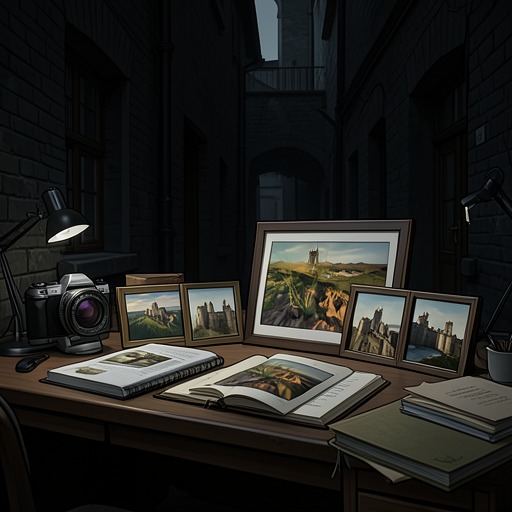
The photographs are discovered in the bedroom of the house where Ronnie McGrath was found. One of the two bedrooms is empty; the other contains a sleeping bag damp from a leaking roof, a bin-liner partly filled with clothes, and dog-eared science-fiction and horror paperbacks. Pictures pinned to the walls give this otherwise makeshift room what Rebus recognizes as a kind of imposed identity. The contrast is telling: the room offers little security or comfort, but the photographs show deliberate attention and a chosen way of looking.
Some images show Edinburgh Castle on damp, misty days; others show it in bright sunshine. The shift in weather does not make the castle appear welcoming: to Rebus, it looks bleak in both kinds of light. One or two photographs show a girl whose age is difficult to determine, posing but grinning broadly, as if she does not take the occasion seriously. The images therefore range from studied views of a familiar landmark to a more informal portrait. They are described as original photographs and, even to Rebus’s untrained eye, well taken. The portfolio is not merely decoration in the room: it is evidence of work Ronnie made and kept.
An ambition that survived his addiction
Tracy says that becoming a photographer was what Ronnie had set his heart on when he left school. She does not know whether he ever held a job, but recalls that he would talk about this ambition. His camera had cost a small fortune, saved penny by penny from his social security, and was the one possession he would not pawn, even to pay for his habit. The camera and the photographs thus mark a persistent investment in a future that his addiction repeatedly threatened. The pictures on the bedroom wall make visible the ambition Tracy describes; the camera’s survival, despite the pressure to sell it, shows how tenaciously Ronnie held on to the means of pursuing it.
That investment did not protect his work from appropriation. Tracy recalls seeing photographs in local newspapers that seemed to reproduce Ronnie’s ideas: the same angle, time of day, and filters. She says the pictures were credited to the same men Ronnie had shown his portfolio to. She cannot now remember their names, so her account supplies a pattern and a grievance, not an identification that the investigation can immediately verify. Her recollection makes the portfolio consequential in two ways: it records Ronnie’s own artistic efforts, and it may have shown those efforts to people capable of copying them.
Images, consent, and exposure
Tracy also recalls that Ronnie tried to persuade her to pose for nude photographs, telling her that he could sell them to magazines for a great deal of money. She refused. The prospect of earning money did not outweigh her concern that the images might continue to circulate: she feared the magazines would be passed around rather than discarded, leaving her anxious that someone might recognize her on the street. Her account distinguishes the photographs Ronnie wanted to make from the images she agreed to let him take; she specifically says the nude shots were not the photographs Rebus had seen.
That distinction gives the portfolio a boundary as well as a history. Photography could offer Ronnie a livelihood, but the proposed sale of intimate images would also put control over their circulation into other hands. Tracy’s refusal is grounded in the practical risk of lasting recognition, not simply embarrassment at posing. In the investigation, meanwhile, images already have a second life: pictures made in a private room may be compared with newspaper photographs, and pictures made at the crime scene may preserve details that have since changed.
Photographs as investigative evidence
The crime-scene prints handled by Rebus are separate from Ronnie’s portfolio. In Rebus’s office, he opens an envelope marked for photographs and examines black-and-white prints measuring ten by eight inches with Tony McCall. One print shows that there was no writing on the wall and that the pentagram was unfinished; Rebus says it was complete when he saw the scene that day. He also passes Tony an image of the deceased. The comparison gives the prints a precise evidentiary purpose: they preserve an earlier state of the room and reveal a difference between that record and what Rebus later encountered. Rebus rolls the envelope into a tube and puts it in his jacket pocket.
The portfolio prompts a different photographic inquiry. Rebus directs Brian Holmes to take the pictures from the bedroom to the local newspaper office and look through its files for recently published images taken from the same angles. He expects a knowledgeable old employee might recognize the photographs, but Holmes finds no such shortcut and no computer to search. Instead, he spends over an hour turning pages in bound daytime and evening editions, with his fingers blackened by old newsprint and his arms aching. The work is repetitive because the clue is visual rather than verbal: Holmes must recognize a familiar place made distinctive by an unusual camera angle. Rebus’s instructions also give the search a practical next step: the reverse of each print should carry a sticker or similar mark naming the photographer and giving an address.
The search for authorship
Holmes eventually approaches a photographer at Hutton Studios, using the pretext that Ronnie McGrath is a missing person. He explains that Ronnie wanted to be a photographer and asks whether Ronnie had ever sought advice. The photographer initially says the name means nothing, then asks what Ronnie looked like. Holmes describes him as tallish, with short brown hair, and says he liked studies of subjects such as Edinburgh Castle and Calton Hill. The exchange establishes the question Holmes is pursuing—whether Ronnie had approached an established photographer—but does not, in the available conversation, establish that he did.
While at the studio, Holmes recognizes a photograph of Edinburgh Castle in mist as almost identical to one he saw in a newspaper, and as a very close counterpart to a photograph from Ronnie’s bedroom. The resemblance sharpens the link between the portfolio and the newspaper images Tracy remembers, but it does not by itself prove who copied whom. That unresolved gap matters: Tracy’s account points toward photographers Ronnie had shown his work to, while Holmes’s comparison produces a visual match that still requires attribution. The photographs therefore function less as a finished answer than as a chain of evidence—kept by Ronnie, remembered by Tracy, and tested against published images by Holmes.