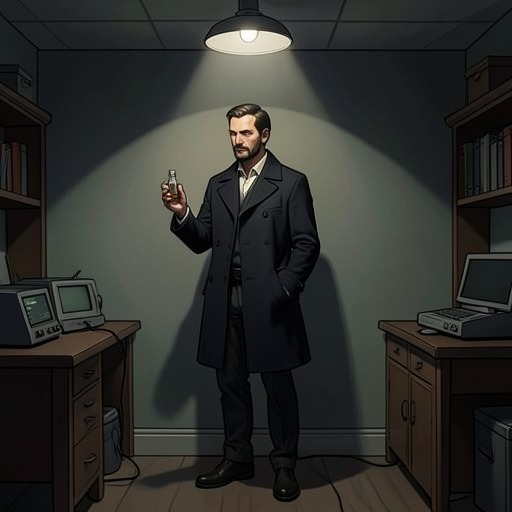
Ronnie’s poisoned heroin packet
Hide and SeekRonnie’s poisoned heroin packet turns an apparent overdose into a question about supply, intent, and the arrangement of evidence. It is linked to Ronnie McGrath’s injection and death, while the later appearance of another packet gives John Rebus reason to suspect that the scene may have been manipulated. The danger of the drug is clear; precisely who supplied it, and why, remain questions in the evidence considered here.
Identification and Toxicity
The packet becomes significant when John Rebus tells Charlie that Ronnie McGrath is dead, that he overdosed, and that the heroin was lethal. Charlie initially treats the death and overdose as ordinary occurrences, but the lethal quality changes the exchange: he recognizes that this is not simply another death associated with drug use. The packet matters because it connects an individual act of injection to a dangerous supply that could have consequences beyond one user.
A doctor describes a sample as 95 percent impure. The exact adulterant is still being investigated, so the composition is not presented as settled. The doctor offers an informed guess: the drug could have been diluted with anything from ground aspirin to rat poison, with the latter the more alarming possibility. The doctor characterizes the sale of such a substance as the sale of euthanasia and warns of the danger if more of it is circulating. Later, John Rebus’s account of the case notes that rat poison had been found. That finding makes the earlier warning concrete, though the evidence here does not establish the source or precise preparation of the packet Ronnie McGrath injected.
Ronnie McGrath’s Use and the City’s Supply
John Rebus reconstructs the immediate sequence as an injection in an empty house: Ronnie McGrath had obtained heroin, injected it, and died after taking the lethal substance. In discussing the sequence with Charlie, John Rebus accepts, provisionally, Tracy’s account that she entered the house, found Ronnie McGrath apparently dead in his room, panicked, and ran away. The account remains an investigative reconstruction rather than an independently confirmed description of every moment. Its central distinction is between the packet Ronnie McGrath used and the different packet that appears later in the sequence.
The risk is set against the wider circumstances of Edinburgh’s heroin use. A doctor challenges John Rebus’s assumption that users have largely moved away from injecting and directs him to the Royal Infirmary, where intravenous drug use runs into hundreds; the doctor also connects that prevalence to Edinburgh’s status as Britain’s AIDS capital. This exchange situates the packet in a public-health emergency, not an isolated curiosity. The immediate cause of Ronnie McGrath’s death is the lethal drug, but the account also makes clear that injecting and exposure to unsafe supplies affect a much larger population.
The surrounding environment adds another material context without explaining the packet’s origin. At Pilmuir, derelict terraces, neglected outdoor spaces, and damaged playgrounds stand close to a development advertised as luxury housing. John Rebus sees the contrast as evidence of an estate treated as a dumping ground. The scene does not prove that poverty or housing conditions caused Ronnie McGrath’s poisoning. It does, however, place the death within a city where severe deprivation and an established drug crisis coexist with more polished claims about urban improvement.
The Second Packet and the Crime Scene
In John Rebus’s reconstruction, Ronnie McGrath had one packet and injected from it. After his body was moved downstairs, a second packet of white powder appeared. Tracy had reported seeing only one packet, although John Rebus explicitly marks that part of her account as unverified. The later packet is described as containing good heroin rather than the poisoned supply. That difference matters: a clean packet left with the scene could lead investigators to test the wrong substance and interpret the death as a straightforward overdose caused by an apparently ordinary supply.
John Rebus considers that possibility while trying to separate established facts from conjecture. Someone moved Ronnie McGrath’s body, and a packet of clean heroin was left behind; perhaps, he reasons, its purpose was to have it tested and make the death appear to be misadventure. But the rat poison had been found, and the apparent attempt to direct attention toward clean heroin does not, by itself, identify whoever moved the body or supplied either packet. The poisoned packet therefore stands at the center of a scene in which the distinction between the substance that caused death and the substance left afterward may be as important as the overdose itself.
Investigative and Thematic Significance
The packet also exposes how incomplete the case remains. John Rebus writes down what he regards as the facts, then recognizes how quickly possibilities have entered his account. Ronnie McGrath had been without a supply despite the abundance of drugs in the city; he then obtained heroin and injected it. The body was moved, and clean heroin was left behind. Those details support suspicion, but they do not yet prove why anyone would want Ronnie McGrath dead. John Rebus considers whether Ronnie McGrath knew something, possessed something, or lacked something someone expected him to have, and admits that none of these possibilities resolves the picture.
The drug’s source is itself obscured by a culture of deliberate not-knowing. In another conversation about money, a speaker says that nobody wants to know where it comes from and that knowing could make a person an accessory; the speaker describes putting hands over their ears rather than hearing more. This does not establish that the speaker supplied Ronnie McGrath’s packet. It does echo the investigation’s wider problem: dangerous transactions can persist when people benefit from avoiding questions about their origins.
As an object, the packet is both a physical cause of death and a contested piece of evidence. Its poison gives the overdose a lethal specificity; the later clean packet creates a competing explanation that could have obscured that specificity. The investigation therefore turns on reading two materially similar packets differently—one associated with Ronnie McGrath’s fatal injection, the other potentially capable of making that death look accidental. Their contrast does not solve the case, but it shows why the apparent simplicity of an overdose cannot be trusted.