Tracy is followed and seeks refuge with Rebus
Hide and SeekTracy is followed and seeks refuge with Rebus when she believes two men have tracked her across Edinburgh and turns to John Rebus for a safe place to stay. The episode moves from her account of being watched to Rebus’s own observation of a police constable waiting outside his flat, making surveillance tangible while leaving the pursuers’ identity unresolved. That uncertainty matters: Tracy finds temporary shelter, but neither her fear nor the possibility of danger is conclusively explained.
The Pursuit Through Edinburgh
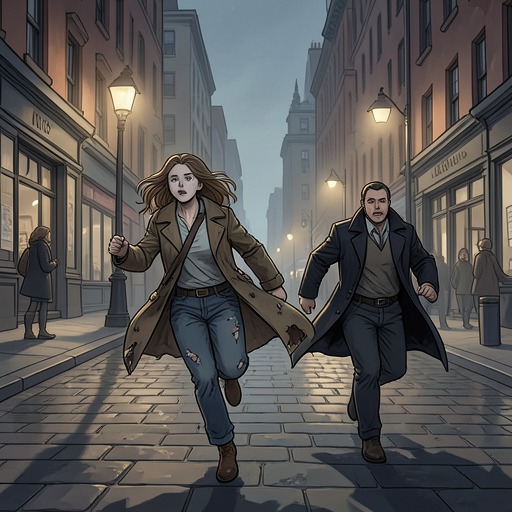
Tracy tells Rebus that she first noticed the men while walking along Princes Street. She thinks there were two, and says they remained behind her throughout the afternoon, close enough that she believed they knew she could see them. Her account is specific about the pattern of pursuit but imprecise about the men themselves: she cannot confidently describe one and remembers the other only as a somewhat heavy man with a moustache, thinning hair, and an appearance that reminded her of Rebus. The limits of her identification leave room for doubt without making the fear she reports disappear.
She says she managed to lose them by entering Marks and Spencer and running for the Rose Street exit, then hiding in the ladies’ room of a pub for an hour. She had no money to telephone Rebus; she had been on Princes Street in the first place because she was short of it. Once she had gathered herself, she made her way to his flat in Marchmont. The route gives her escape a practical, improvised quality: she uses the entrances and exits of the city rather than any formal protection, and arrives at Rebus’s door only after believing she has shaken the men.
Refuge at Rebus’s Flat
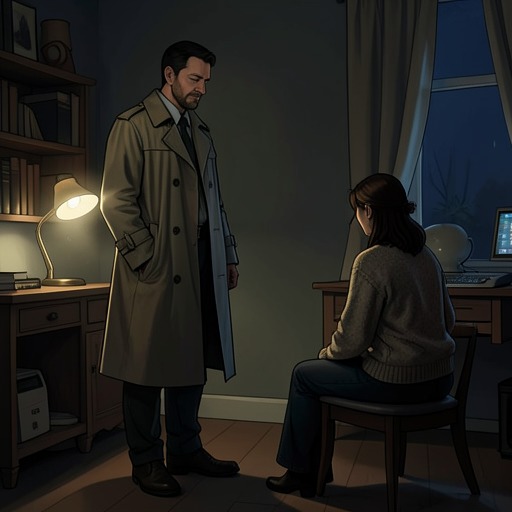
Tracy’s request is direct: she does not want to return to the squat that night and asks to sleep on the couch or floor. She describes the squat as having become increasingly unsettled and connects that unease with the men following her. Her appeal makes Rebus’s flat a temporary refuge, but the scene does not establish that she has proved who is pursuing her or why. Rebus initially considers whether she may be putting on an act, so his response begins in suspicion rather than uncomplicated trust.
That response changes as he looks outside. From the second-floor flat, he sees a car opposite, its driver’s window down and smoke drifting from it. The street lamps give the pavement an artificial, stage-like look, but the important detail is the car’s position: it is waiting directly across from the flat while Tracy asks to stay. Rebus does not immediately decide what it means. He leaves the conversation to investigate, turning her request for shelter into a test of whether the apparent pursuit has reached his own door.
The Car and the Unresolved Identification
Rebus eases the front door open and finds the car still there. Its driver notices him, discards a cigarette, starts the engine, and drives off. Rebus tries to follow on foot, but slips on the pavement and loses the vehicle at a junction. He cannot make out its number plate. He is, however, sure it is a Ford Escort, and says he saw a constabulary uniform inside. He identifies the driver as a constable, but does not see the driver’s face.
That observation is an unsettling addition to Tracy’s story, not a confirmed identification of either pursuer. Tracy reported two men on foot; Rebus sees one driver in a car, and the evidence supplied here does not establish whether the driver was one of those men or whether the car was connected to their pursuit. The distinction preserves the episode’s central tension. A police uniform might suggest an official presence, but it does not resolve who watched Tracy, what the car was doing outside, or whether her account and Rebus’s observation describe one continuous operation.
The chase also ends in an undignified, concrete reversal. Rebus has gone downstairs without shoes, carrying a notice about washing the stairs; after the car escapes, he realizes he has slipped on something and throws away his socks before walking back barefoot. The small domestic detail punctures any clean image of a successful pursuit: he has confirmed the uniform, but failed to catch the car or obtain its number. What he brings back is a partial observation, not an answer.
Place in the Wider Investigation
The encounter belongs to a story in which evidence and authority are themselves in dispute. Rebus later describes the death he is investigating as murder, or at minimum tampering with evidence at a death scene. When he is told that the case against him is a setup, Superintendent Watson nevertheless insists that the allegation must be investigated and orders Rebus to leave the matter alone for a time. Rebus’s exclusion from the inquiry deepens the significance of the earlier constable in the Escort: the episode has already shown that a uniform can be seen without a face or an explanation, while later events put Rebus’s ability to trust official procedure under pressure. The evidence does not connect the car to the later allegations, so the parallel remains one of atmosphere and uncertainty rather than a demonstrated link.
Rebus remains invested in the investigation even while officially sidelined. When Malcolm Lanyon is questioned at Great London Road Police Station, Rebus wants to be nearby because he knows the answers the interrogators need and fears Lanyon could exploit a technicality. The episode’s brief refuge scene thus anticipates a larger pattern: people seek safety or leverage through institutions and personal alliances, but access to reliable protection is uncertain. Tracy’s visit is an immediate request for shelter, not a resolution of the dangers surrounding her.
The later account offers a modest contrast to that night’s alarm. Tracy finds work in a cafe and deli near Edinburgh University Library, and Rebus eventually sees her sharing a meal and a joke with Brian Holmes and Nell Stapleton. This later glimpse does not explain who followed her or establish that her earlier fear was answered by an investigation. It does show her in a different social setting, with work and company, rather than arriving alone at Rebus’s flat. The episode’s lasting force lies in that gap between temporary refuge and durable security: the door can be opened, the car can be watched, and the uniform can be recognized, while the people and motives behind the surveillance remain uncertain.