
Religion as Shelter and Boundary
Hillbilly ElegyThis theme thread traces how faith offers J.D. Vance belonging and practical support, while also teaching him suspicion and exclusion.
increasing Bearing strength in each event
 decreasing
Bearing strength in each eventdecreasingMamaw’s Unorganized Faith

Belief Without Church Loyalty
A personal theology
Mamaw believes God accompanies the family but distrusts organized religion and public displays of piety. Her faith is grounded in practical duty and endurance.
A compassionate lesson
When J.D. Vance fears religious condemnation, Mamaw emphasizes that God’s love is not withdrawn from people who differ.
Her version of faith offers comfort without demanding that every neighbor share the same beliefs.
A Church Community Appears
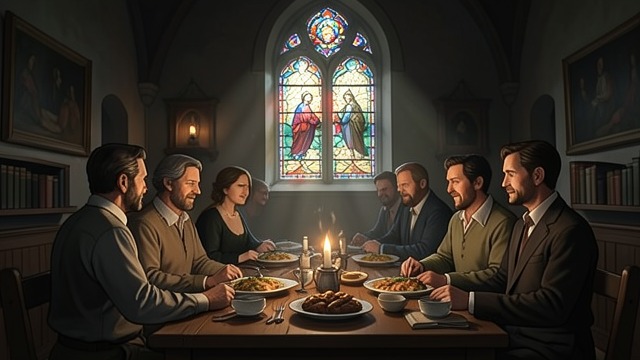
Faith With Practical Help
A new religious home
Don Bowman’s church introduces J.D. Vance to regular worship and a close community. The congregation offers tangible support to people facing addiction, pregnancy, and financial trouble.
Belonging through structure
J.D. Vance is drawn to the certainty and shared life of the church. Its community provides a contrast to the isolation and instability he knows.
Faith appears not only as doctrine but as a network that can materially help people endure.
The World as a Threat

Faith Narrows Its Borders
Suspicion of outsiders
The church warns against secular science, popular music, and other Christians deemed insufficiently orthodox. J.D. Vance learns to treat disagreements as signs of moral danger.
A persecuted identity
Talk of the “War on Christmas” and anti-Christian persecution makes him feel part of a threatened minority. Fear becomes a source of belonging.
The protection offered by certainty carries a cost: it makes the outside world seem more hostile than it is.
A Faith Reconsidered

Doubt Beyond the Slogans
Earlier certainty fades
J.D. Vance eventually rejects much of the evangelical framework he embraced as a boy. Its focus on social enemies and prophecy had not given him a durable account of everyday moral responsibility.
Returning without certainty
As an adult, he explores Christian faith again while reflecting on his family’s failures and on the compassion Mamaw showed. He approaches belief more cautiously than before.
Faith becomes a question of how to live and care, not simply which side is right.
Community as a Possible Resource
Faith Put to Work
A need close to home
J.D. Vance considers Brian’s vulnerability after his mother dies. He argues that supportive relatives, neighbors, and churches may help where policy alone cannot.
Engagement instead of retreat
He hopes for churches that teach love, family, and purpose while keeping young people engaged with the wider world. Faith is judged by the community it helps build.
The conclusion returns religion to its strongest promise: shared responsibility for people at risk.
J.D. Vance’s childhood
after J.D. Vance reconnects with Don Bowman
during J.D. Vance’s early adolescence
from adulthood through law school
in the book’s concluding reflections
