
Class Resentment and the Welfare Divide
Hillbilly ElegyThis theme thread follows J.D. Vance’s early judgments about welfare and class, then develops the contradictions that complicate his view of poverty.
increasing Bearing strength in each event
 decreasing
Bearing strength in each eventdecreasingA Cashier’s Perspective
Seeing Poverty at Work
Daily observations
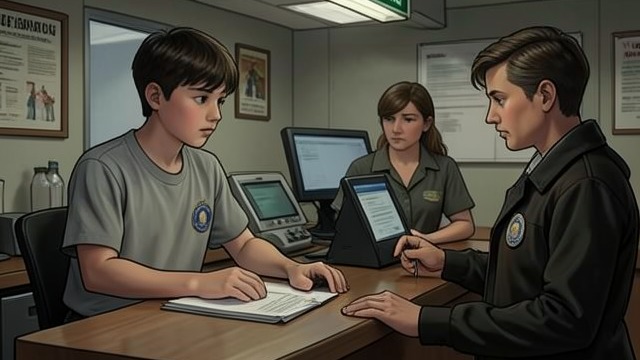
At Dillman’s grocery store, J.D. Vance notices differences in what customers buy, how quickly they shop, and how they pay. He tries to interpret these patterns from the limited position of a teenage cashier.
An angry comparison
He resents seeing people with government assistance buy items he cannot afford, while taxes come out of his own small paycheck. His judgments form before he understands the full circumstances around him.
The job opens his eyes to class but also narrows his sympathy at first.
The Section 8 Neighbor

A Line Drawn Nearby
Anger at a housing change
Mamaw objects when an old friend uses a Section 8 voucher to rent a nearby house. She fears that the arrival of poor tenants will damage the neighborhood.
Familiar lives across the line
The new family has Appalachian roots and faces absent partners, drugs, and conflict—problems that resemble the Vance family’s own history. Mamaw’s certainty about who counts as respectable becomes harder to maintain.
The neighbor turns a political argument into a mirror.
Compassion and Condemnation
Contradictions in Mamaw’s Politics
Two kinds of judgment
Mamaw can call the neighbor lazy and blame government support, then criticize society for failing to provide treatment and decent schools. Her political views shift with the suffering she sees.
A deeper heartbreak
J.D. Vance comes to understand that her anger is mixed with grief for people whose lives resemble her family’s. The contradiction contains both prejudice and care.
Their conversations resist a tidy division between personal responsibility and social support.
A Community’s Self-Destruction

Problems Repeated Nearby
Familiar patterns
J.D. Vance sees neighbors lose jobs, homes, and family stability through addiction, violence, and destructive spending. Children absorb the consequences of decisions they did not make.
No single explanation
Books about poverty and social policy help him identify structural patterns, but they do not explain every intimate choice. Culture, psychology, family history, and economics overlap.
His account becomes more searching when the problem is no longer safely located in other people’s homes.
Responsibility Without Contempt

Looking at the Whole Cause
Limits of policy
J.D. Vance argues that public programs can help but cannot repair every family or cultural pattern. Local choices and relationships also shape children’s prospects.
The danger of easy blame
He challenges both the habit of blaming government for every failure and the assumption that poverty is only a personal moral defect. The same family can be harmed by its history and responsible for its actions.
The unresolved tension becomes the book’s more honest alternative to either contempt or excuse.
during J.D. Vance’s high-school years
during his years living with Mamaw
after the neighbor moves in
during J.D. Vance’s later teenage years
in the book’s concluding argument
