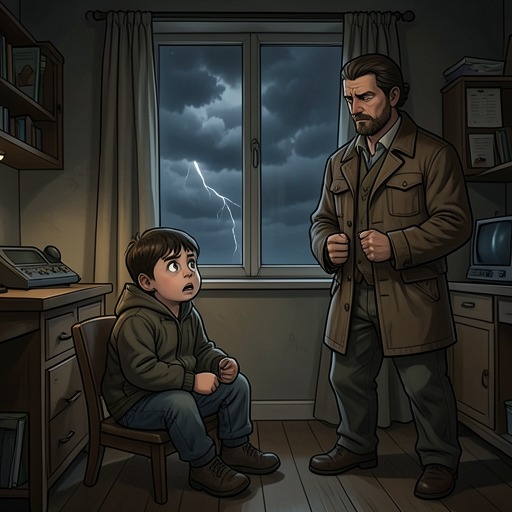
Adverse childhood experiences and their effects in adulthood
Hillbilly ElegyAdverse childhood experiences and their effects in adulthood give J.D. Vance a framework for recognizing that the conflict and instability he knew as ordinary family life could leave consequences long after childhood. The memoir connects repeated exposure to stress with later difficulties in health, school, and intimate relationships, while also showing how dependable care and deliberate reflection can interrupt inherited patterns. Its account is neither a diagnosis nor a claim that childhood determines adulthood: it traces risks, personal experience, and the possibility of change.
Definition and Scope
After trying to seek counseling, J.D. Vance instead turns to library research and encounters the term adverse childhood experiences, or ACEs. The category includes traumatic events and conditions in a child’s family life, not only physical harm. Among the examples he lists are being insulted or humiliated by parents, being pushed or grabbed, feeling that family members do not support one another, parental separation, living with someone who misuses alcohol or drugs, living with someone who is depressed or has attempted suicide, and witnessing abuse within the family. The range matters to his account: chronic insecurity and the atmosphere of a home can be consequential even when a child is not physically injured.
The concept gives a name to experiences that J.D. Vance had previously treated as normal. In his childhood, his mother and Bob Hamel’s conflict escalated, and he once intervened during a fight between them. Later, after Papaw’s death, his mother experienced a public crisis; people at the scene said she had tried to cut her wrists, though J.D. Vance did not know exactly what happened afterward. These episodes sit alongside years of shifting households and adult relationships. The framework makes their cumulative significance visible rather than isolating them as unrelated incidents.
Prevalence and Unequal Exposure
The memoir emphasizes that ACEs occur in every community but reports that they are more common in the social world J.D. Vance identifies with. A report by the Wisconsin Children’s Trust Fund found that fewer than half of people with a college degree or more had experienced an ACE. Among working-class people, well over half had experienced at least one, and about 40 percent had experienced multiple ACEs, compared with 29 percent of those outside the working class. The figures place family trauma within a social pattern, while preserving the distinction between a population-level risk and any individual person’s fate.
J.D. Vance also gives an ACE questionnaire to Aunt Wee, Uncle Jimmy, Lindsay Leigh Lewis, and Usha Vance. Aunt Wee scores seven; Lindsay Leigh Lewis and J.D. Vance each score six. Dan and Usha Vance, whose families had seemed unusually harmonious to him, score zero. The contrast unsettles his assumptions about what counts as ordinary. The people he had considered unusual were those who had not experienced childhood trauma, while severe exposure had been common among people close to him.
Long-Term Effects and Chronic Stress
The research he recounts associates multiple ACEs with increased likelihood of anxiety and depression, heart disease, obesity, some cancers, poorer school performance, and instability in adult relationships. Even frequent shouting, the account notes, can undermine a child’s sense of security and contribute to later mental-health and behavioral problems. These are elevated risks, not guaranteed outcomes: the memoir uses them to explain vulnerability, not to reduce people to a score.
The account also describes a possible physiological pathway. Research discussed by Harvard University pediatricians links persistent childhood stress to changes in the brain’s stress response. The fight-or-flight system, useful in immediate danger, can become chronically activated when a child repeatedly encounters fear or conflict at home. In J.D. Vance’s formulation, a response suited to an occasional threat can become a standing readiness to fight or flee. Its effects may persist even after the source of immediate conflict is gone, leaving a person prepared for danger in situations that call for trust or conversation.
Family Patterns in Adult Relationships
J.D. Vance recognizes this readiness in his own relationship with Usha Vance. When disagreements arose, he tended either to yell or to withdraw and try to leave. He attempted to end the relationship more than once, then reacted with guilt and fear. During a law-school interview trip to Washington, D.C., an argument followed his disappointment about an interview; he stormed out, and the episode recalled earlier family escapes. On the streets near Ford’s Theatre, he understood his behavior as part of a multigenerational pattern of leaving rather than facing conflict. Usha Vance found him, expressed concern, and told him he needed to learn to talk with her. The reconciliation did not erase the pattern, but it gave him a moment in which apology and conversation did not lead to retaliation.
The same framework helps explain why J.D. Vance mistrusted apologies and used words as weapons. In his childhood, apologies could persuade him to lower his guard before another painful episode, while arguments often felt like contests in which someone had to win. He connects those habits to what he had learned around him, including the conflict between his mother and Bob Hamel, rather than treating them as isolated personal failings. He says he continued to struggle with conflict and sometimes feared that the statistical risks associated with his background might be his destiny.
The experiences of Aunt Wee and Lindsay Leigh Lewis offer related but distinct examples. Aunt Wee told J.D. Vance that she had often prepared herself for an argument with Dan, despite their long and successful marriage. She said their relationship improved when she realized she did not need to remain constantly on guard. Lindsay Leigh Lewis described insulting Kevin and urging him to leave during arguments, even though he asked why she treated him like an enemy; sixteen years later, they were still married. These accounts show how defensive habits can enter loving relationships, and how recognizing those habits can make change possible without guaranteeing that change will be effortless.
Stability, Recovery, and Limits
The memoir sets these risks against J.D. Vance’s permanent move to Mamaw’s home. His childhood had been marked by repeated moves: from Middletown to Preble County, back to Middletown, through new addresses and changing adult partners, and eventually to Dayton and Ken’s household. The sequence coincided with drugs, a domestic-violence case, children’s services involvement, and Papaw’s death. J.D. Vance recalls that even remembering this period brought intense anxiety. What he wanted was a home where he knew he could remain, rather than another change governed by an adult relationship.
After the move, the household remained the same through the end of tenth, eleventh, and twelfth grades: J.D. Vance lived with Mamaw, and no one else. He associates that continuity with having a safe place to do homework, concentrating on school and work, making lasting friendships, and clarifying what he wanted from his own life. His grades improved, he aced the SAT, and teachers helped him develop a love of learning. Most consequentially, he recalls no longer fearing the end-of-day school bell or wondering where he would live the next month. The contrast does not demonstrate that stability cancels trauma; it shows that reliable care can create room for opportunity and happiness.
J.D. Vance’s account therefore treats ACEs as a way to understand both inherited vulnerability and the conditions under which it may be challenged. The research makes visible why conflict can persist beyond the original home, while his experience with Mamaw, Usha Vance, Aunt Wee, and Lindsay Leigh Lewis shows that persistence is not the same as inevitability. He acknowledges that he has not unlearned his responses overnight and that the fear of repeating family patterns remains. The concept’s force lies in holding both truths together: childhood adversity can shape adult life deeply, but recognition, stability, and relationships that make room for repair can alter its course.