Childhood adversity and trauma
Hillbilly ElegyChildhood adversity and trauma gives J.D. Vance a framework for recognizing that experiences he once regarded as ordinary were neither harmless nor isolated. In the memoir, adverse childhood experiences (ACEs) connect private family crises—addiction, separation, emotional volatility, and violence—to lasting risks for health, learning, and relationships. The concept does not make hardship inevitable or reduce a life to a diagnosis: it illuminates how repeated stress can shape a child, while the account of Mamaw’s home shows how stable care can open a different path.
Definition and Recognition
Vance encounters the term ACEs after trying, unsuccessfully, to speak with a counselor. Instead, he goes to the library and discovers that psychologists study experiences he and Lindsay had treated as commonplace. The list extends beyond direct physical harm: it includes being sworn at, insulted, or humiliated by parents; being pushed or grabbed, or having something thrown at a child; and feeling that the family does not support its members. Parental separation or divorce, living with an alcoholic or drug user, living with someone who is depressed or has attempted suicide, and witnessing a loved one being physically abused also appear among the common examples.
That list changes the meaning of remembered scenes without changing what happened in them. A child need not have a visible injury for an experience to count as traumatic; persistent humiliation, fear, and instability belong in the account too. Vance’s recognition is retrospective: the vocabulary arrives after years in which adult conflict and upheaval had seemed like the ordinary weather of family life. Naming ACEs makes those memories legible as experiences with consequences, not simply as the background against which childhood took place.
Family Experience and Accumulated Stress
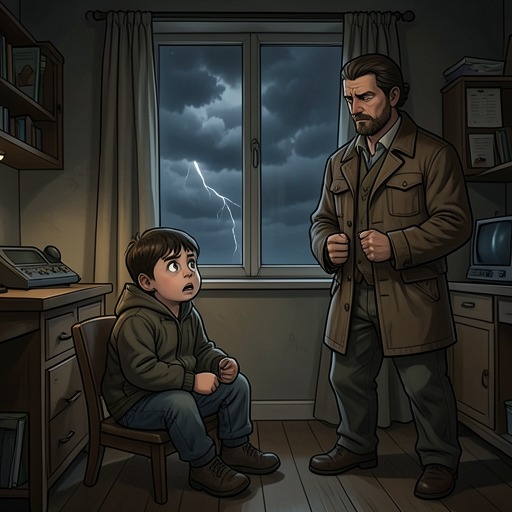
The memoir’s family history gives the concept a concrete setting. After Papaw dies, Mom’s grief becomes volatile and is directed at the people around her. She insists that others have no right to grieve as she does, then erupts at Lindsay and others in the family. A few days after the funeral, she stands in a bath towel in her front yard, screaming insults; when J.D. runs to her, police are already there, and an officer struggles to restrain her. There is blood on the porch, and someone says she has tried to cut her wrists. Mamaw takes J.D. and Lindsay away. At the time, J.D. does not understand the full meaning of what is happening. Read alongside the later ACE framework, the scene shows how a child can be surrounded by danger and distress before having words for either.
The wider pattern is not one crisis but repeated disruption. Before moving permanently in with Mamaw, J.D. changes homes and caregivers through successive school years: from Middletown, Ohio, to Preble County, Ohio, then among homes on McKinley Street, and later to live with Ken and his children. The changes occur alongside drugs, a domestic-violence case, children’s services entering the family’s life, and Papaw’s death. Remembering that period years later still brings him intense anxiety. He recalls wanting not merely an end to fighting or drug use, but a home where he could stay and where strangers would not keep intervening. The accumulation matters: instability repeatedly interrupts a child’s sense of safety and continuity.
Evidence and Consequences
The book places family memory beside population-level findings. A report by the Wisconsin Children’s Trust Fund found that fewer than half of people with a college degree or more had experienced an ACE. Among working-class people, well over half had experienced at least one, and about four in ten had experienced multiple ACEs; the comparable figure for people outside the working class was 29 percent. The contrast does not mean that trauma belongs only to one class or community. Vance stresses that ACEs occur everywhere, while the figures show how unevenly exposure is distributed.
Vance also gives an ACE questionnaire to Aunt Wee, Uncle Jimmy’s wife, Lindsay, Dan, and Usha. Aunt Wee scores seven; Lindsay and Vance each score six. Dan and Usha, whose families had seemed almost strangely peaceful to him, each score zero. The result reverses his sense of what is unusual: in his experience, a childhood without these adversities had seemed exceptional. The questionnaire turns a private impression into a comparison among people close to him, while also showing that family members can carry different histories even when they belong to the same extended family.
The consequences described in the memoir span adulthood. Children exposed to multiple ACEs are more likely to experience anxiety and depression, heart disease, obesity, and certain cancers; they are also more likely to struggle at school and to have unstable adult relationships. Even excessive shouting can undermine a child’s sense of security and contribute to later mental-health and behavioral problems. Research discussed in the book also links constant stress in childhood to changes in brain chemistry. The body’s fight-or-flight response can be useful in immediate danger, but when stress is chronic, the response becomes a persistent burden rather than a brief protective reaction. The memorable image of a bear returning home from a bar captures that reversal: what should be an emergency alarm becomes part of everyday life.
Stability, Opportunity, and the Limits of Explanation
Mamaw’s home offers a counterpoint to accumulated adversity. After J.D. moves in with her permanently, the pattern of changing households ends: at the close of tenth, eleventh, and twelfth grades, he is still living with Mamaw, in the same house, with no one else. He associates that continuity with peace, the ability to do homework and concentrate on school and work, and the chance to form lasting friendships. His grades improve, he aces the SAT, and he loses interest in drugs. The memoir does not claim that one stable household explains every later opportunity; it insists that safety and dependable care made a consequential difference.
That distinction also shapes the book’s social argument. At sixteen, Vance reads William Julius Wilson’s The Truly Disadvantaged and recognizes in its account of poor communities left behind after factory closures something that resembles his own home. He finds a similar resonance in Charles Murray’s Losing Ground, while recognizing that these works concern Black communities rather than Appalachian families. Neither book answers all the questions he has about addiction, abuse, and decisions that harm children. He concludes that no single expert or discipline can explain the problems: sociology must be considered alongside psychology, community, culture, and faith.
The same caution governs his reflections on solutions. Vance resists the idea that a public policy can simply solve problems rooted in family, faith, and culture, but he also remembers how many people gave him support at crucial points. His account links personal outcomes to both adversity and the presence of relatives, mentors, teachers, and friends who made alternatives visible. Childhood adversity and trauma is therefore not a deterministic label in the memoir. It is a way to recognize accumulated harm, to understand why apparent ordinary life can leave deep marks, and to see why reliable relationships and stable surroundings can help change what follows.