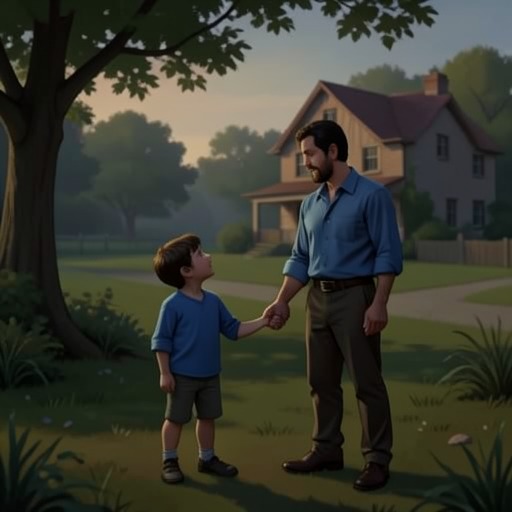
J.D.’s renewed connection with his biological father
Hillbilly ElegyJ.D. Vance’s renewed connection with his biological father, Don Bowman, began during a summer of loss and family change. It reopened a relationship interrupted by adoption, but did not erase the pain or divisions created by that history. Over time, visits with Don and a new account of the custody decision gave J.D. a place in his biological family while leaving him to reconcile competing loyalties and explanations.
The Call and the Return
On August 2, J.D.’s eleventh birthday, he was in Jackson, Kentucky, with Mamaw and his cousin Gail Huber. Mamaw urged him to call Bob Hamel, who remained his legal father. After the family had returned to Middletown, Ohio, Bob and Mom divorced, and he rarely contacted J.D. Still, J.D. expected a birthday call. He phoned, reached the answering machine, and tried again a few hours later. The repeated silence led him to understand, instinctively, that he would not see Bob again.
That same summer, Mom called J.D. into the living room to speak by phone with Don. The conversation was short, but its questions reached back to a life J.D. barely remembered. Don asked whether J.D. remembered wanting a farm with horses, cows, and chickens, and whether he remembered his siblings. J.D. recalled the farm dream and had only a partial memory of the children. Don then asked whether he would like to see him again. J.D. agreed, and Mom allowed the reunion. The timing made the return especially consequential: as one father disappeared from J.D.’s daily life, his biological father re-entered it.
Before the call, J.D. knew little about Don. He understood that Don was his biological father, that he had been adopted by Bob, and that Mom and Mamaw had described Don as having abandoned him to avoid child support. He also knew that Don had a family of his own and that people thought J.D. looked like him. His curiosity about Don’s religious background added another attraction: J.D. had little experience of church and wanted to see what a real congregation was like. The call therefore opened both a family relationship and a new religious world.
A Shared Kentucky Inheritance
Don’s family history helped explain why he understood J.D.’s attachment to Kentucky. Don’s father had migrated from eastern Kentucky to southwest Ohio for work, then died suddenly after starting a family, leaving a young wife and two small children. Don spent much of his childhood in eastern Kentucky with his grandparents after his mother remarried. Though his stepfather was a good man, Don experienced him as firm and as an outsider to the life he had known. In Kentucky, among familiar people and with room to be himself, Don found a sense of belonging that J.D. recognized from his own time with Mamaw.
Don had built a modest version of that remembered life on fourteen acres. His property included a pond stocked with fish, fields for cows and horses, a barn, and a chicken coop. The children gathered eggs in the morning, usually seven or eight, and spent their days outdoors with a dog, catching frogs and chasing rabbits. These details echoed the rural childhood Don had known and the Kentucky experiences J.D. shared with Mamaw. Their connection rested not only on biology: each recognized in the other a feeling for place and a preference for the familiarity of one’s own people.
Visits, Church, and a Divided Family
Despite the lack of a legal relationship between them, J.D. began spending substantial time with Don. He visited on most holidays and every other weekend, rejoining aunts, uncles, and cousins who had been absent from his life for years. The visits gave the relationship continuity, but the two sides of the family remained largely separate. Don avoided Mom’s relatives, and they avoided his. Lindsay and Mamaw welcomed his renewed role while continuing to distrust him; Mamaw saw him as the father who had left J.D. at a critical point in childhood. J.D. also resented the past, even as he grew closer to Don.
Don’s church became part of that closeness. J.D. enjoyed spending time with his father and was drawn both to the church’s structure and to the opportunity to share something important to Don. He became a devoted convert, reading young-earth creationist books, challenging evolution in online chat rooms, accepting millennialist predictions that the world would end in 2007, and discarding his Black Sabbath CDs. At Don’s house, even music associated with Eric Clapton could be rejected because of its supposed spiritual influence. The church thus offered J.D. belonging and a framework for understanding the world, while also encouraging distance from secular culture.
The religious environment also contrasted with the faith J.D. knew through Mamaw. She rarely attended church and distrusted organized religion, yet her personal belief in God shaped her advice and sense of family duty. Don’s church, by contrast, linked belief to an organized community with practical support. It helped people facing addiction find companionship, offered expectant mothers housing and training, connected people to jobs, and rallied to buy Don’s family a used car when money was tight. J.D.’s growing attachment to the church was therefore not only doctrinal; he saw it providing material assistance in a community under pressure from joblessness, addiction, and family instability.
Reconsidering the Adoption
As J.D. spent more time with Don, the adoption that had separated them became a frequent subject. Don gave him an account that differed sharply from what Mom and Mamaw had told him. According to Don, the decision had not been made to evade child support: he had hired several lawyers and tried within reason to keep his son. He said he reconsidered his approach after seeing how frightened J.D. was during pre-adoption visits and learning that the custody dispute was affecting him emotionally and at school.
Don also described asking God for three signs that adoption was in J.D.’s best interest, and said those signs appeared before J.D. became Bob’s legal son. J.D. could empathize with the difficulty of Don’s decision and found comfort in learning that his father had cared about him. That knowledge eased some childhood pain. Yet he remained uneasy about leaving a child’s future to signs from God. Reconnection, then, did not deliver a simple resolution: it supplied evidence of Don’s concern while preserving J.D.’s questions about the choice that had kept them apart.
The relationship’s significance lies in this combination of return and unresolved history. Don became a regular presence, introduced J.D. to relatives and a church community, and offered a version of the adoption that altered J.D.’s understanding of his childhood. But the family remained divided, and the past could not be undone. J.D. came to love Don and his church without ceasing to feel the injury of their long separation; renewed contact made room for affection and a more complicated account of what had happened.