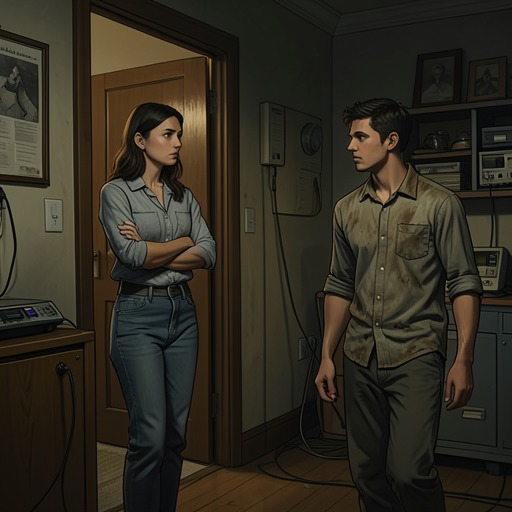
Lindsay's modeling audition ends in a family fight
Hillbilly ElegyLindsay's modeling audition ends in a family fight when a promising trip to a recruitment event becomes a dangerous argument about money. The episode sets a brief vision of escape and family possibility against the instability that governs the children's lives: Lindsay Leigh Lewis seems close to a dream, then, within minutes, is left heartbroken while Mamaw must physically intervene to keep Mom from harming the children or causing a crash.
Background and the promise of the audition
Before the modeling trip, Lindsay Leigh Lewis was already doing much of the work that held the household together. When Mom worked late or failed to come home, Lindsay made sure there was dinner. She did laundry when no one else did and had once rescued J.D. Vance from the back seat of a police cruiser. He depended on her so completely that he struggled to see her as a young girl still learning to manage life for herself and her little brother. The audition therefore carries more than the prospect of a career: it briefly offers the family a chance to imagine that Lindsay's future might open outward.
The family travels north from home in Mamaw's Buick to a modeling recruitment event at a hotel in Dayton, Ohio. J.D. Vance recalls Lindsay Leigh Lewis as beautiful and says that, when he and his friends ranked the prettiest girls, he placed her first, ahead of Demi Moore and Pam Anderson. Lindsay had learned of the event and was excited; J.D. Vance shared that excitement. He understood her possible success as something that could benefit the whole family, not only the person being auditioned.
The recruitment event
The hotel ballroom makes an unimpressive setting for the hopes invested in it. J.D. Vance remembers ugly carpet, large chandeliers, and dim lighting that seemed ill-suited to showing off anyone's appearance. At the front of the line, an agent complimented Lindsay Leigh Lewis and directed her to wait in another room. The agent also said J.D. Vance might be suitable for modeling and invited him to follow his sister to learn about the next step. He accepted enthusiastically.
After waiting in a holding room, the siblings and other selectees were told they had advanced to another round, this one in New York City. Agency employees handed them brochures and asked them to RSVP within the next few weeks. On the drive home, Lindsay Leigh Lewis and J.D. Vance were elated by the prospect of going to New York City and becoming famous models. Their delight depended on treating the invitation as a real opening; the book later registers uncertainty about that assumption. The travel fee was substantial, and the brief conversations that constituted each audition suggested, in retrospect, that the event may have been more scam than genuine search for talent. The narrator does not claim certainty, but the cost and cursory process sharpen the contrast between the family's hopes and the opportunity actually offered.
The drive home and Mamaw's intervention
The change begins in the car, when Mom voices concern about the cost of the trip. Lindsay Leigh Lewis and J.D. Vance bicker over which of them should go, and the narrator acknowledges that he was behaving like a brat. As Mom grows angrier, the conversation turns into screaming and physical violence. Mom drives while slapping the children in the back seat; Mamaw, in the passenger seat, slaps and screams at Mom. The car eventually stops at the side of the road, with both children sobbing. The danger is not merely an argument overheard by the children: the adults are fighting while the car is moving, and the narrator reflects that they could have crashed and died.
Mamaw's intervention halts the immediate escalation. She explains that if Mom loses her temper again, Mamaw will shoot her in the face. The family then drives home in silence and spends the night at Mamaw's house. The threat is a stark expression of the protective role Mamaw takes in the crisis, but the scene does not resolve the family's underlying conflict. Safety comes through her forceful interruption and the move to her house, rather than through any reconciliation described on the drive.
Aftermath and significance
Lindsay Leigh Lewis's walk upstairs stays with J.D. Vance: her face shows the pain of a person who has experienced the highest high and the lowest low within minutes. The audition has offered a glimpse of a childhood dream coming within reach; the fight abruptly returns her to the position of a teenager whose plans are subject to adult anger and household money worries. That reversal gives the event its emotional force. The family trip begins as a shared fantasy of fame and ends with the children sobbing and the family silent.
After the children have gone to Mamaw's house, Mamaw turns toward her couch, where she will watch Law & Order, read the Bible, and fall asleep. J.D. Vance asks her, "Mamaw, does God love us?" Mamaw hangs her head, hugs him, and begins to cry. The question connects the immediate violence to a deeper uncertainty: the incident has unsettled a child whose family life is steeped in faith, especially Mamaw's personal, unconventional Christianity. The book notes that the family rarely attends church and that Mamaw distrusts organized religion and ostentatious displays of piety. Her tears make the question more than a request for doctrine; in the aftermath of the fight, it becomes a plea for reassurance about whether the family is loved at all. The audition's collapse thus exposes both the precariousness of the children's hopes and the emotional cost of the instability surrounding them.