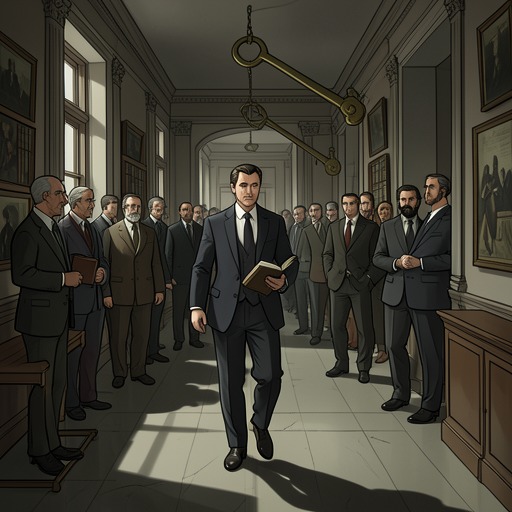
Ohio Senate
Hillbilly ElegyThe Ohio Senate is presented through J.D. Vance’s experience as a student employee: a legislative institution whose internal deliberations complicated his earlier suspicion of politicians, and whose policy debates could overlook the practical circumstances of people living with little financial margin. His work there gave him a close view of constituent service and policymaking, but it also revealed a gap between abstract judgments about payday lending and the short-term problems that such loans could solve for someone in his position.
Work and Firsthand Exposure
While studying at Ohio State, Vance still had about twenty thousand dollars in expenses to cover despite assistance from the GI Bill and relatively low in-state tuition. He took a job at the Ohio Statehouse with Bob Schuler, a senator from the Cincinnati area whom he regarded as kind and whose politics he liked. When constituents called to complain, Vance tried to explain the senator’s positions. The work placed him between elected officials and the people contacting their office, giving him a practical glimpse of how political arguments were communicated beyond a campaign or a television broadcast.
He also watched lobbyists come and go and overheard Schuler and his staff consider whether proposed legislation would benefit constituents, the state, or both. These encounters made the political process more tangible: policy was not merely a spectacle observed from a distance, but a sequence of arguments about competing effects and responsibilities. The experience qualified the broad distrust Vance had absorbed from his grandmother, who believed politicians were crooks. At the Ohio Statehouse, he concluded that this judgment did not hold true of politicians as a whole, regardless of their political affiliations.
Payday-Lending Debate
Shortly before leaving the job, Vance observed the Ohio Senate debate a measure intended to curb payday-lending practices. Schuler opposed it, making him one of the few senators to do so. Schuler did not explain his reasons to Vance. Vance therefore could not claim to know what informed the senator’s position, though he wondered whether they shared some understanding of the role payday lenders played in the informal economy he knew firsthand.
The debate brought different descriptions of the same industry into view. Senators and policy staff regarded payday lenders as predatory businesses that charged high interest on loans and excessive fees for cashing checks; from that perspective, eliminating the practice seemed desirable. Vance understood the risks of those costs, but also saw the lenders as one of the few available ways to manage immediate financial gaps. His account does not erase the criticism voiced in the debate. Instead, it shows how a broad policy judgment can leave out the particular constraints that shape a borrower’s decision.
Financial Circumstances and the Work’s Limits
Vance describes why those circumstances mattered to him. His credit was poor after a series of bad financial decisions, some beyond his control and some his responsibility, so credit cards were not available to him. If he wanted to take someone to dinner or needed a schoolbook without enough money in the bank, he had few alternatives. He wanted to manage such needs independently rather than ask his aunt or uncle for help. These were not remote hypotheticals in a policy discussion; they were the everyday shortfalls against which he evaluated the proposed restrictions.
One Friday, he deposited his rent check knowing that a fifty-dollar late fee would apply if he waited another day. The account did not yet have enough to cover the check, but he expected to be paid that day and planned to deposit his wages after work. He forgot to collect his paycheck before leaving the Statehouse, and by the time he realized the mistake, staff had gone for the weekend. A three-day payday loan, costing a few dollars in interest, let him avoid a substantial overdraft fee. The episode gives concrete scale to the gap between the legislative debate and the immediate arithmetic of his life: the loan was not described as a lasting solution, but as a short-term way to meet a deadline and avoid a larger charge.
Departure and Significance
The Ohio Senate job was meaningful to Vance, but it paid less than his other work. After recovering from mononucleosis and returning to classes in Columbus, he had lost twenty pounds over four weeks and faced growing hospital bills. He added a third job tutoring students for the Princeton Review at eighteen dollars an hour. Three jobs proved too much, so he gave up the work he loved most—his position connected to the Ohio Senate—because it paid the least. The choice makes the limits of public-service work personal: interest in politics and satisfaction in the job could not outweigh the need for money and the financial freedom it offered.
The institution consequently occupies two connected roles in the account. It is where Vance gained a more nuanced view of politicians by observing constituent calls, lobbyists, and staff deliberations; it is also where he encountered a policy debate that, in his view, did not fully reckon with the situations of people like him. His conclusion is not that lawmakers acted with bad intentions, but that powerful people could try to help without understanding the daily conditions of those affected. The Ohio Senate thus serves as a setting for both learning and a limit: proximity to political work deepened Vance’s appreciation of the process, while his own financial pressures showed what that process could fail to see.