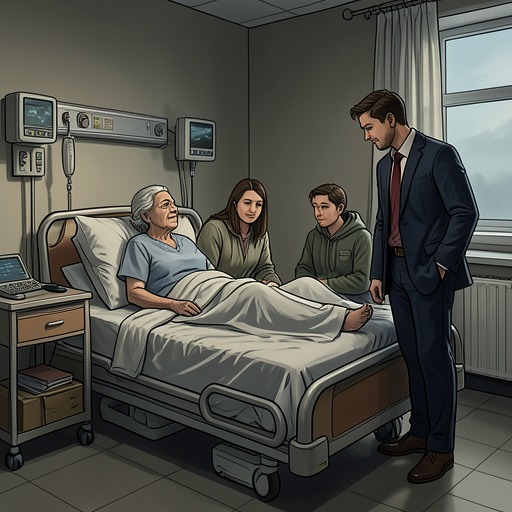
The family withdraws Mamaw's life support
Hillbilly ElegyThe family’s withdrawal of Mamaw’s life support was a carefully considered decision made in the face of a grave prognosis, not a sudden abandonment of hope. The infection that had caused her lung to collapse continued to worsen despite treatment, and the family had to decide whether to prolong life with a ventilator and feeding tube when the doctors saw no realistic chance of recovery. The scene brings Mamaw’s private faith, her place at the center of the family, and the family’s grief into one final vigil.
Background and Meaning of Home
Mamaw had been a source of steadiness for J.D. through years of family upheaval. Before he moved in with her, his childhood had been marked by successive changes of home and household, including moves between Middletown and Preble County, changing adults in his mother’s life, and the instability surrounding addiction and family conflict. Her home offered him a contrast: a place where he could be with people he loved and experience a peaceful Sunday afternoon. Her importance to him was not an abstract lesson about resilience; he understood it through the security he felt in her care.
Faith was central to Mamaw, though it did not take the form of regular church attendance or confidence in organized religion. She distrusted churches as institutions and disliked people who made a public display of piety, yet she sent much of her spare income to churches in Jackson, Kentucky. Her belief was personal and practical: God stayed with the family in good times and bad, and Christian duty called for hard work, care for family, forgiveness, and hope. That lived faith gives particular weight to the Bible J.D. opens at her bedside. The reading is not a new doctrine introduced at the end of her life; it draws on the religious language and assurance that had long shaped their relationship.
Medical Decline and the Family’s Decision
J.D. was away when his sister called to say that Mamaw’s lung had collapsed and she was in a coma. He packed his dress blue uniform in case he would need it for a funeral and drove home. A West Virginia police officer stopped him for driving ninety-four miles per hour on Interstate 77. After learning why J.D. was in a hurry, the officer gave him a warning ticket and told him the highway would be clear of speed traps for the next seventy miles, until he crossed into Ohio. J.D. then drove as fast as 102 miles per hour and completed a trip that normally took thirteen hours in just under eleven.
He reached Middletown Regional Hospital at eleven that night, where his family had gathered around Mamaw’s bed. Her lung had been reinflated, but the infection responsible for its collapse was not responding to treatment. The doctor warned that waking her would be torturous until the infection improved, if she could be awakened at all. In the days that followed, the family waited for evidence that the medication was working. Instead, Mamaw’s white blood cell count kept rising, and some of her organs showed signs of severe stress.
The doctor explained that Mamaw had no realistic chance of living without a ventilator and feeding tube. After discussing the situation, the family agreed to wait one more day: if her white blood cell count rose further, they would withdraw life support. The authority to make the decision legally belonged to Aunt Wee alone. She nevertheless sought J.D.’s reassurance and tearfully asked whether she was making a mistake. He believed then, and continued to believe, that she and the family had made the right decision, while recognizing that certainty about such a choice was impossible. He also wished they had a doctor in the family.
The Final Hours
The doctor expected Mamaw to die within fifteen minutes to an hour once the ventilator was removed. Instead, she lived for three hours. The family stayed with her: Uncle Jimmy, Mom, Aunt Wee, Lindsay Leigh Lewis, Lindsay’s husband, and J.D. They took turns speaking quietly into her ear, hoping she could hear them. As her heart rate fell and they understood that her death was near, J.D. opened a Gideon’s Bible to a passage at random. He read First Corinthians, Chapter 13, verse 12, about seeing indistinctly in the present and face to face later. Mamaw died a few minutes after he finished.
The passage joined the immediate circumstances to the faith Mamaw had practiced throughout her life. J.D. did not turn the reading into proof that the family’s choice had been painless or that its uncertainty vanished. The family had waited, watched the medical evidence worsen, and acted on the doctor’s prognosis; at the bedside, the Bible offered words of faith and companionship rather than a medical answer. The three-hour interval, longer than the doctor anticipated, became the time in which the family could remain present and take turns addressing Mamaw.
Aftermath and Significance
J.D. did not cry when Mamaw died or for several days afterward. Aunt Wee and Lindsay Leigh Lewis first grew frustrated with his apparent composure and then worried that grief held back might overwhelm him. He understood his own restraint as a way of appearing strong while the family faced the possibility of collapse. Mamaw’s death brought practical burdens as well as grief: the family had to wind down her estate, determine her debts, dispose of her property, and distribute what remained.
During that process, Uncle Jimmy learned how much Mamaw had spent on Mom, including drug-rehabilitation charges and numerous loans that had not been repaid. He thereafter refused to speak to her. The decision at the hospital thus stands at the intersection of intimate care and a family already strained by loss, addiction, and financial obligations. Mamaw had been a dependable refuge for J.D.; after her death, the family had to confront both the absence of that refuge and the unresolved costs of caring for one another. His reading from the Bible gives the event a distinct ending, but not a simple resolution: it accompanies the family through Mamaw’s last moments while leaving grief, doubt, and family conflict in view.