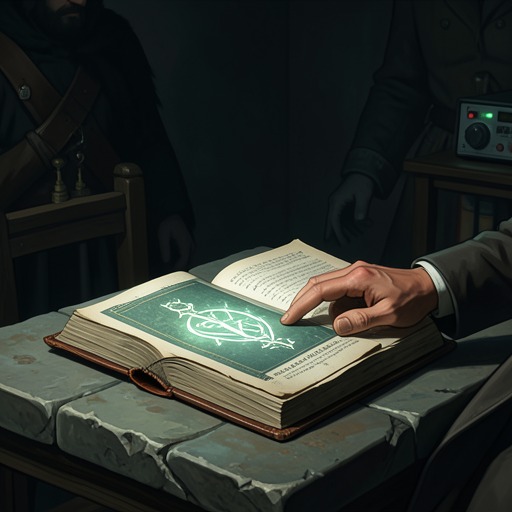
Book of Talus mate-selection rule
His Property (A Dark Vampire High School Bully Romance) (Vampire Boy Swords): Prince of Londinium (Dead Sun: Prince of Londinium (A Dark High School Bully Romance) (Vampire Boy Swords) Book 1)The Book of Talus mate-selection rule governs the selection of Taleian mates through a magical hereditary record. At a child’s birth, the Book of Talus reveals the child’s name and writes beside it the name of the designated fated mate. No one knows how the book performs this selection, but its unexplained operation is treated as an authority capable of defining relationships, succession, and political legitimacy across Taleian history.
Definition and Historical Authority
The rule belongs to the older social order of the Taleians, a people divided into clans and governed by Queen Morrigan, whose consort and Knight of Swords was traditionally taken from the Breannin Clan. The Book of Talus did more than identify romantic partners: it supplied mates and advisors connected to the royal order, helping protect the Queen and the immense power associated with her position. Its design therefore joined private attachment to clan structure, military office, and rule.
The book’s authority was embedded in a wider Taleian system of gifts and inherited identity. Taleian men were described as warriors with exceptional strength and sword skills, while women possessed extraordinary psychic abilities. After the Druids cursed the Taleians and transformed them into Vampires, the scattered survivors retained the old mate-selection tradition even as their society changed. Later, because Taleians could no longer reproduce among themselves, Taleian men formed unions with human women and produced Taleian-human hybrids. These children did not assume their full Taleian vampire form until later in life or until their bodies judged the transformation suitable, and they remained physically no older than twenty-five. The rule thus persisted through a disrupted lineage rather than a stable, unchanged population.
Courtship, Bonding, and Enforcement
The Book of Talus identifies the destined pairing, but selection alone does not complete the union. The related Taleian bonding custom requires a psychic connection before the final physical act of claiming. Once the bond is established, the thoughts of the two mates flow as one; only afterward may the male bite the female and consummate the union. The ritual consequently treats mental connection, blood, and bodily marking as successive signs of a relationship that has both supernatural and social force.
The rule also imposes a martial test. Six sword duels must be fought against designated challengers to the bond, and the mate must win every duel to keep the prize. The language of winning and retaining a prize exposes the rule’s asymmetry: the male claimant is tested through combat, while the woman’s position is largely represented as the object being won. The requirement makes courtship dangerous as well as ceremonial, since failure can threaten the claimant’s life and prevent consummation.
Conflict with Imperial Power
By the twenty-sixth century, the old system operates under imperial suppression. Octavius explains that his father, The Emperor, attempts to stamp out the ancient ritual and the Taleians’ true heritage, forcing those who still believe in the old ways to seek muted methods of claiming a mate. The Book of Talus therefore remains culturally powerful without being fully recognized by the reigning authority. Its status resembles a rival legal order: the Emperor can restrict its public practice, while Taleian tradition continues to define what some characters regard as a legitimate claim.
That conflict is inseparable from the history of the royal bloodline. After the original Queen and Knight of Swords were murdered by the Druids while trying to aid their people with the Magician, no new Queen was born until 1893, when a union between a Taleian male and a human female produced one. The Empress later possessed the DNA strands of all the people and governed with the Five Princes, with the Book of Talus providing mates and advisors to guard her power and keep her safe. Octavius presents this earlier arrangement as a period in which the people benefited from royal guidance and nurture, while accusing The Emperor of murdering The Empress, her child, and the Princes. In this account, suppressing the book is part of suppressing the political memory and hereditary legitimacy of the Empress’s regime.
Clara Driscoll and the Rule of Courtship
The rule becomes an immediate source of conflict at the ball in The Emperor’s Palace when Byron Phraeon claims that a kiss on Clara Driscoll’s cheek has staked his claim under the rule of courtship. He treats the gesture as a muted form of the ancient custom, but Darius Constantine rejects that interpretation, saying that the act is not an appropriate bonding ritual and has not initiated a bond to claim Clara. The disagreement establishes that the Book of Talus tradition is not self-executing: its meaning must be interpreted by competing authorities, each with a different interest in Clara.
Clara rejects the language through which the men discuss her. When they continue speaking as though she were absent and an object to be owned, she demands that they stop. Her resistance exposes the gap between the rule’s traditional legitimacy and personal consent. The fact that a courtship claim can be announced over her objections makes the rule a mechanism of possession as much as a system of destiny, especially within the palace’s public and hierarchical setting.
Clara’s hidden lineage intensifies the stakes. During the dance, she learns that she is the lost child of The Empress and that she had been stolen and hidden in 1987, making her apparent family history a false construction. The revelation places her inside the very bloodline whose power was once protected through the Book of Talus. It also means that the rule is not merely an abstract Taleian custom surrounding an ordinary woman: it bears directly on the identity of a possible royal heir whose heritage has been concealed for centuries.
Psychic Prerequisite and Unresolved Future
The rule’s operation around Clara remains incomplete because she has not undergone the full Taleian transformation. Octavius senses that she possesses the psychic gifts of a Taleian hybrid but has not yet completed the change into a vampire. This condition explains why the psychic-bond prerequisite matters: Clara carries the potential associated with the tradition, but her body and powers have not fully entered the state in which the old bonding system would operate.
The competing claims made by Byron Phraeon, Darius Constantine, and Octavius show the rule producing rivalry rather than harmony. Octavius says he felt drawn toward Clara from the moment he saw her and that his consciousness has reached the edge of her mind, with a bond still to be established. His statement makes the rule’s fated logic feel invasive as well as romantic: the connection is presented as natural and inevitable, yet Clara experiences the surrounding claims as pressure and loss of control. The Book of Talus mate-selection rule therefore ends this portion of the story as an unresolved authority, powerful enough to organize desire and dynastic memory, but challenged by imperial law, rival interpretations, and Clara’s refusal to be reduced to a prize.