Darius Constantine
His Property (A Dark Vampire High School Bully Romance) (Vampire Boy Swords): Prince of Londinium (Dead Sun: Prince of Londinium (A Dark High School Bully Romance) (Vampire Boy Swords) Book 1)Darius Constantine, known as Lord Darius Constantine and the Lord Protector, is the political and physical force who repeatedly intervenes when Clara Driscoll is treated as an object of aristocratic possession. At the Emperor’s Palace in the underground city of Londinium, he stands between Clara and rival claims, yet his protection is inseparable from his own desire for her. He therefore embodies the story’s central contradiction between rescue and control: Darius opposes unauthorized violence against Clara while participating in the same possessive system that defines her as a mate to be won.
Identity and Authority
Darius holds the office of Lord Protector of Londinium, a position that gives his warnings institutional weight during the palace ball. When Byron Phraeon claims that a kiss has staked his claim under the rule of courtship, Darius rejects the implication that the gesture is sufficient. He explains that the ancient Taleian bonding ritual, even in its muted form, has not been properly initiated, and he insists that Byron has not established a bond with Clara.
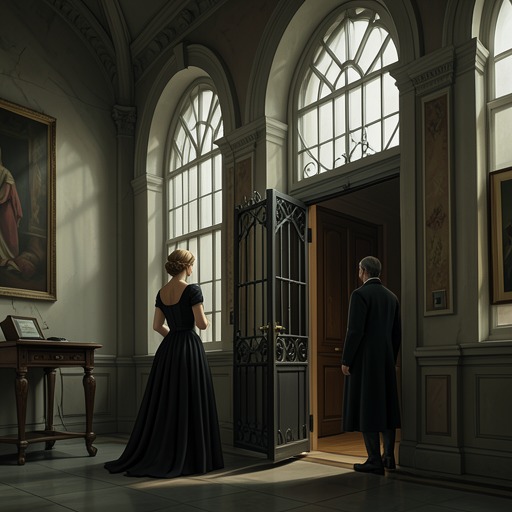
His authority is not merely ceremonial. After Byron catches Clara’s gloved hand and declares that he will watch her until he can make her his, Darius abruptly takes her arm and pulls her behind him. He tells Byron to keep away because Clara is under his protection. The intervention changes the physical arrangement of the scene: Clara is no longer held by the dancer who has publicly marked her, but she is also being restrained by another man whose grip she has not invited. Her immediate protest that she can look after herself exposes the limit of Darius’s protective logic. He acts for her safety, but he does not initially treat her refusal as decisive.
Presence at the Palace Ball
Darius witnesses Byron’s possessive kiss and the display that follows it. Clara notices that Darius narrows his eyes at Byron, his blue eyes turning icy cold as he glares at him with an intensity that suggests he might kill him. The spectacle is public: the ballroom is as large as a football field, lined with tall mirrors, gold statues bearing burning candles, crystal chandeliers, and frescos depicting figures from Greek mythology. In that setting, Byron’s gesture becomes a public claim, and Darius’s response becomes a rival assertion of jurisdiction over Clara.
The conflict also exposes Darius’s emotional involvement. Byron openly tells him that he has designs on Clara and wants to possess her, while claiming that the courtship rules allow him to stake his claim. The accusation is not presented as wholly false. Darius’s protection and his proximity to Clara are already legible to the other men as signs of desire. Clara is consequently placed at the center of a competition in which men interpret her body, her reactions, and the ritual law while speaking over her objections.
When Clara tries to leave the dancefloor to find somewhere quiet and think about the revelation that she is the lost Empress’s child, Darius remains behind arguing with Byron. Louise Turner comes to Clara’s aid after seeing her tears, while Darius and Byron continue their confrontation. This contrast matters: Darius contests the men who claim authority over Clara, but Louise Turner responds directly to Clara’s distress by asking whether she is all right and offering to talk.
Connection to the Taleian Bonding System
Darius’s knowledge gives him a central role in explaining the rules governing Clara’s predicament. Prince Octavius recounts that the Taleians were divided into clans in ancient Briton, that their women possessed psychic gifts, and that mates were selected through the Book of Talus, a magical book in which a child’s designated fated mate appeared at birth. The Taleians also followed an ancient mating ritual in which several duels had to occur before two fated mates could be joined by blood and form a psychic bond.
The bond is described as a mental union in which the partners’ thoughts flow as one. Before the final union, the male bites the female. Darius’s position is therefore not an ordinary romantic preference but part of a ritualized and politically charged system involving fate, blood, psychic connection, and bodily branding. His opposition to Byron is grounded in procedure: a claimant must fight the prescribed challenges before the winner can claim Clara with a bite and brand.
Darius’s intervention also reveals that the ritual has changed. Through his voice inside Clara’s mind, he warns her not to believe everything Octavius tells her because Octavius is overcome by the ritual, and he states that all of them now have the right to claim her as a mate. The old order of exclusive designation has therefore been altered into a broader contest. Darius understands the rules well enough to enforce their restrictions, but he also benefits from the new permission that places him among Clara’s possible claimants.
Psychic Bond and Rivalry with Octavius
Darius’s connection to Clara is mental as well as physical. Prince Octavius says that he can feel the Lord Protector dwelling on the outskirts of Clara’s mind, ready to penetrate it, and that Darius is not the only man drawn toward her. Darius himself confirms the connection through a distinctive masculine growl that Clara hears inside her mind rather than nearby in the corridor. His warning reaches her while Octavius is still kissing her, turning the rivalry into a struggle conducted simultaneously through bodies and consciousness.
The psychic intrusion is protective in immediate purpose, but it is not neutral. Darius does not merely tell Clara to escape; he contests Octavius’s account of the ritual and asserts his own presence within the mental space surrounding her. His mind is already near hers, and Octavius recognizes that proximity as a threat. The conflict thus makes Clara’s consciousness another contested boundary. The men fight over who may reach her, define the rules, and ultimately establish the bond, while Clara struggles to retain authority over her own body and mind.
Darius’s rivalry with Octavius becomes openly physical when Octavius attempts to bite Clara. After Octavius announces that it is time to make her his, he raises his mouth toward her, but Darius pulls her away and catches her against a solid wall of muscle. Darius holds her in place against him while Octavius bares his incisors and hisses. Darius returns the hiss, and the confrontation is interrupted only by Carter’s arrival. Darius then tells Octavius that the challenges must be fought before the winner can claim Clara with his bite and brand.
Protection, Possession, and Character Function
Darius’s behavior remains deliberately divided between care and coercion. Clara can feel genuine fear for her when he refuses to release her, and this fear distinguishes his intervention from Byron’s theatrical triumph or Octavius’s immediate attempt to bite her. Yet the same scene records that Darius grips her arm painfully tightly when she tries to pull away. His protection is therefore embodied as force. He prevents one man from branding Clara, but he does so by physically controlling her himself.
This contradiction gives Darius more complexity than a straightforward guardian. He recognizes that Clara is frightened and insists that Octavius calm himself because he is frightening her. He also disregards Clara when she says she can look after herself. The narrative repeatedly places his stated concern beside Clara’s loss of agency, making his protection both necessary within the violent scene and ethically unstable within the larger courtship system.
Darius’s relationship with Clara is also shaped by her memory of their earlier meeting in 1987. She recalls his long ash-blond hair as having spellbound her since they met that night in her own time, establishing attraction that predates the palace revelations. At the ball, she is distressed not only by her newly exposed heritage but by the knowledge that Darius, Byron, and Octavius have witnessed intimate gestures and are interpreting them as evidence in a contest over her. Darius is consequently both a source of reassurance and one of the men whose desire intensifies her predicament.
Narrative Significance and Continuing Conflict
Darius serves as Lord Protector, rival suitor, psychic participant, and enforcer of ritual procedure. His role connects the palace’s public social order with the older Taleian history of cursed vampires, fated mates, blood union, and psychic bonds. The history revealed to Clara explains that the Druids transformed the Taleians into vampires and drove them across the world, while later imperial rule placed the Empress and the Five Princes at the center of a political order organized around the Book of Talus. Against that background, Darius’s claim is never merely personal: it touches the survival, inheritance, and authority of a supernatural society.
His decisive actions leave the conflict unresolved rather than settled. Byron has publicly asserted a courtship claim; Octavius has attempted to bypass the required challenges and brand Clara by biting her; Darius has physically rescued her and invoked the rules against Octavius; and Carter arrives to offer practical help while Darius and the Prince threaten one another. Darius protects Clara from immediate assault, but he cannot yet offer a relationship free from ownership. His importance lies precisely in that unresolved tension: he is the character most capable of stopping the ritual’s abuse, yet he is also one of its empowered participants.