Louise Turner
His Property (A Dark Vampire High School Bully Romance) (Vampire Boy Swords): Prince of Londinium (Dead Sun: Prince of Londinium (A Dark High School Bully Romance) (Vampire Boy Swords) Book 1)Louise Turner functions as Clara Driscoll’s most direct source of friendship and practical support during the palace ball. Her importance lies less in political authority than in her ability to recognize Clara’s distress, interrupt an intimidating social scene, and help her move toward safety and explanation while the surrounding men treat Clara’s identity and relationships as matters of possession.
Identity and Introduction
Louise appears at the Emperor’s Palace in Londinium as one of Clara’s companions and is present during the formal dance at which Lord Phraeon holds Clara tightly despite her attempts to pull away. The ballroom is crowded with observers, including Louise and Terri, and Clara is humiliated when her tears and struggle become a public spectacle. Louise therefore encounters Clara at a moment when private shock has been turned into courtly entertainment.
Her position is marked by the title Lady Turner, but the evidence presents her primarily through responsive action rather than rank. She watches the conflict, notices Clara’s visible distress, and moves from the social arrangement of the dance to Clara’s side. That movement distinguishes her from the men arguing over Clara, whose language frames Clara as someone to be claimed, defended, or controlled.
Intervention at the Ball
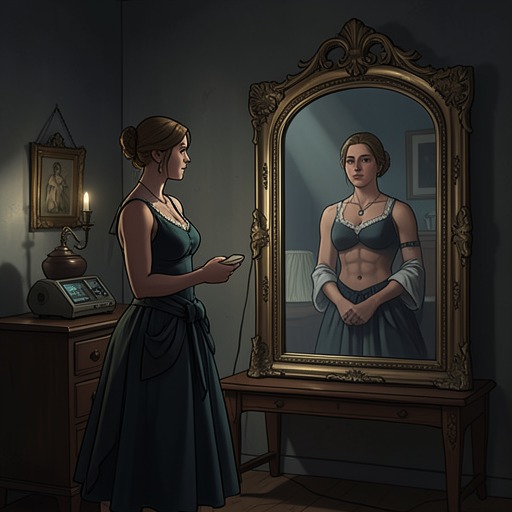
After learning from Lord Phraeon that Clara may be the child of the missing Empress and was hidden in 1987, Clara becomes physically and emotionally overwhelmed. She tries to leave the dancefloor, lifting the skirt of her black silk dress as she turns away in search of somewhere quiet. Louise reaches out to touch her arm and asks whether she is all right. When Clara responds by shaking her head with tears hot in her eyes, Louise immediately leaves Terri and comes to her aid.
Louise’s intervention is deliberately simple but decisive. She suggests that they go somewhere to talk and looks for a balcony or another private place away from the ballroom. Her concern gives Clara an alternative to the competing male claims surrounding her. Instead of interpreting Clara’s tears as weakness, seduction, or evidence that Clara should submit to protection, Louise treats them as a sign that Clara needs companionship and space.
The attempt to find privacy is cut short when Prince Octavius addresses them in a marble corridor. Louise becomes anxious when he stops them, while Clara recognizes that she cannot tell him what Lord Phraeon has revealed: Clara now understands herself to be connected to the imperial family and therefore, unwillingly, an enemy of Octavius’s father, the Emperor. Louise cannot remove Clara from the palace, but her presence makes Clara’s first effort to withdraw a shared act rather than an isolated escape.
Friendship and Practical Care
Louise asks who the man dancing with Clara was and identifies Lord Phraeon as the person associated with the kidnapping of Clara and her friends. Her alarm shows that she understands the immediate danger beneath the palace’s elaborate etiquette. She also asks how Phraeon has avoided arrest. Clara explains that Darius Constantine cannot arrest him because there is no proof against him and because he sits on the Emperor’s Council of Advisors.
This exchange establishes Louise as someone who tests the palace’s official appearance against what she and Clara have experienced. The beautiful ball, its gothic clothing, and its strict hierarchy do not reassure her; they coexist with kidnapping, political immunity, and male coercion. Louise’s questions help articulate the contradiction that Clara is struggling to process: the palace presents itself as ordered and civilized while leaving dangerous figures protected by office.
Louise also voices astonishment at the physical and cultural setting. She finds it strange that the group is underground in London, that the future has produced eleven levels so far, and that people once again dress and speak like gothic Victorians. Her astonishment supplies a grounded human response to Londinium’s fantastic scale. Clara answers that Octavius says more levels are planned and that Londinium is not the only city. Louise’s teasing remark about Clara being on first-name terms with the Prince briefly restores the rhythm of ordinary friendship, even though the conversation occurs inside an extraordinary and threatening world.
Relationship with Clara and the Court
Louise’s relationship with Clara is based on recognition rather than possession. When Clara is distressed, Louise does not speak over her or claim authority over her choices. She asks whether Clara is all right, offers to talk, and follows Clara’s attempt to leave. Her support is especially significant because Clara has just objected to being discussed as though she were an object to be owned. Around her, Darius, Lord Phraeon, and Prince Octavius are drawn into a struggle over Clara’s body, lineage, and supposed destiny; Louise’s conduct instead acknowledges Clara as a person whose feelings and decisions matter.
When Octavius says he will take Clara somewhere private to rest, Louise accepts the arrangement because she sees genuine warmth and concern in him and because Clara does not disclose the political secret now burdening her. Louise tells him she is sure she is leaving Clara in good hands, curtsies, and departs. This moment contains both trust and limitation. Louise helps secure a private space for Clara, but she cannot know that Octavius is the son of the man who would have Clara killed if her identity were known, nor that Octavius himself describes Clara as his property and threatens to fight Darius to the death for her.
Her departure also leaves Clara exposed to the court’s intimate power. Octavius comforts Clara, touches her face, and questions her tears while Louise is no longer present. Louise’s support has created a temporary passage from public embarrassment to privacy, but it cannot by itself protect Clara from the coercive claims that follow her into that private setting.
Contrast with the Male Claims on Clara
Louise’s role becomes clearer through contrast. During the dance, Clara struggles against Lord Phraeon while everyone watches, and Darius Constantine glares at Phraeon with murderous anger. Later, Prince Octavius insists that the rules must be followed and tells Darius to calm himself while the conflict over Clara continues. The men’s apparent protection is inseparable from rivalry, ownership, and the threat of violence.
Louise offers a different form of care: she notices Clara’s crying, moves toward her, asks questions, and tries to remove her from the audience. That care does not resolve the political revelation or the Taleian systems governing mate selection and bonding. It nevertheless gives Clara a brief counterspace in which her distress is not immediately converted into evidence for someone else’s claim.
Louise’s limited knowledge is also narratively important. Clara is unable to tell her the truth about her heritage, so their friendship operates under an unequal burden of information. Louise knows that Lord Phraeon may have been involved in the kidnapping and sees that Clara is upset, but she does not know that Clara may be the lost Empress’s child or that the Taleian history includes the Book of Talus, psychic bonds, blood-bonding through a bite, and a struggle among fated or aspiring mates. Her loyalty therefore precedes full understanding, making it practical and personal rather than dependent on political allegiance.
Narrative Role and Significance
Louise anchors the palace sequence in ordinary emotional ethics. The setting offers mirrors, gold statues, burning candles, crystal chandeliers, mythological frescos, and a ballroom the size of a football field, but Clara’s crisis is not solved by spectacle or ceremony. Louise’s hand on Clara’s arm and her invitation to talk are small gestures that resist the palace’s tendency to make every relationship public, hierarchical, and ceremonial.
She also helps expose the gap between a society’s ritual language and its treatment of vulnerable people. The court speaks in terms of ladies, princes, rules, consolation, and proper conduct, yet Clara is held against her will, watched while she cries, and later told that she belongs to a powerful man. Louise’s response does not erase those structures, but it makes their violence legible. By moving toward Clara when others merely watch, she converts sympathy into action.
Louise’s final confirmed action in this sequence is to trust Octavius’s assurance, curtsey, and leave Clara with him. The decision is not presented as a completed solution; it is a temporary handover made within conditions Louise does not fully understand. Her significance lies in the tension between that limited protection and the escalating danger around Clara. Louise cannot control Londinium’s court, arrest Lord Phraeon, reveal Clara’s identity, or stop the competing claims of Darius Constantine and Prince Octavius. She can, however, recognize Clara’s suffering and stand beside her before the palace turns that suffering into another instrument of power.