Six-duel bonding requirement
His Property (A Dark Vampire High School Bully Romance) (Vampire Boy Swords): Prince of Londinium (Dead Sun: Prince of Londinium (A Dark High School Bully Romance) (Vampire Boy Swords) Book 1)The Six-duel bonding requirement is the lethal courtship rule that determines whether a Taleian mate bond may reach its consummation. It requires the designated male mate to fight six sword duels against challengers before he can join with the female by blood and claim her through the ritual bite. In the palace scenes, the rule transforms desire into procedure: a kiss, a claim, or a threatened bite cannot by itself complete the bond, because victory in all six contests must come first.
Definition and Ritual Function
The requirement forms one stage of the broader Taleian bonding system. A mate is selected through the Book of Talus, which records a child’s fated partner at birth. Once the two designated mates recognize one another, several duels are required before they can be joined by blood; those contests establish a psychic bond in which their thoughts flow as one. The six-duel requirement therefore stands between psychic recognition and physical consummation. It is not merely ceremonial combat but the condition that permits the male to bite the female and mark the union.
The final act carries a distinctly possessive physical meaning. Prince Octavius explains the ritual while holding and caressing Clara Driscoll’s wrist, then presses his incisors against her skin without puncturing it. The threatened bite makes the rule tangible: the bond would be sealed through blood, while the bite would also brand Clara as the winner’s mate. The sequence links inward mental union, sword combat, blood, and bodily marking into one escalating process.
Stakes of Losing
The rule is dangerous because the challenger’s defeat is not simply a romantic setback. When Clara Driscoll asks what happens if the intended male loses or is killed, Prince Octavius explains that she is lost to the victor. The winning man becomes the one with whom she must spend eternity, even though she will not love him as she loved her true mate. The rule thus converts the death of one contender into the forced reassignment of the woman’s future.
Its cruelty is intensified by the permanence attached to the outcome. The defeated mate cannot merely withdraw and leave Clara free, while Clara cannot determine the result by affection alone. The stated tradition makes her the prize of a contest between men, and the language of winning and claiming places her autonomy under pressure. The rule’s emotional logic is consequently in conflict with Clara’s explicit resistance to being treated as property.
Conflict at the Palace
The requirement becomes an immediate obstacle during the confrontation between Prince Octavius and Darius Constantine. Octavius feels a pull toward Clara from the moment he sees her and says that his consciousness has reached the edge of her mind, where he intends to establish the bond. He claims that Darius is also present there and declares that he will fight to the death to win Clara and rule her. His attempted kiss and threatened bite are presented as efforts to stake a claim before the required contests have occurred.
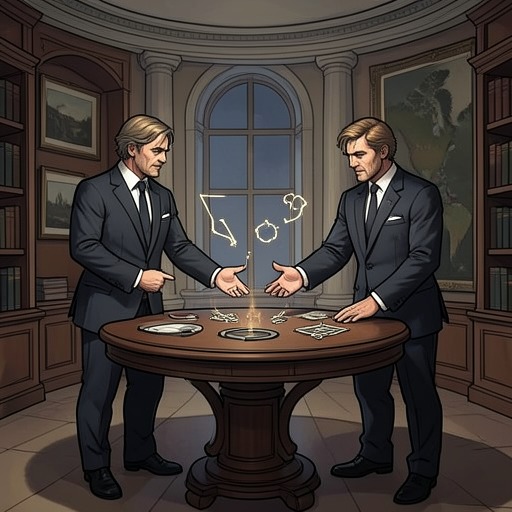
Darius intervenes at the moment Octavius raises his mouth to bite Clara. He pulls her away and holds her against him while Octavius bares his incisors and hisses. Darius then invokes the rule directly, telling Octavius that if he intends to participate in the ritual, he must follow its conditions: the challenges must be fought before the winner can claim Clara with his bite and brand. The rule gives Darius’s intervention more than personal jealousy; it supplies a recognized procedural objection to Octavius’s immediate attempt to mark her.
Octavius does not accept the restriction peacefully. After Darius invokes the required order of events, Octavius proposes that they fight immediately. The confrontation therefore shifts from threatened possession to the possibility of formal combat, with Clara’s safety and future positioned between the two men. Her protests remain clear throughout: she tells Octavius to let her go and rejects the idea that he can brand her with his bite. The rule may regulate the ritual, but it does not erase the coercion surrounding the claims.
Relation to the Taleian World
The six-duel system belongs to a heritage that the ruling order has tried to suppress. Prince Octavius describes the ancient Taleians as divided into clans, governed by Queen Morrigan, and guided by the Book of Talus in the selection of mates and advisors. He also says that his father, the Emperor, rejects reminders of the Empress’s rule and has forced the old practices into muted forms. The contemporary ritual is therefore both a surviving custom and a sign of historical resistance to imperial control.
The rule also operates within a society shaped by hybrid blood. Taleian men joined with human women after the Taleians could no longer reproduce among themselves, producing Taleian-human hybrids whose vampire form awakened later in life and whose bodies never appeared older than twenty-five. Prince Octavius identifies psychic gifts in Clara Driscoll and says that she has not yet completed the change into a vampire. Her uncertain biological status makes the bonding requirement personally consequential: an inherited system that Clara did not know existed is already being applied to her body and future.
Narrative Significance
As a narrative device, the requirement combines a love rivalry with a battle structure. The rule promises that the competing claims of Prince Octavius, Darius Constantine, and other interested men cannot be settled by declaration or seduction alone; they must be tested through repeated, potentially fatal contests. It also creates a sharp contrast between the language of fate and the reality of force. The Book of Talus may designate a mate, and psychic attraction may announce a connection, but the social ritual still demands that a man win Clara through violence before he can seal the bond.
The rule’s dramatic power comes from that contradiction. It presents combat as the lawful path to union while Clara repeatedly resists the property-based logic of being won, taken, or branded. Lord Byron Phraeon’s public kiss and promise to make Clara his bride foreshadow the same possessive pattern, but Darius’s intervention reveals that even such claims are supposed to be constrained by ritual order. The Six-duel bonding requirement therefore serves simultaneously as world-building, a source of rivalry, and an ethical fault line: it gives the supernatural courtship a coherent structure while exposing how little space the tradition leaves for Clara’s consent.