Taleian Bonding Ritual
His Property (A Dark Vampire High School Bully Romance) (Vampire Boy Swords): Prince of Londinium (Dead Sun: Prince of Londinium (A Dark High School Bully Romance) (Vampire Boy Swords) Book 1)The Taleian Bonding Ritual is the inherited institution through which a designated mate is identified, psychically joined, and ultimately claimed through blood. Although the Emperor has restricted its ancient form, the ritual remains powerful enough to govern desire, rivalry, political legitimacy, and the threat surrounding Clara Driscoll. Its rules make romance inseparable from combat and possession: a mate must establish a psychic bond, defeat six designated challengers, and receive the final bite and brand before the union can be consummated.
Origins and Historical Setting
The ritual belongs to the ancient Taleians, one of two races who inhabited ancient Briton before the Roman invasion; the other was the Druids. Taleian society was divided into clans and ruled by Queen Morrigan, the first ruler of the first Royal Clan, whose consort and Knight of Swords was drawn from the Breannin Clan, the second royal clan that also supplied her knights. The arrangement joined sovereignty, military protection, and mating within a single inherited order.
Mate selection did not begin with personal choice. At a child’s birth, the magical Book of Talus revealed the child’s name and placed beside it the name of the designated fated mate. No one knew how the book made its selection. The ritual therefore presents destiny as something written into the community’s records before either partner can consent to or reject it, giving a supernatural text authority over intimate and dynastic life.
The institution developed under the shadow of the Druid curse. Jealous of the Taleians’ lands, Queen, and warrior-advisor, the Druids transformed the Taleians into Vampires, provoking blood lust and turning members of the afflicted people against one another. Druid and human persecution scattered the clans across the world. The Queen and the Knight of Swords were murdered while attempting to aid their people with the help of the Magician, the Queen’s magical advisor.
The later history of the Taleians further complicated the ritual’s meaning. They became unable to reproduce among themselves, while Taleian men formed unions with human women and produced Taleian-human hybrids. These children did not assume their true vampire form immediately; they underwent a small death before awakening later in life, or when their bodies judged the time suitable, and thereafter appeared no older than twenty-five. The ritual thus survives not merely as a courtship custom but as part of a damaged lineage whose reproduction, inheritance, and supernatural identity have all been shaped by violence.
Rules and Physical Process
The ancient form of the ritual requires several duels before the two fated mates can be joined by blood. These combats establish a psychic bond, allowing the partners’ thoughts to flow as one. The bond is therefore both mental and juridical: it marks the relationship as more than attraction, while also preparing the basis for a later physical claim.
The decisive bodily act is the male’s bite. After the psychic connection has been formed, the male bites the female, and the final union is represented through blood, bite, and brand. The claim is not complete merely because one person announces it. As Darius Constantine explains, the challenges must be fought before the winner can claim Clara Driscoll with his bite and brand. A declared intention is consequently weaker than ritual performance; possession becomes legitimate only when the required sequence has been fulfilled.
The requirement is exact: six sword duels must be fought against designated challengers to the bond. The mate must win every duel to keep the prize. If he loses and is killed, the woman is lost to the victor and is forced to spend eternity with the man who won. The rule makes the woman’s future depend on a contest fought by men, while also ensuring that the ritual carries lethal stakes rather than symbolic ceremony alone.
The consequences are described as emotionally cruel as well as physically coercive. A woman who is transferred to the winner cannot love him as she loved her true mate, yet remains bound to him for eternity. The ritual therefore treats supernatural compatibility as permanent while leaving emotional fulfillment uncertain. Its promise of fated union contains the possibility of lifelong dispossession.
Imperial Suppression and Muted Survival
By the time of the narrative, the ritual has been weakened by an order from the Emperor. Prince Octavius says that the practice remains the same in origin but has become dampened in recent times, and that his father would not approve of discussing it. The imperial regime suppresses the old form while failing to erase its attraction or authority. What survives in Londinium is a muted version, adapted to a society in which ancient Taleian inheritance has been placed under centralized rule.
The Emperor’s opposition is political as much as administrative. Octavius claims that his father wants no reminder of the Empress’s rule, the order under which the hybrids helped their people survive and evolve, or the aliens who later joined their people. The Empress possessed the DNA strands of all their people and governed with the Five Princes, while the Book of Talus supplied mates and advisors to guard her power and keep her safe. The imperial rejection of the old ritual is therefore also an attempt to suppress an alternative history of legitimate rule, collective ancestry, and protected female sovereignty.
Octavius characterizes the Emperor as cruel and jealous and accuses him of murdering the Empress, her child, and the Princes. Against that erased order, the ritual preserves a memory of older institutions: the magical book, the royal clans, the warrior consort, and the female ruler whose authority was supported by designated bonds. Its persistence gives private courtship the force of political remembrance.
The Ritual at the Palace Ball
The ritual becomes an immediate source of conflict at the Emperor’s Palace in the underground city of Londinium. During the ball, Byron Phraeon leads Clara Driscoll across the wooden dance floor and publicly behaves as though he has acquired a legitimate claim over her. He insists that he has staked his claim under the Rule of courtship, even though the act he relies upon is a kiss on the cheek. Clara rejects the implication with contempt, asking whether such a kiss can truly constitute a claim.
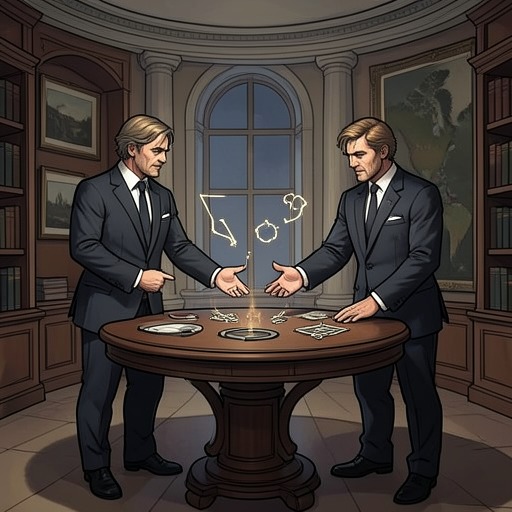
Darius Constantine disputes Byron’s interpretation. He calls the ancient practice inappropriate in its present setting and argues that Byron has not initiated a bond to claim Clara. The disagreement exposes two competing uses of the ritual: Byron treats its muted public form as sufficient for possession, while Darius insists that the underlying requirements still govern any valid claim. Clara’s body becomes the disputed ground on which those interpretations are tested.
The ballroom’s spectacle intensifies the ritual’s public character. It is the size of a football field, lined with tall mirrors and gold statues holding burning candles, beneath crystal chandeliers and frescoes depicting figures from Greek myths. Guests watch while Byron retains Clara despite her distress and struggle. The ceremony of courtship is thus inseparable from social witnessing: the claim gains theatrical force because the court sees it, even as Clara experiences the scene as humiliation and confinement.
The contrast between ceremony and refusal is central. Clara asks Byron to let her go while trying to recover from the revelation that she may be the lost child of the Empress, stolen and hidden in 1987. Her tears, embarrassment, and attempt to escape show that the ritual’s language of destiny does not erase her immediate resistance. Byron’s smug confidence and Darius’s opposition turn an inherited bonding practice into an open contest over whether Clara’s will has any authority within it.
Clara Driscoll and the Unfinished Claim
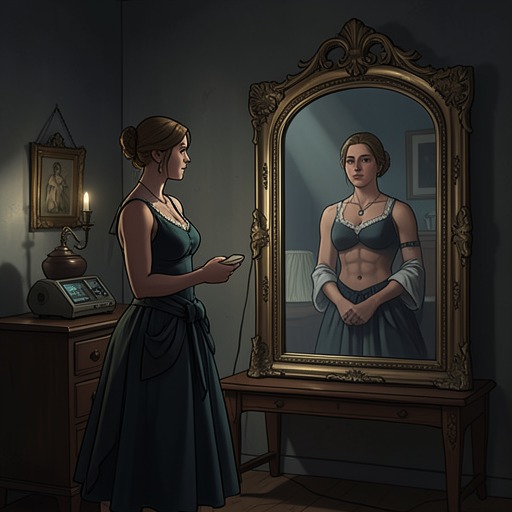
Clara is not simply an outsider observing the ritual. Darius senses that she possesses the psychic gifts of a Taleian hybrid, although she has not yet completed the change into a Vampire. This unfinished biological condition makes her both evidence of the lost lineage and a participant whose body has not fully entered the supernatural order that the ritual presupposes.
The revelation of Clara’s ancestry transforms the ritual from an abstract historical curiosity into a threat directed at her future. She learns that her apparent life in 1987 may have been constructed around false memories, that James Driscoll was not her true father, and that she may be the lost Empress’s child. Her identity is therefore entangled with the same royal and hereditary system that determines mates. The discovery of bloodline and the demand for bonding arrive together, making genealogy feel less like liberation than capture by an older law.
Octavius claims to have felt a pull toward Clara from the moment he saw her. He says that his consciousness has moved naturally to the periphery of her mind and that it is only a matter of time before he breaches it and establishes the bond. His claim treats psychic connection as inevitable, but the narration places it beside Clara’s uncertainty and alarm. The ritual’s promise of mutual thought does not begin with mutual agreement; it begins with one party approaching the other’s mind.
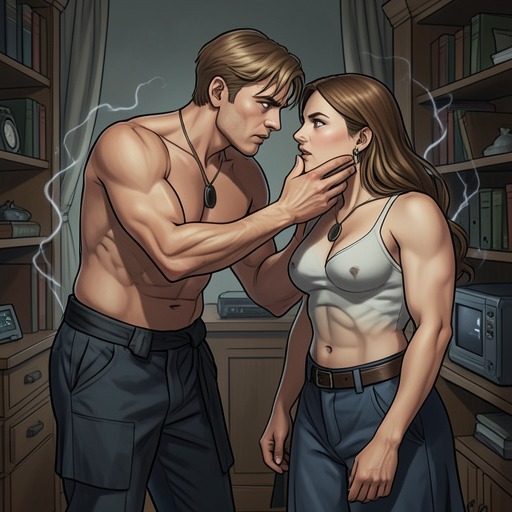
Octavius also embraces the violence built into the ancient system. He describes the prospect of fighting challenges or duels to keep his prize as invigorating and speaks possessively while touching Clara’s wrist. His attraction to the ritual is therefore a desire for both intimacy and ownership. The physical gestures surrounding the explanation, including his kisses and the pressure of his incisors against her wrist, make the future bite and brand palpable without completing them.
Darius takes a different position but remains inside the same structure. He holds Clara in place, reacts with fear for her safety, and refuses to release her while Octavius threatens confrontation. He insists that the challenges must precede any bite and brand, yet his defense still treats Clara as the object of a regulated claim. The ritual consequently produces no simple opposition between coercion and protection: both men act through a system that gives them authority to contest her possession.
Interruption and Narrative Significance
The ritual remains incomplete because the necessary psychic bond has not yet formed between Clara and the competing men. Darius states that the time for a duel has not arrived because he, Octavius, and the other challengers have not established a bond with Clara’s mind. The six-duel sequence is therefore postponed at the precise moment when rivalry threatens to become physical combat.
Before the confrontation can proceed, the ground beneath the group shakes violently. A second shock threatens to throw them from their feet, followed by a flash of blue light and a loud bang that sends everyone crashing to the floor unconscious. The interruption suspends the ritual at its threshold: the claims have been spoken, the rules have been explained, and the contestants are poised for violence, but no bond, duel, bite, or brand has been completed.
As a plot mechanism, the Taleian Bonding Ritual converts hidden history into an immediate test of identity and power. It links the Book of Talus to the body, the body to the bloodline, and the bloodline to the palace’s political struggle. Its recurring language of claiming, winning, and keeping a prize exposes the ethical conflict beneath the romance: destiny may promise recognition, but the ritual’s surviving forms repeatedly place Clara’s autonomy under pressure. The book ends with that conflict unresolved, leaving the promised duels and the consequences of Clara’s awakening for the continuation of the story.