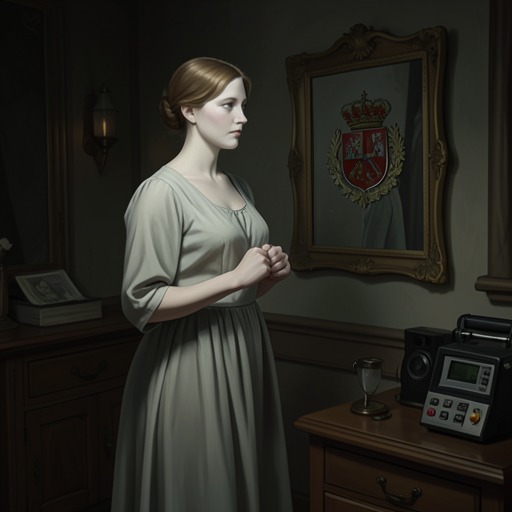
Taleian hybrid age constraint
His Property (A Dark Vampire High School Bully Romance) (Vampire Boy Swords): Prince of Londinium (Dead Sun: Prince of Londinium (A Dark High School Bully Romance) (Vampire Boy Swords) Book 1)The Taleian hybrid age constraint is the rule that separates a Taleian-human hybrid’s chronological age from the visible age and supernatural condition of the body. A hybrid may remain outwardly human until later in life, or until the body itself determines that the change is suitable; the transition includes a small death before the hybrid awakens into a true Taleian Vampire. Once awakened, the hybrid always appears no older than twenty-five. The rule therefore makes maturation a biological and inherited event rather than a predictable process measured simply by years.
Origin in Taleian History
The constraint belongs to the wider history of the Taleians, whose society was divided into clans and governed by Morrigan, the Queen of the first Royal Clan, alongside a Knight of Swords from the Breannin Clan. The Taleians possessed distinct gifts: their men were renowned warriors with exceptional strength and sword skills, while their women possessed powerful psychic abilities. Their reproductive history was transformed by the curse imposed by the Druids, who changed the Taleians into Vampires and drove them from their lands after the resulting blood lust and human persecution scattered the clans across the world.
The curse also altered the conditions under which the Taleians could continue as a people. The Taleians were unable to reproduce among themselves, so Taleian men formed relationships with human women and produced hybrids. This mixed origin is essential to the age constraint: the hybrid body carries Taleian inheritance but does not immediately express its full Vampire nature. The rule is thus part of a larger history of forced adaptation, survival, and dependence on human bloodlines rather than an isolated supernatural characteristic.
Operation of the Transformation
A Taleian-human hybrid does not necessarily become a Taleian Vampire during childhood or at a fixed age. The true form may emerge later in life, or when the body judges itself ready. Before awakening, the hybrid may therefore be mistaken for an ordinary human even while carrying psychic or biological signs of Taleian descent. The transformation is described as a small death, making the passage from one condition to the other a literal rupture rather than a gradual change that outsiders can easily observe.
The post-transformation appearance is equally significant. An awakened hybrid always appears no older than twenty-five, regardless of later experience or chronological age. The rule fixes the visible body within a youthful limit and creates a permanent distinction between outward appearance and lived time. It also means that age cannot be reliably inferred from appearance among the Taleian descendants: a body that looks young may have passed through a deathlike awakening and possess the powers, history, and social status of a mature Vampire.
Clara Driscoll and Delayed Awakening
The rule becomes personally consequential when Octavius identifies Clara Driscoll as more than an ordinary human. He senses that she possesses the psychic gifts of a Taleian hybrid, but also states that she has not yet completed the full change into a Vampire. Clara is therefore positioned in an unstable intermediate state: her inheritance is active enough to be perceived by a Prince, yet her transformation remains incomplete and unavailable to her own understanding.
This revelation follows the disclosure that Clara is the child of the lost Empress and was hidden in 1987, centuries before Londinium existed. At the ball in the Emperor’s Palace, the discovery destroys the apparent continuity of her life. She realizes that the memories and family assumptions on which she relied were false, and that James Driscoll was not her biological father. The age constraint intensifies this crisis because Clara’s body has not yet visibly confirmed the identity that her bloodline and psychic abilities imply.
Clara’s chronological age also sharpens the danger of the rule. She insists that she is only seventeen and is not ready to be claimed by any man. Her statement places a clear boundary between her present human life and the adult reproductive, political, and ritual expectations imposed on her by Taleian society. Octavius nevertheless treats her hybrid status as evidence that the inherited process has already begun, even though Clara has neither chosen nor understood it.
Ritual, Consent, and Political Pressure
The age constraint operates alongside the Book of Talus and the Taleian mating ritual. The Book of Talus designates a mate for a child at birth, while the ritual requires several duels before the fated pair can be joined by blood and establish a psychic bond. Once that bond exists, their thoughts flow as one; the male bite is presented as the act that precedes the final union. These rules convert bodily maturation into a matter of social and romantic claims, especially when a hybrid’s hidden inheritance is recognized before the hybrid has awakened fully.
Octavius uses Clara’s unfinished transformation to argue that she cannot protect herself and that he must protect her from challengers. He tells her that she now belongs to him and promises to protect her, while Clara rejects the idea that protection gives him authority over her. His certainty rests on a collision between inherited custom and personal consent: the Taleian order treats destiny, psychic attraction, and ritual obligation as binding, whereas Clara insists that her age and unreadiness must matter.
The physical encounter reinforces that conflict. When Clara tries to pull away, Octavius restrains her, and she experiences a confusing mixture of resistance, involuntary surrender, and attraction to his strength. The narrative does not present her bodily response as equivalent to free agreement; instead, it places her uncertainty beside his claim that neither of them has a choice. The hybrid age constraint thereby becomes part of a coercive structure in which biological potential, supernatural destiny, political lineage, and desire are made to support one another.
Narrative and Thematic Significance
The rule gives Clara’s identity a delayed, bodily dimension. She is not simply told that she belongs to another race or royal lineage; she is told that her body has yet to complete the change that would make that lineage visibly and supernaturally legible. Her unfinished state preserves uncertainty, but it also leaves her vulnerable to interpretation by powerful men who claim to know what her body means before she does.
More broadly, the constraint embodies the Taleian history of hybrid survival. The union of Taleian men and human women produced descendants capable of carrying the species forward, but the resulting bodies do not fit a simple human or Taleian category. They mature according to an internal timing, pass through a symbolic death, and emerge with a fixed youthful appearance. The rule therefore makes hybridity both a survival mechanism and a source of social instability: it preserves the Taleian inheritance while preventing identity from being immediately visible, settled, or controlled by the person who bears it.