Werewolves
His Property (A Dark Vampire High School Bully Romance) (Vampire Boy Swords): Prince of Londinium (Dead Sun: Prince of Londinium (A Dark High School Bully Romance) (Vampire Boy Swords) Book 1)Werewolves are identified as one of the supernatural lineages carried within the population of the twenty-sixth-century world. Their significance lies in the novel’s refusal to treat humanity, vampirism, and other forms of life as cleanly separate categories: the survivors of a planet that has lost its sun are biologically layered descendants of several ancient and alien inheritances, with Werewolves forming one part of that hidden history.
Origins in the Ancient World
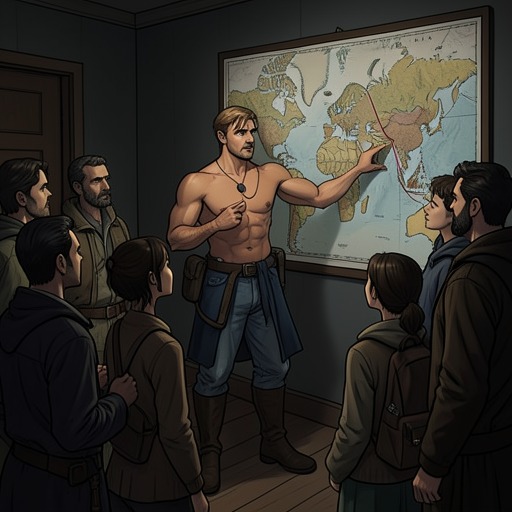
The history related by Prince Octavius begins with ancient Britain, before the Roman invasion, when the Druids and the Taleians were described as two distinct races. The Taleians possessed exceptional physical and psychic gifts: their men were renowned warriors with expert sword skills and extraordinary strength, while their women possessed powerful psychic abilities. Although this account focuses primarily on the Taleians, it establishes the wider prehistoric setting in which supernatural peoples existed alongside humans rather than emerging as a recent anomaly.
The Taleian catastrophe also shows how the world’s supernatural distinctions could be altered through violence. The Druids devised a curse that changed the Taleians into Vampires, driving them into blood lust and scattering them across the world after humans and Druids hunted them from their lands. Werewolves are not said to have undergone the same transformation, but they belong to the broader supernatural history that the official version of civilization conceals or simplifies.
A Dormant Genetic Strain
By the twenty-sixth century, Werewolves are part of a much larger inheritance present in the people of Londinium and the other cities of the broken world. Octavius explains that the population is descended from the Taleians and their hybrids, and that the ancient bloodline entered their DNA, where it remained dormant alongside strains derived from Lycans and other supernatural creatures that once inhabited the world. In this account, Werewolves are therefore not merely legendary beings from a vanished age; they are one of the latent biological forces carried forward into the post-solar future.
The term “Lycans” appears as another designation within this supernatural genealogy. The text does not provide a separate account of Werewolf customs, leadership, physical appearance, or individual representatives. What it does establish is their place in a mixed inheritance: Taleian, human, Lycan, and other strains coexist within the descendants of a civilization adapting to catastrophe.
Survival After the Sun’s Loss
The dormant supernatural strains have practical as well as historical importance. The world has become a frozen wasteland after losing its sun and now drifts aimlessly through space in search of a new one. According to Octavius, the inherited strains from Werewolves and other supernatural creatures were strong enough to help many survivors endure the frozen surface. Werewolves are thus connected to the physical survival of the species, even though the narrative does not isolate their contribution from that of the other lineages.
This survival history makes supernatural ancestry a foundation of civilization rather than an ornamental myth. The underground cities, including Londinium, are inhabited by populations whose capacity to persist in an impossible environment depends partly on bodies carrying dormant nonhuman inheritances. The boundary between “human” society and supernatural biology is consequently unstable: what appears to be a futuristic human population is, in genetic terms, a hybrid continuation of several older worlds.
Relation to Taleian Hybrids
Werewolves are mentioned in the same account that explains the emergence of Taleian-human hybrids. After the Druids’ curse, the Taleians were unable to reproduce among themselves. Taleian men therefore formed relationships with human women and produced hybrid children. These children did not take their true Taleian vampire form immediately; their transformation occurred later in life or when their bodies judged the time suitable, and they underwent what was described as a small death before awakening into that form. Their bodies also remained no older in appearance than twenty-five years.
The comparison is important even though the text does not claim that every hybrid carries a Werewolf strain. Both histories present identity as something latent, inherited, and revealed through bodily change rather than as a simple social label. Clara Driscoll is told that she possesses the psychic gifts of a Taleian hybrid but has not yet completed the change into a Vampire, demonstrating how the novel makes hidden biology a source of uncertainty, power, and political danger. Werewolves occupy the same broad conceptual field of dormant supernatural inheritance, but their own transformation process is not described in the available evidence.
Narrative Significance
Werewolves broaden the novel’s mythology beyond the immediate conflict among Clara Driscoll, the Taleian royal legacy, and the Vampire rulers of Londinium. The bloodlines embedded in the population expose a buried history in which curses, interbreeding, alien refuge, and environmental collapse have all reshaped what counts as human. Prince Octavius also states that a new alien strand entered the world’s blood after extraterrestrial refugees joined its people, further emphasizing that survival has produced a composite species rather than restored an original human purity.
As a result, Werewolves function primarily as evidence of the world’s layered genealogy. They are named but not individually dramatized; their narrative role is structural, showing that the future society’s apparent order rests on ancient transformations and mixed biological origins. Their presence helps turn the frozen world from a merely technological dystopia into a posthuman civilization whose survival depends on lineages that its rulers may suppress, deny, or selectively use.