26th century
His Property (A Dark Vampire High School Bully Romance) (Vampire Boy Swords): Prince of Londinium (Dead Sun: Prince of Londinium (A Dark High School Bully Romance) (Vampire Boy Swords) Book 1)The 26th century is the novel’s decisive future setting and the point at which concealed history becomes immediate personal crisis. In the Emperor’s Palace on Level One of the underground city of Londinium, Clara Driscoll learns that her identity, family, and apparent past have been shaped by events centuries earlier. The future is therefore not presented as a clean break from history: it is a controlled society whose institutions, bloodlines, rituals, and rivalries remain governed by unresolved ancient violence.
Setting and Social Order
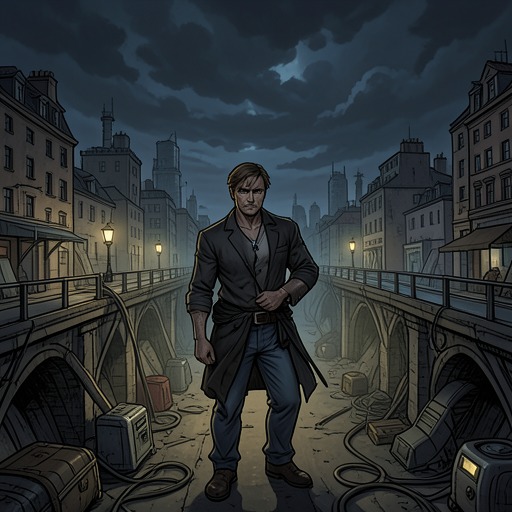
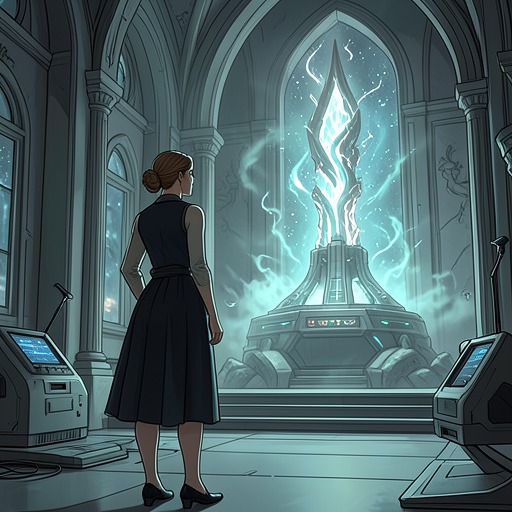
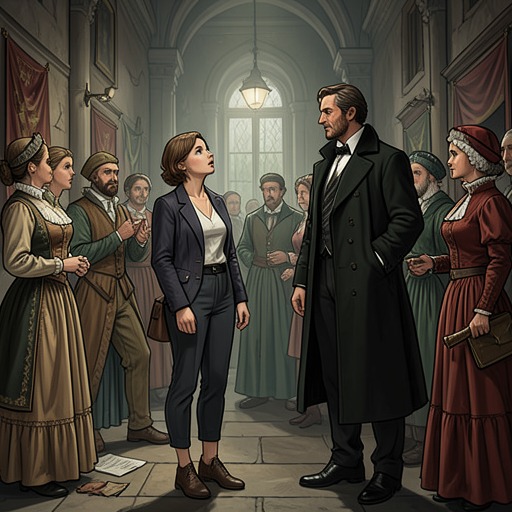
The opening chapter places the principal ballroom scene in the 26th century, inside the Emperor’s Palace on Level One of Londinium. The city is vast and underground, and the palace is illuminated only by moonlight, making the future simultaneously technologically remote and theatrically archaic. Its ball uses a wooden dance floor, eighteenth-century embroidered tail coats and waistcoats, gothic dresses, crystal chandeliers, gold statues holding burning candles, and frescoes depicting figures from Greek mythology. The setting combines futurity with inherited aristocratic display, presenting Londinium as a controlled underground Victorian cyber society rather than as a simple vision of technological progress.
The surrounding society includes humans who have evolved into or become associated with vampires, werewolves, demons, and other altered peoples. Its political structure is hierarchical and hereditary, centered on the Emperor, the imperial palace, the Five Princes, and the suppressed legacy of the Empress. The society’s modern appearance thus conceals older systems of rank and possession. Courtship, bloodline, supernatural inheritance, and political legitimacy continue to shape individual conduct even when the ruling order attempts to regulate or erase their origins.
Historical Depth and Concealed Past
The account given in the 26th century reaches back to ancient Briton, before the Roman invasion. The Britons were divided into the Druids and the Taleians, whose social organization included clans and a royal hierarchy. Taleian men were renowned warriors with exceptional sword skills and strength, while Taleian women possessed powerful psychic gifts. The first royal clan was ruled by Morrigan, who was mated with a Knight of Swords from the Breannin Clan, the second royal clan that also included her knights.
The Taleians’ history is preserved through the Book of Talus, a magical book that identifies a child’s fated mate at birth. The name of the child appears in the book alongside the name of the designated partner, although the mechanism behind this selection is unknown. In the 26th-century narrative, this ancient system is not merely a legend: it supplies the ideological foundation for contemporary claims over Clara Driscoll and helps explain why courtship can be treated as a political and bodily act rather than as private romance.
That history is also marked by persecution and demographic crisis. The Druids murdered the Queen and the Knight of Swords while they were attempting to help their people with the aid of the Magician, the Queen’s powerful magical adviser. A new Queen was not born until 1893, and she was the product of a union between a Taleian male and a human female. Because the Taleians had become unable to reproduce among themselves, Taleian men formed relationships with human women and produced hybrids. Taleian women were hunted by slavers, sold to humans, and sometimes taken for their flesh because it was believed capable of curing terminal illness. The future society therefore inherits a history in which survival, exploitation, interbreeding, and political succession are inseparable.
Clara Driscoll’s Displacement into the Future
For Clara Driscoll, the 26th century is initially an impossible world, but it becomes the setting in which the false stability of her life collapses. During the palace ball, Byron Phraeon reveals or confirms that she is the lost Empress’s child and that she was stolen and hidden in 1987, centuries before Londinium existed. Clara understands that the identity she had accepted as her own was constructed around a concealed displacement in time. Her belief that James Driscoll was her father and that her family history was ordinary is overturned, leaving her to reinterpret her memories as false or incomplete.
The shock is intensified by the fact that the revelation occurs publicly, while Byron Phraeon continues to lead her around the ballroom. Clara tries to pull away, struggles to breathe, and becomes unable to conceal her angry, hurt tears as the watching guests turn their attention toward the pair. The vast ballroom, with its mirrors, statues, chandeliers, and mythological frescoes, becomes a stage on which private identity is converted into public spectacle. Her movement from 1987 into the 26th century is consequently more than time travel: it is a forced entrance into a hereditary order that claims to know who she is and to whom she belongs.
Clara’s resistance remains explicit even after she begins to understand the implications of her origin. She says that she has just lost her home and does not belong in Londinium or in the period, much less to anyone there. Yet the narrative also records her recognition that this denial is not wholly truthful. The future produces a divided consciousness in her: she rejects its claims over her, while the revelations make it impossible to return psychologically to the life she believed she had lived.
Ritual, Power, and Possession in the Future
The 26th century preserves the ancient Taleian bonding ritual, although the Emperor has weakened or muted it. Byron Phraeon invokes the rule of courtship after kissing Clara on the cheek, claiming that he has staked his claim upon her. Darius Constantine rejects the validity of that gesture as a complete bond, explaining that the ancient ritual has not been properly initiated. The dispute shows how the future’s political authorities have attempted to suppress old customs without eliminating the desires and inherited impulses that sustain them.
Prince Octavius describes the ritual as a system in which challenges or duels may be fought to retain a mate. He regards the prospect of fighting for Clara as invigorating and presents himself as a skilled swordsman rather than the pampered prince imagined by the public. Because the Emperor has stamped upon the old heritage, those who still feel its pull must use muted ways of claiming a mate. The future thus converts an ancient ritual into a contested legal and social language: the characters disagree not over whether Clara is subject to the system, but over which man has properly activated it.
The imperial suppression of the past is political as well as ceremonial. Prince Octavius says that the Emperor wants no reminder of the Empress’s rule, of the period when hybrids helped the people survive their evolution, or of the aliens who joined with them. Under the Empress, the Book of Talus supplied mates and advisers for the Five Princes, who guarded her immense power and kept her loved and safe. Octavius characterizes the Emperor as cruel and jealous and accuses him of finding a way to murder the Empress, her child, and the Princes. The 26th century therefore rests on an official order built over an erased succession and a possible dynastic crime.
Narrative Significance
The 26th century functions as both destination and historical pressure chamber. It gives the novel its underground city, imperial court, supernatural social categories, and technologically transformed culture, but its deepest narrative function is to expose the persistence of the past. The future has not resolved the divisions between Druids and Taleians, the crisis of hybrid reproduction, the struggle over royal legitimacy, or the violence surrounding the Empress’s line. Instead, it has buried them beneath ceremony, architecture, and official suppression.
The period’s apparent sophistication contrasts with the coercive behavior that governs Clara’s arrival. In the palace, courtship claims are made through kisses, physical restraint, psychic influence, and threats of duels. Clara’s body and mind become the place where the 26th century’s competing histories meet: she is the hidden child of the murdered Empress, a possible heir to suppressed power, and the object through which ancient bonding rules are reactivated. The resulting conflict turns historical recovery into an immediate struggle over autonomy.
The novel leaves this future in suspension. When Clara refuses to go with the men claiming or protecting her, the ground shakes violently, a flash of blue light erupts with a loud bang, and the group is thrown into the air and rendered unconscious. The 26th century ends the first book not as a stable endpoint but as an unstable present, still subject to buried forces and unresolved succession. Its future remains open precisely because the history it tried to control has returned in Clara Driscoll.