Clara’s Hiding in 1987
His Property (A Dark Vampire High School Bully Romance) (Vampire Boy Swords): Prince of Londinium (Dead Sun: Prince of Londinium (A Dark High School Bully Romance) (Vampire Boy Swords) Book 1)Clara’s Hiding in 1987 is the concealed displacement that transformed a lost royal child into Clara Driscoll, apparently an ordinary young woman raised far from the future underground city of Londinium. Its decisive significance is that it does not merely move Clara through time: it obscures her parentage, replaces her history with false memories, and postpones the political consequences of the Empress’s murder until Clara reappears in the twenty-sixth century.
Identity Concealed Across Time
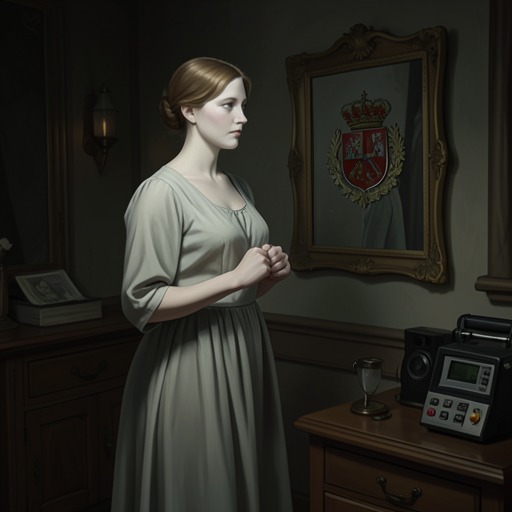
Clara learns at the Emperor’s Palace that she may be the child of the lost Empress and that she was somehow stolen and hidden in 1987, centuries before Londinium existed. The revelation overturns the structure of her remembered life. She understands that her memories have presented a false version of the truth, that the woman she called Mum was not her true mother, and that she had never been the child of James Driscoll. Her father’s apparent dislike, once an unexplained wound in her family life, becomes newly charged by the possibility that the family itself was part of the concealment.
The date 1987 gives the hiding a precise historical displacement. Clara’s own time becomes a refuge that is also an erasure: it protects her from the society that might recognize her, while depriving her of the knowledge needed to understand herself. When she remembers 1987 in Londinium, it remains emotionally intimate but historically unstable. She refers to it as her own time even as the future reveals that her belonging there was manufactured.
The Political Background
The concealment is inseparable from the violent history of the Taleians. Prince Octavius explains that the Empress possessed the DNA strands of all her people and had governed wisely with the Five Princes, whose roles were defined through the Book of Talus as mates and advisers who would guard her power and keep her safe. He also states that the Emperor found a way to murder the Empress, her child, and the Princes. Clara’s hidden survival therefore represents more than a private secret: it leaves a surviving claimant to a destroyed order.
That history also includes the murder of the Queen and Knight of Swords by the Druids while they were trying to help their people with the aid of the Magician, the Queen’s magical adviser. Afterward, the Taleians could no longer reproduce among themselves; their women were hunted by Taleian slavers and sold to humans, sometimes for their flesh, which was believed capable of curing terminal illness. Taleian men formed unions with human women and produced hybrids, whose true Taleian vampire form emerged only later in life or when their bodies deemed them ready. Clara’s apparent human identity thus conceals a lineage shaped by extinction, hybridization, and political violence.
Return and Recognition
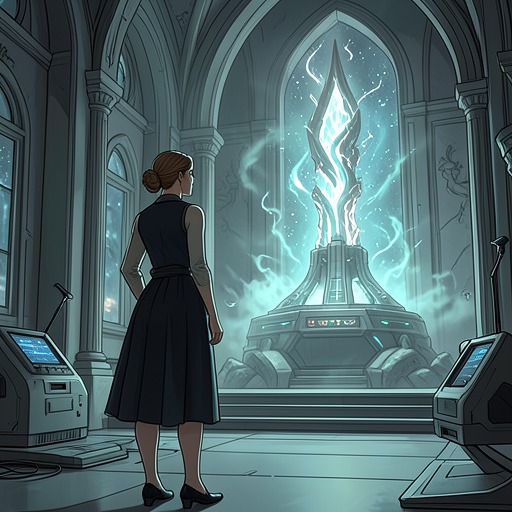
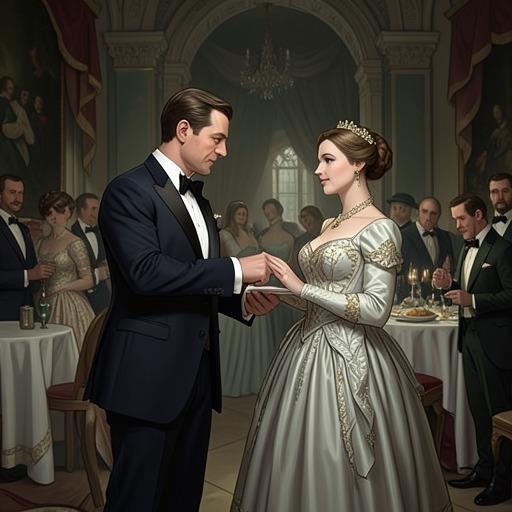
The consequences of the hiding become visible at the ball in the Emperor’s Palace on Level One of Londinium, where Lord Byron Phraeon leads Clara around the wooden dance floor beneath moonlight. As the possibility of her royal identity becomes clear, she feels that everything in her life has been a lie. The setting intensifies the reversal: the vast underground city, its ballroom the size of a football field, belongs to a future civilization utterly unlike 1987, yet it is there that Clara is forced to reinterpret the past she thought she knew.
Clara’s response is physical as well as intellectual. She tries to pull away from Byron, struggles in his hold, and asks to be released while tears gather despite her determination not to cry in front of anyone. The crowded ballroom watches the scene, including Louise Turner and Terri; Prince Octavius is taken aback, while Darius Constantine looks at Byron with icy anger. The public spectacle exposes how little control Clara has over the identity that has been imposed on her. When the music ends and Byron finally lets go, the interruption offers no resolution. Clara remains caught between the remembered safety of 1987 and the dangerous recognition awaiting her in Londinium.
Louise Turner becomes one of the first people to respond to the displaced girl rather than to the possible princess. When Clara leaves the dance floor in her black silk dress, desperate for somewhere quiet to think about her heritage, Louise asks whether she is all right and offers to talk. Clara cannot disclose the whole truth because she fears that she and her friends could be placed in danger. Her silence shows that the old concealment continues to operate after her return: even when the secret has begun to surface, Clara still has to manage who may safely know it.
Belonging, Possession, and Protection
Clara’s temporal displacement creates a crisis of belonging. She says that she has lost her home and does not belong in Londinium or in the present time, although she recognizes that the statement is not entirely true. She wants to go home and be safe, yet the revelation has made her former home uncertain: she is an orphan cast out from her real home and hidden in time. Her tears, which fall onto Octavius’s hand, make the emotional cost of the concealment tangible.
Her reentry into future society also turns recognition into a struggle over possession. Byron claims that his courtship gesture has staked a claim according to the rule of courtship, while Darius Constantine rejects the idea that the muted ancient Taleian bonding ritual he used is appropriate or that Byron has initiated a true bond. Clara objects to being discussed as though she were an object to be owned. The men’s competing claims convert her recovered identity into a public contest, even though the person most affected is still trying to understand what has happened to her.
Octavius frames his own claim as protection. He insists that Clara now belongs to him and promises to protect her from challengers, while Darius insists that the rules must be followed and tells Clara to calm herself. Prince Octavius grows ready for a fight and repeats that she belongs to him; Carter remains composed and offers to come and get her, but Clara signals him to stay back so that he will not be hurt. These reactions show how the hidden child’s return destabilizes the social order: protection, desire, law, and ownership are expressed through the same coercive language.
Narrative Significance
Clara’s Hiding in 1987 functions as a delayed identity revelation and as a form of temporal political control. The interval between the Empress’s murder and Clara’s discovery allows the ruling order to continue without the visible presence of its lost heir, while Clara grows up with no access to the history that would make her dangerous. Her return therefore reconnects a private biography to suppressed dynastic history.
The concealment also makes time itself a contested inheritance. Clara is emotionally attached to 1987, but that attachment was built inside an imposed life; Londinium is historically hers, yet it treats her as a newly discovered object of rivalry. The result is a deliberately unstable homecoming. Clara has survived because she was hidden, but survival has cost her family, memory, and certainty about where she belongs. Her movement from 1987 to the twenty-sixth century is consequently not a simple journey into the future. It is the moment when a buried past acquires a living body and begins to threaten the political arrangements that buried it.