Londinium
His Property (A Dark Vampire High School Bully Romance) (Vampire Boy Swords): Prince of Londinium (Dead Sun: Prince of Londinium (A Dark High School Bully Romance) (Vampire Boy Swords) Book 1)Londinium is the vast underground city in which the twenty-sixth-century society of the novel survives after the world has lost its sun and drifts through space in search of a new one. More than a refuge beneath London, it is a stratified political and cultural world where descendants of Taleians and their hybrids, along with dormant strains associated with Lycans and other supernatural beings, have adapted to a frozen surface and developed a controlled underground civilization. Its importance lies in the way it turns Clara Driscoll’s arrival into a collision with concealed ancestry, rewritten history, and inherited systems of power.
Setting and Physical Structure
Londinium exists beneath London as a layered underground city. Clara learns that it already has eleven levels, with further levels planned, and that it is not the only city of its kind. The city therefore appears not as a single sealed refuge but as an expanding network of subterranean settlements built to sustain human and supernatural descendants after the surface became uninhabitable.
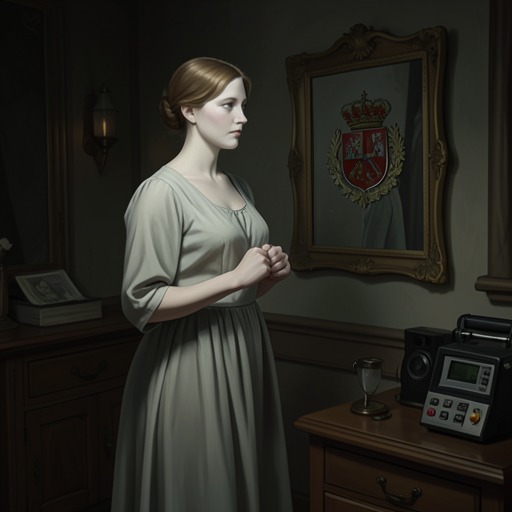
Its most prominent spaces combine advanced futurity with an intentionally archaic visual culture. The Emperor’s Palace stands on Level One, while a ballroom the size of a football field contains a wooden dance floor, tall mirrored panels, gold statues holding burning candles, crystal chandeliers, and a domed ceiling covered with vivid frescoes of figures from Greek mythology. The guests wear gothic ball dresses and long black eighteenth-century embroidered tail coats and waistcoats. Moonlight provides the ballroom’s only illumination during the dance, making the palace feel simultaneously futuristic, subterranean, aristocratic, and haunted by earlier civilizations.
Society and Historical Foundations
The history explained within Londinium traces its dominant bloodlines to ancient Briton before the Roman invasion. The Britons were divided into the Druids and the Taleians. Taleian men were renowned warriors with expert sword skills and exceptional strength, while Taleian women possessed extraordinary psychic gifts. Their society was divided into clans and governed by Morrigan, the Queen of the first Royal Clan, whose consort and Knight of Swords was traditionally drawn from the Breannin Clan, the second royal clan that also included her knights.
The Taleians’ social order was governed not only by royal authority but by the Book of Talus. This magical book revealed a child’s designated fated mate at birth, although no one knew how it operated. The associated bonding system required several duels before two fated mates could be joined by blood and establish a psychic bond; after the bond, their thoughts could flow as one, and the male’s bite completed the union. These customs survive in Londinium in muted or contested forms, even though the Emperor attempts to suppress reminders of the Empress’s rule and the old heritage.
The city’s inhabitants inherit a history shaped by catastrophe. The Druids, jealous of the Taleians’ lands and their beautiful Queen and warrior consort, devised a curse that transformed the Taleians into vampires and drove them into blood lust. Druids and other humans hunted them, forcing the clans to scatter across the world. Morrigan and the Knight of Swords were murdered while trying to aid their people with the help of the Magician, the Queen’s powerful adviser.
The later Taleian population could no longer reproduce solely among themselves. A new Queen was not born until 1893, and she was the child of a Taleian male and a human female. Taleian women were hunted by Taleian slavers and sold to humans for various purposes, including the use of their flesh as a cure for terminal illness. Taleian men consequently formed relationships with human women and produced hybrids. These children did not assume their true Taleian vampire form until later in life, or until their bodies judged the transformation suitable; the awakening involved a small death, and the hybrids thereafter appeared no older than twenty-five.
Political and Dynastic Conflict
Londinium is governed through the authority of the Emperor, whose rule is presented as a reaction against the earlier order associated with the Empress. The Empress carried the DNA strands of all the people and governed wisely with the Five Princes. The Book of Talus provided the Princes with their mates and advisers, who helped guard the Empress’s immense power and keep her protected and loved. According to Octavius, the Emperor was cruel and jealous and found a way to murder the Empress, her child, and the Princes.
That dynastic crime gives the city’s architecture and ceremony a political shadow. The palace ball presents inherited rank as spectacle, but the gathering also exposes unresolved claims to authority. Lord Phraeon invokes the rule of courtship to claim Clara after kissing her cheek, while Darius rejects the validity of that gesture as a genuine initiation of the ancient bonding ritual. Clara’s body and ancestry thus become matters of public and political contention within the palace, not merely private romantic concerns.
Londinium’s institutions also protect powerful figures from accountability. Lord Phraeon remains on the Emperor’s Council of Advisors, and Darius explains that he cannot arrest him because there is no proof of his wrongdoing. The city’s sophisticated structure therefore coexists with a system in which political position can obstruct justice and old violence can remain concealed behind official authority.
Clara Driscoll’s Encounter with the City
For Clara, Londinium is the place where an apparently impossible future becomes undeniable. At the palace ball, she discovers that she may be the child of the lost Empress and that she was somehow stolen and hidden in 1987, centuries before Londinium existed. The revelation destroys the continuity of her former life: the memories she had relied upon appear false, her presumed mother is no longer what she believed, and she understands that she was never James Driscoll’s child. Her sense of home collapses at the same moment that Londinium identifies her as a royal descendant.
The city intensifies this displacement through its customs. Clara has arrived from 1987 and does not belong to the period, the palace, or the society that surrounds her, yet she is drawn into a system that treats her as a fated mate and dynastic object. She protests that she has just lost her home and belongs neither in Londinium nor in the future, although she recognizes that this denial is not entirely truthful. The city’s claim upon her is therefore both external and psychological: it removes her from the world she knew while awakening a connection to a buried heritage.
Her reactions also reveal Londinium’s mixture of estrangement and familiarity. She finds the underground city insane and cannot believe that people in the future have returned to dressing and speaking like gothic Victorians. The spectacle is not simply decorative. By reviving older forms beneath a ruined surface world, Londinium makes history visible as costume, ritual, and social hierarchy while presenting that revival as the normal order of the future.
Narrative Significance
Londinium functions as a threshold between eras and identities. It links 1987 to the twenty-sixth century, ancient Briton to a technologically advanced underground society, and human memory to inherited supernatural history. Its layers spatialize the novel’s temporal structure: Clara descends into a city beneath London while also being drawn backward into the concealed origins of her bloodline and forward into a political struggle over the Empress’s legacy.
The city is also a refuge founded on survival but governed through coercive inheritance. Its people endure the frozen surface because ancient supernatural strains remain in their blood, and the city shelters descendants who might otherwise perish. Yet the same bloodlines dictate rank, mating, bodily transformation, and political legitimacy. Londinium consequently embodies a central contradiction of the setting: it preserves life after planetary catastrophe, but it also preserves the curses, dynastic crimes, and possessive rituals of the past.
For Clara, the city’s decisive meaning is that it converts hidden history into immediate pressure. The palace, the ball, the Book of Talus, the contested bonding ritual, and the claims of the princes all force her to confront a world in which identity is not solely personal or remembered. In Londinium, ancestry is a political fact, the body is evidence, and the future is built over histories that its rulers would prefer to suppress.