Taleian mating ritual
His Property (A Dark Vampire High School Bully Romance) (Vampire Boy Swords): Prince of Londinium (Dead Sun: Prince of Londinium (A Dark High School Bully Romance) (Vampire Boy Swords) Book 1)The Taleian mating ritual is the inherited system through which Taleian mates are identified, contested, psychically joined, and finally bound by blood. Although the Emperor has ordered its older form to be muted, the ritual remains powerful enough to govern courtship, shape aristocratic conflict, and turn Clara Driscoll’s uncertain heritage into an immediate struggle over bodily and emotional autonomy.
Origins and Mate Selection
The ritual belongs to the ancient Taleians, one of two races inhabiting ancient Briton before the Roman invasion; the other was the Druids. Taleian society was divided into clans and ruled by Morrigan, the Queen of the first Royal Clan, alongside a Knight of Swords drawn from the Breannin Clan, the second royal clan. The system therefore joins intimacy to dynastic order: the Queen’s consort is not merely a romantic partner but a warrior, adviser, and military leader.
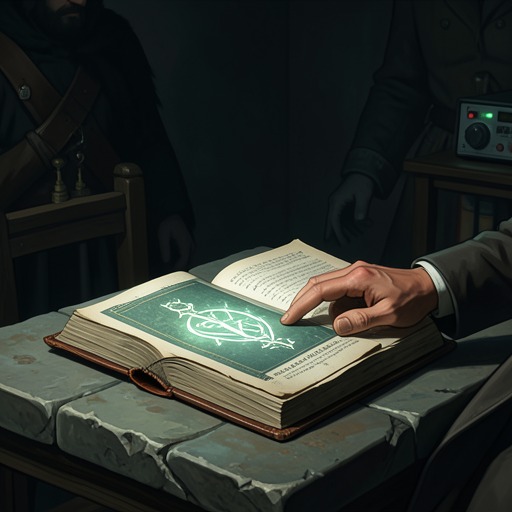
Mate selection begins before personal choice. The Book of Talus is described as a magical book whose writing reveals itself when a child is born. Beside the child’s name appears the name of the designated fated mate, although no one knows how the book produces its decisions. The ritual consequently presents partnership as a written destiny rather than a negotiation between equals, and its authority is embedded in birth, genealogy, and inherited political structure.
The history that gives the ritual its importance is also marked by catastrophe. The Druids, jealous of the Taleians’ lands and their royal household, devised a curse that transformed the Taleians into Vampires and drove them into blood lust. The Queen and the Knight of Swords were murdered while trying to aid their people with the help of the Magician, the Queen’s magical adviser. Afterward, Taleians could no longer reproduce among themselves. Their continued existence depended on unions between Taleian men and human women, producing Taleian-human hybrids whose full vampire form emerged only later in life or when their bodies judged the time suitable.
Operation of the Bond
In its older form, the ritual requires more than recognition by the Book of Talus. A prospective bond must be established psychically, allowing the partners’ thoughts to flow as one. Only after that connection exists can the male complete the union by biting the female. The bite is not simply an expression of desire: it is the physical act that consummates the psychic and blood-based bond and marks the mate’s claimed status.
The decisive obstacle is the requirement of six sword duels. Designated challengers must be fought before the bond can be consummated, and the mate must win every duel to retain the prize. The rule makes courtship a public contest in which the prospective male’s combat ability determines whether the relationship survives. If he loses and is killed, his mate passes to the victor and is forced to spend eternity with the man who won. The account explicitly describes this as cruel because the woman cannot love the victor as she loved her true mate, making victory both a romantic entitlement and a condition of preventing permanent emotional dispossession.
The ritual has been weakened in Londinium by order of the Emperor. Its suppression does not erase it; instead, it produces diminished or symbolic forms of claiming. Byron Phraeon argues that a kiss on Clara’s cheek has allowed him to stake a claim under the Rule of courtship, while Darius Constantine rejects that interpretation, insisting that the ancient Taleian ritual of bonding has not been initiated by such a gesture. The disagreement shows that the ritual functions as a contested legal and cultural code: its participants dispute not only whom Clara belongs to, but which act counts as a valid claim.
Conflict with Political Authority and Consent
The Emperor’s hostility is presented as political rather than merely personal. Prince Octavius explains that his father wants no reminder of the Empress’s former rule, under which the Empress governed with the Five Princes. The Book of Talus supplied mates and advisers who would guard the Empress’s immense power while keeping her loved and safe. By suppressing the ritual, the Emperor attempts to sever the surviving society from the institutions and bloodline associated with the Empress.
Octavius nevertheless claims that the old compulsion survives in the body. He says that his father can suppress the ritual and their true heritage, but those drawn to the old ways will continue to seek muted methods of claiming their mates. He further insists that the ritual is part of who they are and must not be mocked. His position treats inherited impulse as a source of legitimacy: because the desire to fight for a mate is embedded in Taleian descendants, political authority cannot permanently abolish it.
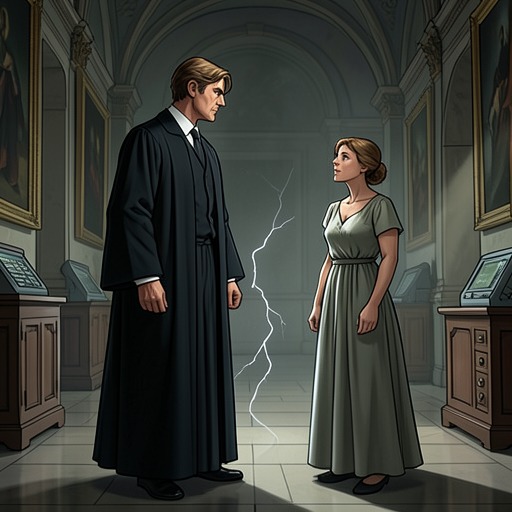
Clara challenges that legitimacy directly. When the men discuss her as though she were an object, she demands to be recognized as present rather than spoken about as property. She objects that women receive no say in the arrangement and declares that no one will dictate whom she spends eternity with. Her proposed solution is political reform: if she were Empress, she would change the ritual’s rules. The ritual thus becomes a conflict between communal tradition and individual consent, with Clara refusing to accept that antiquity or biological inheritance can settle her future.
Clara Driscoll and the Modernized Ritual
Clara’s position is complicated by her concealed ancestry. At the ball in the Emperor’s Palace on Level One of the underground city of Londinium, she learns that she is the lost Empress’s child and had somehow been stolen and hidden in 1987, centuries before Londinium existed. The revelation destabilizes her understanding of her family and memory, while the ritual immediately reclassifies her as a politically and romantically significant descendant.
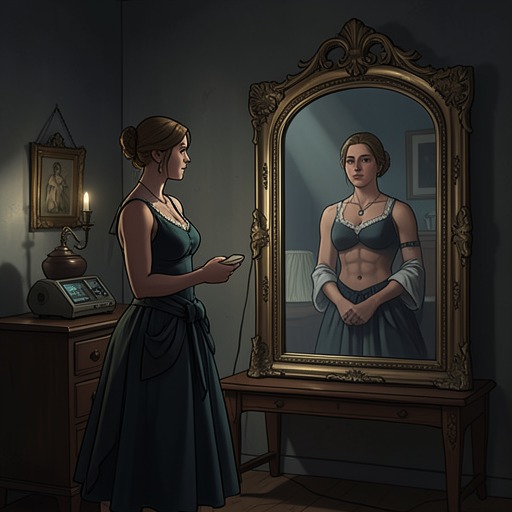
Octavius identifies psychic gifts in Clara characteristic of a Taleian hybrid, although he says she has not yet completed the change into a vampire. This unfinished condition places her between identities: human in her lived experience, hybrid by inheritance, and potentially Taleian vampire by bodily destiny. The ritual’s authority therefore operates through her body before she has accepted its meaning. Her incomplete transformation becomes evidence used by others to explain why she can be claimed, even as her resistance exposes the ethical weakness of treating latent ability as consent.
The ritual also intensifies the rivalry among the men around her. Phraeon publicly presents his cheek kiss as a courtship claim. Darius responds that the required bond has not been initiated, while later asserting that the challenges must occur before a winner can claim Clara with a bite and brand. Octavius, meanwhile, moves toward the physical act himself, opening his mouth and lowering his incisors to Clara’s wrist without puncturing it. The scene makes the ritual’s stages visibly threatening: flirtation can become possession, psychic connection can become surveillance, and a bite can transform desire into an irreversible mark.
Darius’s intervention introduces another version of the ritual’s modern rules. Speaking within Clara’s mind, he warns her not to believe everything Phraeon says, explains that the ritual has changed, and states that all of them now have the right to claim her as a mate. He says their bond came first and is currently the strongest, but that Clara may be capable of joining with more than one mate. The revised system therefore does not restore a single uncontested destiny; it expands the field of competing claims while leaving Clara surrounded by men who interpret her future for her.
Consequences and Narrative Significance
The ritual turns private attraction into a public and potentially violent spectacle. At the ball, Phraeon keeps Clara against him as she struggles and asks to be released, while the ballroom, with its tall mirrors, gold statues, burning candles, crystal chandeliers, and Greek myth frescoes, becomes an audience chamber for the dispute. Louise Turner and Terri watch, Octavius is taken aback, and Darius’s anger becomes visible as he glares at Phraeon. The ornate setting contrasts with the coercive logic beneath the ceremony: elegance and tradition provide a polished surface for possession and rivalry.
Its consequences extend beyond romantic tension. The ritual links Clara’s bloodline to the murder of the Empress and her child, to the vanished royal order, and to the survival of Taleian descendants across a frozen world drifting through space in search of a new sun. It is simultaneously a courtship practice, a hereditary memory, a mechanism of social legitimacy, and a remnant of a suppressed political regime. The same rule that promises fated union also preserves the history of conquest, slavery, forced reproduction, and the violent transformation of the Taleians into Vampires.
The ritual’s immediate climax remains unresolved. Clara refuses to go with any of the claimants, but Darius will not release her, and the men appear ready to fight. Before the confrontation can begin, the ground shakes twice; a flash of blue light and a loud bang throw everyone into the air and leave them unconscious. The interruption postpones the duels, the bite, and any decision about Clara’s consent. The ritual therefore closes the first book not as a completed union but as an active threat and an unfinished contest, carrying its claims, contradictions, and violence into the promised continuation.