Kidnapping of Clara and Her Friends
His Property (A Dark Vampire High School Bully Romance) (Vampire Boy Swords): Prince of Londinium (Dead Sun: Prince of Londinium (A Dark High School Bully Romance) (Vampire Boy Swords) Book 1)The Kidnapping of Clara and Her Friends is a crucial offstage action whose consequences shape the palace confrontation in the twenty-sixth century. Lord Phraeon is identified as the man who had Clara and her friends taken, yet the abduction has produced no arrest. Its unresolved status turns a past act of violence into a present threat: Phraeon can approach Clara openly, claim authority over her, and present coercive courtship as legitimate while the people around her debate rules and protection.
Recollection and Background
The kidnapping enters the narrative through Louise Turner’s alarmed recognition of Phraeon at the palace ball. When Clara identifies the man with whom she has been dancing as Lord Phraeon, Louise immediately recalls that he was the person who had them kidnapped. Clara confirms the connection, making the elegant ballroom encounter inseparable from the earlier crime.
The abduction is especially significant because it occurred within a power structure capable of suppressing accountability. Clara explains that Darius Constantine cannot arrest Phraeon because no one has proof that he was responsible. Phraeon also sits on the Emperor’s Council of Advisors, giving him institutional standing that protects him from the consequences of the kidnapping. The crime therefore remains both personally threatening and politically insulated.
The Kidnapping’s Return at the Palace
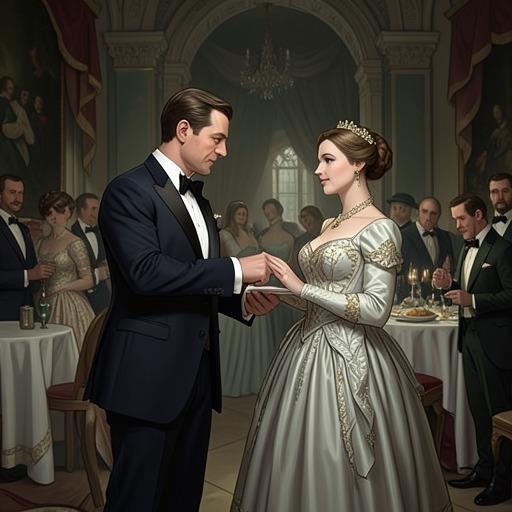
The earlier abduction is not treated as a closed episode when Phraeon appears at the ball. He continues to control Clara physically by leading her around the dance floor and holding her when she tries to pull away. His conduct forces the past into the present: the man associated with Clara’s disappearance now performs possession before the court, surrounded by dancers, mirrors, statues, candles, chandeliers, and watching nobles.
Clara’s distress is intensified by the setting and by the public nature of the encounter. The revelation that she is the lost Empress’s child has already made her question the truth of her life and her memories. Phraeon’s intervention turns that identity crisis into a spectacle, while his kiss on her cheek functions, in Clara’s understanding, like a brand intended to mark her before Darius Constantine, Prince Octavius, Carter, and the rest of the ballroom. Louise and Terri also watch, leaving Clara exposed before an audience the size of the grand hall itself.
Impunity and Competing Claims
Phraeon’s freedom allows him to convert alleged criminality into social power. He insists that the kiss has staked his claim according to the rule of courtship, even though Clara rejects the idea that she can belong to anyone as property. Darius Constantine intervenes and orders Phraeon to keep away from Clara, declaring that she is under his protection. The intervention removes Clara from Phraeon’s immediate grasp, but Darius does so by taking hold of her arm and pulling her behind him, repeating the bodily control that has already defined the scene.
The conflict is consequently not a simple opposition between a kidnapper and a rescuer. Phraeon claims Clara through courtship; Darius Constantine claims responsibility for her protection; Prince Octavius later declares that she belongs to him and promises to protect her from challengers. Clara repeatedly objects to being discussed as an object, yet the men continue to translate her danger into competing claims over her body and future. Protection becomes another language through which possession is asserted.
Consequences for Clara and Her Friends
The kidnapping leaves Clara and her friends without an effective legal remedy. Louise’s question about why Phraeon has not been arrested receives a structural answer rather than a personal one: the absence of proof and Phraeon’s position on the Emperor’s Council of Advisors make him difficult to challenge. Their survival or release has therefore not restored security. They remain inside a society in which status can neutralize suspicion and in which formal rules may protect the powerful more readily than the threatened.
For Clara, the consequences extend beyond fear of Phraeon. The kidnapping is part of a larger history of concealment and political violence surrounding her identity. She has been hidden in 1987, centuries before Londinium existed, and is now confronted with the claim that she is the lost Empress’s child. The palace scene links her personal displacement to the destruction of the former royal order: Darius Constantine recounts that the Emperor found a way to murder the Empress, her child, and the Five Princes. Whether considered as a direct crime against Clara’s friends or as part of the wider struggle over Clara’s inheritance, the abduction places her body at the intersection of suppressed history and dynastic power.
Narrative Significance
The kidnapping functions as a recurring pressure rather than a fully narrated past scene in the supplied episode. Its importance lies in what the characters’ recollection makes visible: Phraeon’s menace is not merely romantic aggression, and his conduct at the ball is not an isolated breach of etiquette. He is a figure already associated with taking Clara and her companions by force, yet he remains socially protected and able to invoke the very courtship rules that should regulate his behavior.
The episode also establishes a contrast between physical escape and genuine freedom. Clara can leave the dance floor with Louise Turner, but she cannot simply leave the political system that made the kidnapping possible. Darius Constantine’s warning, the court’s surveillance, Phraeon’s claim, and Prince Octavius’s insistence that the rules must be followed all keep her within a network of observation and control. The remembered abduction thus explains why the palace confrontation carries stakes beyond embarrassment: it signals that Clara and her friends have entered a future where rescue is provisional, justice is obstructed, and the past can return in the person of the man who was never held accountable.