Adam Baye
Hold TightAdam Baye is the son of Mike Baye and Tia Baye, a teenager whose growing distance from his parents becomes the center of their search for him. Once a devoted hockey player and an open admirer of his father, he withdraws from the sport, keeps painful messages from Spencer Hill, and disappears while carrying a secret he believes could cost his father his medical license. His story turns familiar signs of adolescence—an old screen name, a closed-off bedroom, a son reluctant to call home—into clues about grief, mistrust, and the burden of protecting someone he loves.
Childhood and Hockey
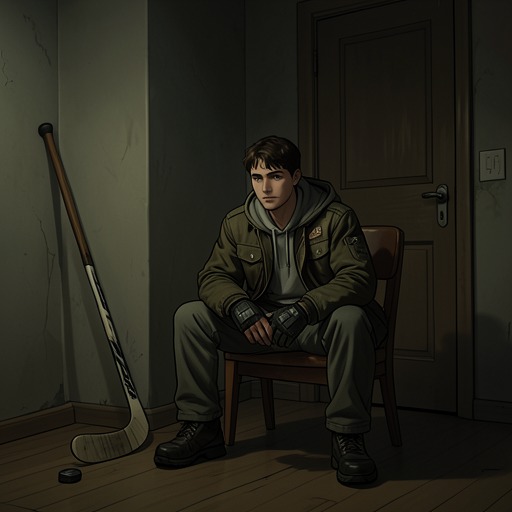
As Mike looks around Adam’s bedroom, the room holds on to a younger version of his son. Hockey trophies remain on the shelf, and posters of Jaromir Jagr and Chris Drury are still on the wall. Adam once read Goosebumps and Mike Lupica’s stories about young athletes overcoming impossible odds, studied hockey statistics, and wrote to players for autographs. At Madison Square Garden, he would wait by the players’ exit on 32nd Street near Eighth Avenue, hoping to get pucks signed. These memories make the bedroom more than a collection of childhood keepsakes: they mark a closeness between father and son that Mike fears he can no longer reach.
Mike had passed his love of hockey to Adam. Adam began skating at three, became a goalie in junior hockey, and appeared to be a strong prospect for college. The change was abrupt: six months before Mike reflects on it, Adam put down his stick, pads, and mask and said he was finished. Mike tries not to treat athletic success as a measure of a child’s future, but the decision hurts him. He wonders whether quitting marked the beginning of Adam’s withdrawal. His uncertainty matters: he recognizes that he may be interpreting his son’s change through his own attachment to the sport, and the book leaves the precise beginning of Adam’s troubles unsettled.
A Son Becoming Difficult to Read
Adam’s bedroom still contains the objects of his earlier life, but Mike sees that their meaning may have changed. The trophies and hockey equipment are remnants, not proof that Adam still wants the same future. Mike remembers when Adam wanted to become a physician like him and regarded him as a hero; now he can only wonder whether some part of his son still takes comfort in those childhood years. The distance between what Mike remembers and what he can know about Adam becomes one of the story’s central tensions.
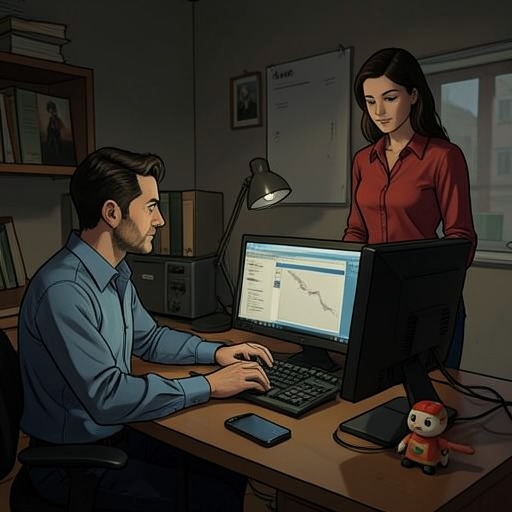
That distance is sharpened by the monitoring software Mike considers for Adam’s computer. The program can record every keystroke, report on websites and messages, and show activity live through an option labeled LIVE SPY! In the exchange Mike later sees, Adam is still using the screen name HockeyAdam1117, chosen years earlier by combining his favorite player Mark Messier’s number with Mike’s number from Dartmouth. A brief message from CeeJay8115 asks whether he is all right; Adam replies that they should say something. The other person urges him to stay quiet, saying it is long over and that silence will keep everyone safe. The exchange supplies no explanation of what happened, but it shows Adam weighing disclosure against the safety of others. Even his unchanged hockey-based screen name is ambiguous: a remnant of childhood, a private continuity, or simply a detail whose significance cannot be established from the messages alone.
Disappearance and the Search for Contact
As Adam becomes unreachable, his parents’ concern turns into an urgent effort to find him. Mike shows Anthony a photograph of Adam and asks whether he has seen him, carrying the search beyond the family home. When Mike is badly hurt, his own attention returns to the missing boy: amid the confusion of waking in a hospital, his repeated thought is Adam’s whereabouts. Tia, beside him, sees that his fear has not lifted and hears him ask where their son is. Adam’s absence therefore persists even when his father is injured and dependent on care; it remains the question around which the family’s crisis turns.
A message from Mike reaches Adam at a moment when he is still able to choose whether to respond. Mike asks him to call home, says he is worried and on Adam’s side, and tells him that he loves him. Adam listens and nearly cries. He holds his phone, considers calling his father, and imagines asking him to come get him; he even thinks of going to a Rangers game with Mo and telling them everything. Mike’s number is speed-dial one, and Adam’s finger hovers over it. The scene gives the possibility of reunion a physical form in a single unpressed button. Before he acts, someone speaks to him from behind, interrupting the moment. The hesitation is not indifference: Adam wants contact, but wanting it does not yet overcome the force keeping him silent.
Spencer Hill and the Weight of Silence
Adam’s connection to Spencer Hill emerges through both other people’s suspicions and the messages Adam has kept. Betsy Hill encounters Adam walking alone with a heavy backpack and deliberately steps into his path to speak to him. Later, she tells Tia that she thinks Adam was with Spencer on the night Spencer died, and confirms that she has already spoken with him. The suspicion places Adam close to the unresolved circumstances of Spencer’s death, but it does not by itself explain what Adam knew or did.
On a hill, alone, Adam hears Spencer’s voice in memory. He has kept Spencer’s voice messages on his phone and listened to them every day, each time feeling the pain anew. One message includes Spencer apologizing. The daily repetition makes the phone both a connection to the dead boy and an instrument of renewed hurt: Spencer is absent, but his recorded voice remains available to Adam. This private practice helps explain why questions about that night do not arrive as detached requests for information. They press on a grief Adam has continued to revisit rather than put away.
When Adam meets Betsy, she tells him that his parents are worried and asks what happened and where he has been. He is now taller than Mike, nearly a man, yet Betsy notices a gesture that reminds her of his father. The observation sets his physical coming-of-age beside the family resemblance he cannot simply outgrow. Adam says he does not visit Spencer’s memorial page and believes the photograph there has been posted for a long time. His response does not erase the intimacy of the messages he has preserved; instead, it underscores how much of his connection to Spencer remains private and difficult for others to see.
The Secret Behind His Silence
Adam’s return to the question of trust is uneasy. He recognizes that his parents did not trust him, and that this made him furious, but also asks himself whether he had earned their trust. After the previous night, he panicked, ran, and stayed hidden because he needed time to think. He says he needs to talk to his parents and asks to use a phone. These admissions give his disappearance a specific shape: it is a deliberate retreat under pressure, not proof that he has stopped caring about his family. His wish to reach his parents recurs, even as he fears the consequences of telling them what he knows.
When asked why he is not telling the truth, Adam says it does not matter because it is his word against theirs. Darryl LeCrue identifies a more particular danger: Rosemary McDevitt and Carson Bledsoe, LeCrue says, have threatened to blame Adam for stealing prescription pads if he speaks. LeCrue connects that threat to Adam’s attempt to end the situation the previous night and to his fear that his friends could get into trouble. Adam rejects the suggestion that he was worried about his friends. His concern, he says, was his father: Mike would be blamed and would certainly lose his license. Adam’s explanation makes the cost of his silence concrete. He has not kept quiet because the matter is meaningless to him, but because he believes speaking could destroy his father’s professional life.
The discovery recasts the signs that have surrounded Adam throughout the story. The boy who once wanted to follow Mike into medicine is now trying to protect Mike’s ability to practice it. The hockey relics and the old screen name preserve traces of childhood, while his hidden messages, repeated listening, and flight reveal a young man caught between the need to speak and the wish to shield others from harm. His account does not make his choices simple or dissolve the mistrust between parent and child; it shows how love, grief, fear, and secrecy have become entangled in them.