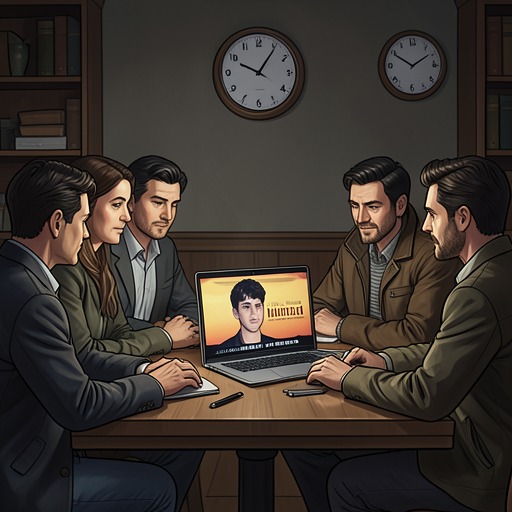
Adam reveals the truth about Spencer and clears his name
Hold TightAdam’s account of his final conflict with Spencer Hill emerges in a room where grief, suspicion, and the fear of saying too much have converged. Evidence found by Ron Hill changes the meaning of the stolen prescription pads, and Betsy Hill gives Adam a way to speak about the fight and the calls he did not answer. His admission does not undo Spencer’s death, but it separates Adam’s remorse from responsibility for his friend’s suicide and clears him of the theft that had implicated him.
The Evidence Changes the Story
The exchange unfolds with Adam crying and Hester Crimstein keeping a hand on his forearm, prepared to stop him from speaking. Betsy sits across the table, also in tears; Ron stands behind her, arms crossed, his gaze turned upward and his lips trembling. Darryl LeCrue asks Betsy to tell the others what she has told him. The arrangement places Adam opposite the parents of the friend whose death he has been unable to discuss, while Mike Baye watches and asks what is happening.
When Adam begins to address Betsy, Hester tries to quiet him. He pulls his arm away. Betsy recognizes that he is afraid he will not be believed and afraid that speaking will hurt Spencer’s memory. She tells him that Spencer is dead and that the death is not Adam’s fault. Her response does not yet explain what happened; it gives him permission to hear the evidence without treating every painful fact as proof of guilt.
Betsy says that the family has proof. Ron explains that he searched Spencer’s room on the night he died and found eight thousand dollars in cash under the bed, along with a prescription pad. He had kept this discovery from Betsy, reasoning that Spencer was already dead and that telling her would only add to her pain. He recognizes that Adam may have held back for a similar reason. The cash and pad give the conversation a concrete basis: the stolen prescriptions were not taken by Adam, as suspicion had suggested, but by Spencer.
The Fight and the Unanswered Calls
Betsy uses the discovery to reconstruct the final rupture between the boys. She says that Adam learned Spencer had stolen the prescription pads from his father’s house, confronted him, and fought with him. In her account, Adam struck Spencer during the fight. When Spencer later called to apologize, Adam did not want to hear from him and let the calls go to voicemail. The sequence makes clear why the night has remained unbearable to Adam: anger and a deliberate refusal to respond came before Spencer’s death.
Adam confirms the central details himself. He says he should have answered, acknowledges hitting Spencer and calling him names, and recalls telling him he never wanted to speak to him again. He then says that he left Spencer alone when Spencer called for help. The confession gives Adam’s guilt its exact object—not the theft of the prescription pad, but the fight, the final words, and the unanswered calls. It also distinguishes what Adam did from what the evidence establishes: the room’s account identifies his actions and regret, while Betsy explicitly rejects the claim that Spencer’s death was his fault.
The admission is difficult precisely because it does not offer Adam an innocent version of himself. He acknowledges cruelty and a missed chance to respond, but the truth does not turn those choices into a proven cause of Spencer’s death. By allowing the painful facts to be spoken, the scene replaces an unexamined suspicion with a more precise and more complicated understanding of the friendship’s last night.
From Exposure to Support
After Adam speaks, the room erupts into tears, embraces, and apologies. The revelation does not repair the loss, and the account describes old wounds as being opened and closed rather than erased. Hester takes charge of the immediate aftermath, bringing Darryl LeCrue and Duncan into the response. Those present have seen what happened in the room, and no one wants to prosecute the Bayes. Adam agrees to cooperate in helping send Rosemary McDevitt and Carson Bledsoe to prison; that further step is left for another day.
The change in the room is both practical and personal. Ron’s discovery clears Adam of stealing his father’s prescription pads, while Adam’s admission gives Betsy and Ron an account of the fight and the calls they had not had before. At the same time, the group’s response refuses to reduce the encounter to a confession followed by punishment. Their embraces and apologies mark a turn from accusation toward support, even as the facts remain painful and the family’s grief remains unresolved.
Significance of the Revelation
The scene resolves a mystery through a family’s belated disclosure: Ron had found evidence, withheld it to spare Betsy, and only later brought it forward. His silence had been intended as protection, but it left the stolen pads and Adam’s guilt without explanation. Betsy’s role is equally decisive. Rather than asking Adam to deny the fight, she names what she believes happened and gives him room to confirm it. The truth arrives not as a clean exoneration from every hurtful act, but as a distinction between wrongdoing, remorse, and responsibility for a death.
For Adam and Spencer’s friendship, the revelation preserves both attachment and conflict. Adam had cared enough to be shaken by Spencer’s theft, but his anger ended in words and silence he cannot take back. The scene lets him acknowledge those choices in front of Spencer’s parents without making them the cause of Spencer’s suicide. Its resolution is therefore limited but consequential: Adam’s name is cleared of the theft, the Bayes are not to be prosecuted, and Adam can help pursue Rosemary McDevitt and Carson Bledsoe, while Spencer’s death remains a loss that neither evidence nor apology can reverse.