Betsy Hill
Hold TightBetsy Hill is Spencer Hill’s mother, and her response to his suicide gives the novel one of its clearest accounts of grief as both an intimate absence and a search for facts. She cannot restore Spencer or make the loss easier by explaining it, but she refuses to let the first account of his final night stand unexamined. A memorial page, a fleeting photograph, and candles on the high school roof turn mourning into an investigation, drawing her toward Adam Baye and a difficult reckoning with what the adults did not know.
Identity and the House After Spencer
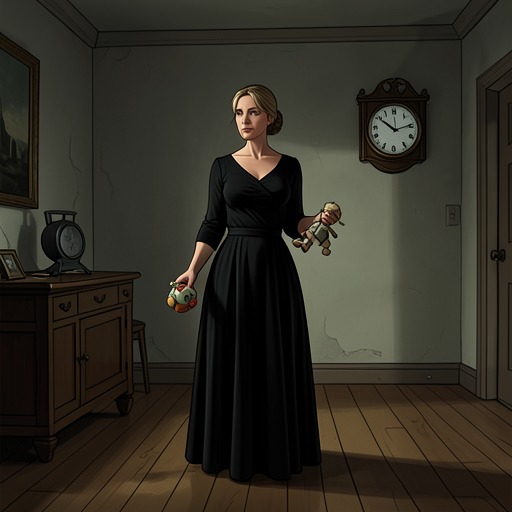
In the days after Spencer’s death, Betsy experiences the family home as more than quiet: it feels emptied by the absence of its son. That sense of vacancy is not a passing mood but the condition through which she encounters ordinary life. When Daniel Huff, the town police officer and father of DJ Huff, comes to the door, Betsy remembers seeing him and collapsing. Even a visit from someone connected to Spencer’s circle arrives inside the shock of bereavement.
The loss also separates Betsy from the familiar routines of parenthood. Later, she waits in the high school parking lot near the curb known as Mom Row, where parents sit in cars or gather while waiting to take their children to activities. She remembers having occupied that place herself. Now she has come to confront Adam, not to collect a child from school. The contrast makes her altered position visible: she remains a mother, but Spencer’s death has removed her from the ordinary future those routines presume.
Betsy and her husband, Ron Hill, do not grieve in identical ways. The day after Spencer was found dead, Ron began packing away his room, as he had already packed away Spencer’s kitchen chair. Betsy stopped him. She could recognize a difference between yielding to grief and being pushed past what she could bear. For days after the suicide, she lay on Spencer’s bedroom floor and wept; later, she still held his old cell phone, though its battery had long since died. The room and its objects preserve a connection that cannot be replaced by an explanation.
The Memorial Page and the Photograph
Betsy visits the MySpace memorial page that Spencer’s classmates made a few days after his death. A flickering candle occupies the place usually reserved for a profile picture, while photographs, collages, and comments assemble a public remembrance. The page plays Broken Radio, one of Spencer’s favorite songs. Betsy listens, attending to the memorial as a place where her son’s presence has been arranged by other people and made available to view.
The page also sharpens her sense of how public mourning can differ from private loss. She finds little recent or deeply personal material, and little from Spencer’s close friends, including Adam. After three weeks without checking the page, she sees that activity has ebbed. In her view, classmates have moved on while those who grieve most deeply may keep their pain private. The slideshow reinforces that unease: photographs appear one after another, each image giving way to the next. As Betsy watches, tears come; then a picture rotates into view and changes the meaning of her visit.
The photograph is visible only briefly. More images cover it before Betsy can study it, and she has to work out how to find it again. The novel does not make the page a simple memorial object: it becomes both a site of continuing attachment to Spencer and the accidental source of a question about his death. Betsy’s effort to recover the image grows from her grief, but it also gives that grief a concrete task.
From the Parking Lot to the Roof
Betsy waits for Adam in the high school parking lot and asks him what happened on the night he was with Spencer. The question puts her in the position of an adult confronting a young person who had been part of her son’s life. She has not yet received an account that resolves her concerns, and the photograph has made the silence around that night harder to accept.
When Betsy arrives at Tia Baye’s home, Tia opens the door and immediately asks whether she knows where Adam is. Betsy says she does not. Instead of leaving, she asks Tia whether she has checked the high school roof—the place where Spencer’s body was found. She believes Adam was with Spencer that night and has already spoken to him about it. Tia does not prolong the exchange; she calls to Jill Baye that she will be back, and the two women hurry toward Betsy’s car.
On the roof, they find dozens of candles. Most have burned down and hardened, but one or two are still soft enough to suggest recent use. Betsy stands looking at them without moving or crying and identifies the place as where Spencer’s body was found. The candles do not establish precisely who was there or what happened. Their importance is narrower and more unsettling: they make the roof look like a place people have revisited, not a scene everyone left behind without returning.
Afterward, Betsy explains the question the candles raise. Everyone had said Spencer was alone that night; she asks whether their presence means that others had been with him. Her suspicion is not proof, but it is a reason to keep asking. The rooftop search joins Betsy and Tia in a shared effort to understand their sons’ connection to Spencer’s final hours, while leaving the central facts unresolved for the moment.
Seeking the Truth, Not a Cure
Betsy later tells Ron that she needs to find out what really happened that night. She knows that knowledge will not bring Spencer back and may not make either of them feel better. She nevertheless believes they need to pursue it. Her purpose is not presented as a promise that investigation will heal bereavement; rather, she refuses the idea that the impossibility of changing the outcome makes the truth irrelevant.
This resolve remains bound to the ordinary material traces of Spencer’s life. Betsy sits on the floor of his room holding the dead phone and remembers stopping Ron from packing everything away. His scent has left the pillow, but she smooths the sheets and stays among the things that remain. The objects cannot answer her, yet she keeps returning to them and to the questions attached to them. Her attachment to Spencer persists alongside her recognition that no discovery can reverse his death.
Adam and the Limits of Blame
When Adam calls Betsy, he says through tears that he saw her and his mother on the roof and apologizes. The call links his distress to the search she and Tia have undertaken, but Betsy’s eventual response is not to make him carry the loss as a punishment. She recognizes that he is afraid he will not be believed and afraid that telling the truth will hurt his friend. She reminds him that Spencer is dead and that Adam cannot hurt him now.
Betsy also turns the inquiry toward the adults who raised Spencer. She acknowledges to Adam that she and Ron missed important things, and that they will live with that knowledge. She cannot say whether closer attention would have saved Spencer; she allows that the answer may be unknowable. What she can say with certainty is that Adam is not responsible for Spencer’s death. Her reassurance does not erase the unanswered questions or settle every detail of that night. It draws a necessary boundary between learning what happened and assigning a grieving young person the blame for an outcome no one can now change.
Betsy’s role therefore holds two responses to loss together: she continues to seek an account of Spencer’s final hours, and she accepts that an account cannot restore him or deliver a complete explanation. The memorial page, the rooftop candles, the old phone, and her conversations with Adam each keep the dead son present in a different way. Her insistence on truth is not a departure from her bond with Spencer; it is one of the forms that bond takes, even as her final words to Adam prevent the search from becoming a demand that he bear what cannot be undone.