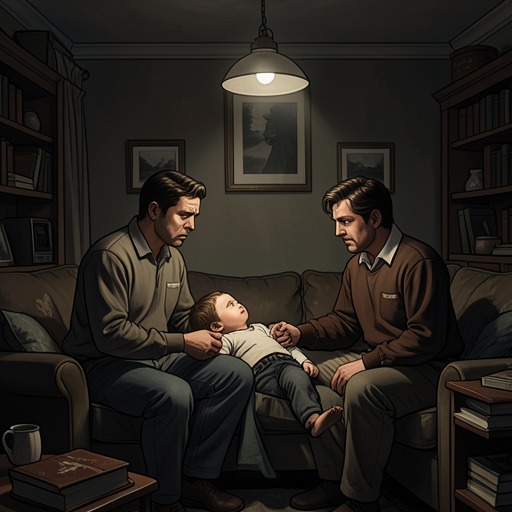
Betsy Hill–Spencer Hill mother-son relationship
Hold TightBetsy Hill’s relationship with Spencer Hill does not end with his suicide: it persists in the details of how he slept, in the objects she cannot bear to put away, and in her insistence that the circumstances of his death matter even if the truth cannot bring him back. Her grief is at once a mother’s continuing attachment to her son and the force behind her effort to reconsider the account of his final night.
A bond carried through grief
The death changes the conditions of Betsy’s bond with Spencer, but not its everyday intimacy. She remembers him not as an abstract tragedy but as the child whose sleeping habits she knew: until he was ten, he sucked his thumb in his sleep, and even later he curled into a fetal position. When she returns to the roof where his body was found, these details make the place more than a crime scene. They are traces of the boy she had watched and cared for, and they shape how she understands what she sees there.
In the days after Spencer’s death, Betsy lies on the floor of his room in a fetal position and sobs. She smooths the sheets on his bed and presses her face into his pillow, though the scent she hopes to find there is gone. The gestures bring her close to familiar parts of his life while making the absence unmistakable. Her response is not presented as a clean passage from loss toward acceptance; she continues to reach for the ordinary physical surroundings of her son even when they cannot restore him.
That attachment also appears in the disagreement over what to do with his things. The day after Spencer is found dead, Ron begins packing away the room, as he had packed away Spencer’s kitchen chair. Betsy stops him. The distinction she makes between bending and breaking conveys the limit she sees in her husband’s attempt to put things away: for her, clearing the room risks turning a painful reality into a removal of Spencer from the household’s present life.
Memorial images and a changed understanding
Betsy visits Spencer Hill’s MySpace memorial page, made by his classmates a few days after his death. A flickering candle occupies the place usually reserved for a default picture, and Broken Radio, one of Spencer’s favorite songs, plays beside a line from its lyrics. She listens for a while. The page gives her a public record of remembrance, but it also directs attention to the difference between visible mourning and the grief she believes is harder to display.
When she looks through the page, Betsy finds little recent or deeply felt material and few contributions from Spencer’s real friends, including Adam Baye. She considers the possibility that those who grieve most genuinely keep their pain private. The slide show, meanwhile, turns the photographs into a succession of images that appear and are covered by others. Betsy has not checked the page for three weeks, and its quiet activity underscores how quickly public attention can move on while her relationship with Spencer remains immediate.
During that slide show, a photograph appears and disappears among the others. Betsy recognizes it as a picture that changes everything for her, but the image is not described at this point. Its significance lies in the rupture it creates: instead of letting the familiar memorial settle into a record of a death already understood, Betsy tries to find the photograph again. Her continuing concern for Spencer becomes an investigation into whether the accepted account of his last night is complete.
The roof as a place of memory and testimony
Later, Betsy stands with Tia Baye at the school roof, where candles have been placed in remembrance of Spencer. She identifies their exact location as the place where his body was found. She recalls insisting on seeing him before he was taken down, despite the officers’ efforts to move him and Ron’s attempt to dissuade her. She climbed up using a ledge that was later knocked off, refusing an officer’s offer of help and making the others move back. In the present, she explains where Spencer lay and connects his curled position to the posture in which he used to sleep.
The account makes Betsy both a bereaved mother and a witness to the scene of her son’s death. Her insistence on seeing him then, and her return to the precise place now, show how memory is anchored to location as well as to keepsakes. She does not offer the roof as a way to resolve her grief. Instead, she gives Tia the details that preserve Spencer as a particular child, linking the place where he died to the familiar habits of the son she knew.
Seeking truth without closure
Betsy’s investigation strains the trust between the two mothers. If her interpretation of the photograph is right, Adam may have lied; Tia, in turn, has information about messages involving Adam and a mother who approached him that she is not yet ready to share. The uncertainty does not make Betsy’s concern for Spencer less powerful. It means that the other boy’s possible involvement is now entangled with her effort to understand her own son’s death.
Betsy says she missed signs, and she recalls that Ron questions what more there is to discover when Spencer’s death has been called suicide. She rejects the idea that her search is simply a route to closure. To her, closure would imply a door through which she could pass while leaving Spencer on the other side, an outcome she finds intolerable. She knows that learning the truth will not return him or necessarily make the family feel better, but believes they must find out what happened anyway.
The parallel with Adam’s disappearance sharpens this resolve: the police think Adam ran away, while they think Spencer died by suicide. When Tia tells her Adam is missing, Betsy loses color, reminded of what happened to her own son. Later, Adam tells her that he saw her and his mother on the roof and apologizes. The brief contact does not settle the questions around Spencer’s death, but it places Betsy’s grief within the living relationships formed by the search. Her bond with Spencer persists not as a claim that the past can be undone, but as a refusal to let uncertainty, other people’s assumptions, or the passage of time make his final night unworthy of attention.