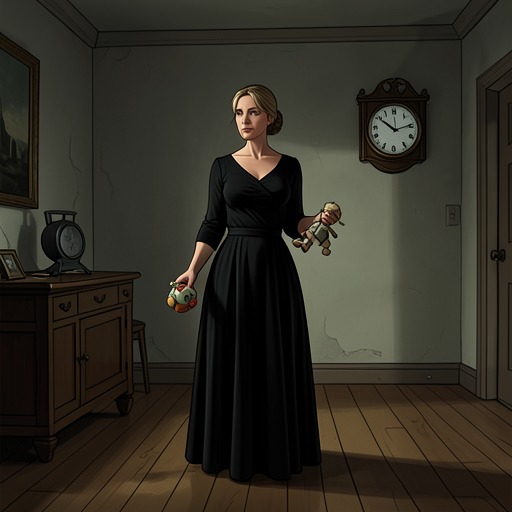
Betsy and Ron Hill's bereavement after their son's suicide
Hold TightBetsy and Ron Hill's bereavement after their son's suicide shapes their home and marriage around an absence that neither can manage in the same way. Spencer Hill’s death leaves the house feeling emptied of life, while familiar rooms and possessions become painful reminders. Ron tries to put parts of the past away; Betsy resists that retreat. Their grief does not resolve into a single process of acceptance: it separates them, keeps them attached to Spencer, and eventually gives Betsy a reason to seek the truth about his final night.
A House Made Hollow
For Betsy, the Hill house is not simply quiet after Spencer’s death. It feels dead: an image that turns private grief into the condition of the whole home. The distinction matters because the neighborhood has resumed its ordinary life. Betsy remembers the neighbors who attended the funeral and offered comfort, but she also believes she can see blame in their eyes. In her view, blaming the parents lets others imagine that a loss like this could not happen to their own families.
That contrast deepens her isolation. Friends and neighbors can leave the funeral and return to their lives; the family cannot step outside the loss in the same way. The house holds the consequences after visitors are gone. Even the children still at home respond differently: one twin ignores what has happened, while the other sulks. Betsy tries to keep family routines going, serving dinner and getting the twins ready for bed, though ordinary care now takes place inside a household altered by Spencer’s absence.
Different Ways of Carrying the Loss
Ron’s grief often turns inward. Some nights he comes home, parks in the garage, and sits in the car crying. Betsy fears that he might leave the engine running and close the garage door, repeating the means by which Spencer ended his life. The fear reveals how the suicide has changed the meaning of familiar places and actions: even Ron’s private retreat in the garage can appear to her as a danger.
Two days after Spencer’s death, Ron moved Spencer’s dinner chair to the basement. He also removed Spencer’s name from his locker and began filling the space with other things. Betsy understands these acts as an effort to keep reminders out of sight. Her own response moves between trying to occupy herself with projects and wanting to sink into grief again. Work feels heavy; at other times she deliberately lets the pain return rather than trying to contain it.
The difference between their coping styles becomes particularly clear in Spencer’s room. The day after Spencer was found dead, Betsy stopped Ron from packing the room away. Later, she sits on the floor holding Spencer’s old cell phone, its battery long dead. In the days after the suicide she had lain curled on that floor and cried; now she smooths the sheets and presses her face into his pillow, but the scent she remembers is gone. The objects preserve a connection, but they cannot restore the person who used them.
Marriage and Shared Memories
Betsy and Ron continue to live together, talk, and love each other, but since Spencer’s death they have neither fought nor made love. Their lack of conflict does not mean the loss has brought them into easy agreement. Instead, tenderness itself seems difficult to bear, and they live as if separated while still sharing a home.
Betsy fears that Ron wants the loss to disappear and that, eventually, he may want her gone because she reminds him of Spencer. She thinks he sees his dead son when he looks at her. The fear is set against their shared history: their first kiss outside a library, an overnight at the shore, a honeymoon cruise, work on wallpaper in their first home, and laughter at a farmers’ market. These memories remain hers, but she worries that grief has made them inaccessible to Ron. When Atlanta comes up as a possibility, Betsy understands it as part of his wish to run from what he cannot face. She wants him to be happy and fears losing him, so the impulse to let him go collides with her need for him to stay.
Their different responses become visible when Betsy wonders whether someone might have hit Spencer. Ron tells her that Spencer mixed pills and alcohol; as he speaks, tears run down his face. Betsy reaches for him, but he pulls away. The moment brings a painful fact into their conversation without repairing the distance between them: they can share knowledge of what happened and still be unable to comfort one another.
Remembrance and the Search for Truth
Betsy maintains a connection to Spencer through his classmates’ MySpace memorial page. It has a flickering-candle graphic, photographs and collages, comments, and a slideshow; the song Broken Radio, one of Spencer’s favorites, plays on the page. She notices that little has been added recently and that Spencer’s close friends have left little there. She considers that public displays may not measure private grief, especially for those who are truly hurting. The memorial is therefore both a record of communal remembrance and an incomplete measure of what Spencer meant to the people around him.
While watching the slideshow, Betsy sees a photograph rotate into view and recognizes it as a turning point. It disappears beneath the next images before she can examine it again. The supplied account does not specify what the photograph shows, but its sudden appearance changes the direction of her attention: she wants to find it again. Later, holding Spencer’s dead phone in his room, she tells Ron that she needs to know what really happened that night. She understands that an answer will not bring Spencer back or necessarily make either of them feel better, but believes they need to pursue it anyway. Grief has not ended; it has acquired a question that cannot be put away with the chair or the locker.
The need to know also opens a fragile point of contact beyond the marriage. A boy’s tearful voice tells Betsy that he saw her and his mother on the school roof, and she recognizes Adam. He apologizes. The brief exchange links Betsy’s search to someone who was present in Spencer’s life, without itself supplying the explanation she seeks. Her bereavement thus remains both intimate and unresolved: sustained through rooms, objects, and memories, and increasingly directed toward understanding the night of Spencer’s death.