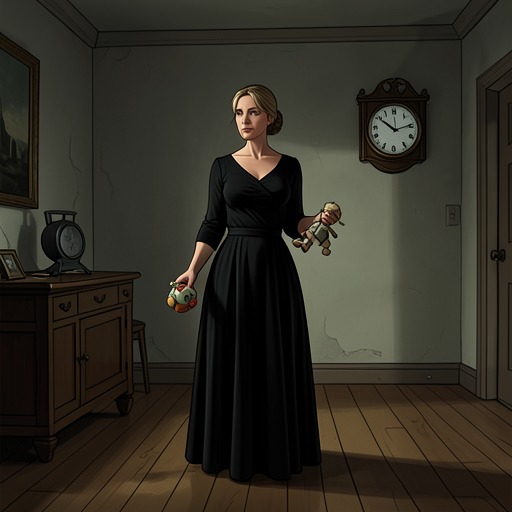
Betsy confronts Adam in person
Hold TightBetsy Hill confronts Adam in person in the high school parking lot, turning a photograph from the night Spencer died into a direct but unresolved question. The encounter brings Betsy face to face with the possibility that Adam knows more about Spencer’s final night than he has said, but his denial and abrupt flight leave her without an answer.
Waiting at the School
Betsy waits where she can intercept Adam as school lets out. Around her is “Mom Row,” the curb along Maple Avenue where parents sit in idling cars or gather to talk while waiting to escort their children to lessons, appointments, and activities. Betsy remembers that she used to belong among those mothers. The familiar setting therefore marks both continuity and change: she is still a parent waiting outside a school, but now grief and suspicion have made her wait for a confrontation rather than an ordinary pickup.
Before Adam appears, Betsy wonders whether Spencer might not have been alone that night. She knows that whatever she learns will not bring her son back, and questions whether she is looking for resolution. The thought does not stop her. When she spots Adam walking alone, his backpack seems to Betsy to weigh on them both, giving the ordinary sight of a student leaving school the weight of their shared connection to Spencer.
The Photograph and the Question
Betsy moves into Adam’s path and keeps herself in front of him as he walks with his eyes down. She greets him; when he begins to veer away, she calls him back and asks, “Can I talk to you a moment?” Adam stops and jogs toward her with athletic ease. Betsy recalls that he has always been a good athlete, unlike Spencer, and wonders whether that difference had been part of what mattered. For a moment, the conversation retains the familiar asymmetry of an adult speaking to a child: Betsy tells him to look at her, and he obeys.
She asks what happened that night and reminds him that he was with Spencer. Adam first answers that he was not there, then asks what she means by what happened. Betsy takes out the picture from Spencer’s MySpace memorial page. When Adam’s eyes drop again, she pushes the image toward him and asks, “That’s you, isn’t it?” His reply—that it might be—leaves room for uncertainty. Betsy makes the point explicit: the picture was taken the night Spencer died.
Denial and Flight
Adam shakes his head. When Betsy presses him to look again, he insists, “I don’t know what you’re talking about, Mrs. Hill. I didn’t see Spencer that night.” The exchange stops at the boundary between the image Betsy has brought and Adam’s account of himself: the photograph gives her grounds to ask, but the scene does not establish what it proves or whether Adam’s denial is true.
Adam says he has to go. Betsy asks him to stay, but he answers, “I’m sorry, Mrs. Hill,” and runs. He heads back toward the brick school building, goes around behind it, and disappears from her sight. His departure cuts off the conversation before Betsy can obtain an explanation or a resolution. The encounter thus changes neither the fact of Spencer’s death nor Betsy’s uncertainty; it makes the photograph and Adam’s refusal to discuss it the immediate focus of that uncertainty.
Significance and Limits
The scene places Betsy’s bereavement inside an everyday school setting. Her approach is deliberate: she waits, steps into Adam’s path, shows him the image, and asks plainly about Spencer’s final night. Adam’s movement carries the scene from tentative contact to withdrawal: he initially comes toward her, faces the evidence, denies seeing Spencer, and then runs out of the conversation. The shift leaves Betsy with a sharper question but no confirmed answer.
The photograph is consequential because it gives Betsy a specific reason to approach Adam, not because the encounter resolves what happened. His hesitant acknowledgment that the pictured person might be him is followed by a categorical denial that he saw Spencer that night. The gap between those responses sustains the scene’s tension, while his flight makes the absence of an explanation its ending. Betsy’s hoped-for resolution remains out of reach.