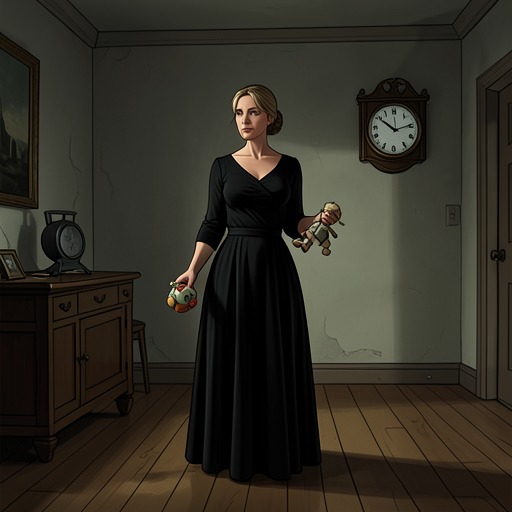
Betsy shows Ron the photo
Hold TightBetsy Hill shows Ron Hill a photograph that unsettles the accepted account of Spencer Hill’s death and exposes how differently the couple has been carrying their grief. The image suggests Spencer was not alone that night, but it offers no clear answer about who was there or what happened. For Betsy, that uncertainty warrants asking questions; for Ron, it collides with painful knowledge of his own responsibility and the possibility that their son’s death was more complicated than they had been told.
The photograph and the decision to share it
Betsy has printed the picture from Spencer Hill’s MySpace memorial page and spent an hour at the kitchen table wondering what to do. The twins are staying with her sister, and she does not want them home for what is coming. Those circumstances make the photograph more than an item to show Ron: she has chosen a private moment, away from the children, to bring a difficult possibility into their home.
When Ron returns from work, his appearance and mood sharpen her hesitation. Betsy still sees him as handsome, with salt-and-pepper hair that has become mostly salt and blue eyes like Spencer’s. He has kept himself in shape, unlike many of his colleagues. More important, he enters with a smile Betsy has not seen for a long time. She immediately slips the photograph beneath a magazine, trying to preserve that smile for a few minutes. Her concealment is an act of care, but it also postpones a truth she has decided he needs to see.
The delay ends only after Ron has started upstairs. With one hand on the railing, he turns back when she calls him. His lowered shoulders make him seem to have recognized the moment as an attempted escape. Betsy says she needs to show him something, and he takes the photograph. The movement from hidden picture to shared object marks the scene’s decisive change: suspicion that Betsy has been holding alone becomes a source of distress between both parents.
What the image suggests—and what it cannot prove
Ron studies the photograph, but Betsy can tell that he has stopped seeing it. He puts it down, folds his arms, and picks it up again. His repeated handling registers agitation rather than a settled interpretation. He asks what the image changes, a question that exposes the gap between the fact Betsy sees and the conclusion Ron is willing to draw from it.
Betsy’s central claim is that Spencer was not alone that night. She has already acted on the photograph: she waited until school ended and confronted Adam Baye, then showed him the image. Adam ran away from her, and she took his flight as evidence that something was troubling him. But she cannot say precisely what his reaction means. The photograph and the encounter raise suspicion; neither establishes what Adam knows, what he did, or even whether the people in the image remained with Spencer.
Ron offers alternatives that keep the picture from becoming proof. The others may have been frightened, Spencer may have told them to stay silent, or the date may be wrong. Even if the date is right, Spencer might have seen them briefly and then gone out; the photograph might have been taken earlier that day. His objections do not disprove Betsy’s reading, but they show how much remains uncertain. The scene makes the difference between a clue and an explanation emotionally consequential: the image can reopen the case in their minds without resolving it.
Grief, injury, and blame
Betsy recalls the bruise beside Spencer’s eye when the police found him. Ron points to the explanation that Spencer passed out and fell on his face; Betsy raises the possibility that someone hit him. The bruise becomes another disputed detail, neither a confirmed assault nor a meaningless mark. In the context of the photograph, it gives Betsy a reason to resist treating the death as fully explained, while Ron remains attached to the known facts of Spencer’s choices.
Those facts turn the exchange inward. Spencer mixed pills and alcohol, stole vodka from the family cabinet, and took pills from Ron’s medicine chest. Ron emphasizes that nobody forced Spencer to do either. He also admits that he left the prescription bottle in view and kept asking for renewals when he believed he should have recovered from the pain and moved on. The photograph thus arrives not in an emotionally neutral investigation but in a household where Ron already links himself to the circumstances of Spencer’s death.
Betsy tries to deny that she blames him, but Ron believes she does. Her earlier decision to hide the picture to protect his smile acquires a painful counterpoint: when she finally shares it, she cannot keep him from feeling accused, even though the discussion concerns what may have happened to Spencer. Ron leaves through the door before she can bridge that divide. The immediate consequence of disclosure is therefore not agreement or reassurance, but a renewed separation between two parents trying to make sense of the same loss.
The scene’s significance
The photograph changes the couple’s conversation from mourning a known sequence of events to confronting the possibility of missing witnesses and a still-unexplained injury. Yet the scene withholds confirmation. Betsy’s inference from Adam Baye’s flight is compelling to her, while Ron’s questions preserve other possibilities; the evidence supports unease, not a verdict. The unresolved quality is central to the event: the picture makes certainty harder rather than supplying it.
Ron’s rapid blinking makes the cost of that uncertainty visible in his body. His mother had explained that it began after he was beaten often in second grade and hid it from her; the habit eased as he grew older and had scarcely appeared for years. Betsy has not seen it even since they learned of Spencer’s death. Its return signals that the photograph and their argument have reached a depth of distress beyond their ordinary grief. By the time Ron leaves, the image has done two things at once: it has reopened questions about Spencer’s final night and brought Ron’s private self-reproach back into the open.