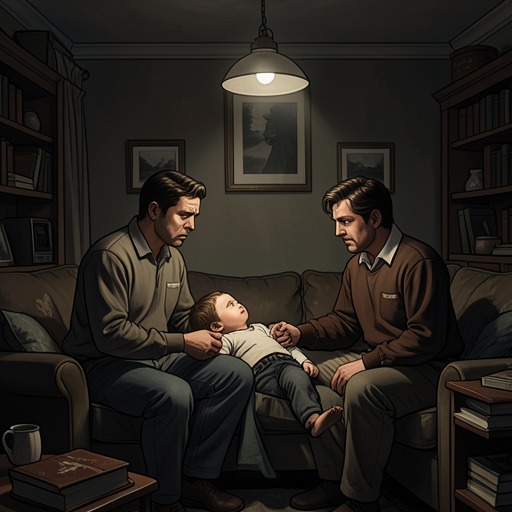
Guy Novak–Yasmin Novak father-daughter relationship
Hold TightGuy Novak’s fatherhood of Yasmin is presented less as a title than as a responsibility he has carried in daily life: after Marianne Gillespie left when Yasmin was very young, he became her primary caretaker and made raising and protecting her central to his sense of himself. His devotion is real, but it is not untroubled. The same bond that gives him purpose also leaves him acutely vulnerable to the possibility that he has failed to keep his daughter safe.
A father made by daily care
The account of Guy and Yasmin emphasizes the circumstances of their household. Marianne Gillespie left when Yasmin was less than two, and Guy says she now lives in Florida and sees her daughter only four or five times a year. He describes her as having little involvement in Yasmin’s life. These details establish an uneven parental presence: Guy is the constant caregiver, while Marianne’s contact with their daughter is infrequent.
Guy’s own understanding of his role is starkly personal. In his thoughts, Yasmin is the one significant achievement of his life: he has fathered her, raised her, and served as her primary caretaker. The phrasing joins biological parenthood to the work of care, but it is the latter that gives his identity as a father its weight. He does not define himself through occasional visits or a distant claim; he defines himself through having been there to bring her up.
That self-definition is also fragile. Guy measures himself against the responsibility he believes comes first: protecting Yasmin. The question of whether he has fulfilled it shadows his pride in having raised her. His attachment therefore carries two linked emotions—affirmation in the care he has provided and distress at the possibility that care has not been enough.
Protection, fear, and a sense of failure
The novel places Guy’s protectiveness within an episode in which he drives past another family’s house. Dolly Lewiston has been watching her three-year-old daughter, Allie, through a webcam at K-Little Gym, where parents can check on children during activities such as snack time, building blocks, reading, and singing. Dolly understands something of Guy’s frustration: unlike her, he has not been able to watch his own daughter or make sure she is safe. Her sympathy, however, does not mean she will allow him to hurt her family. The scene makes the distinction between understanding a father’s fear and accepting the danger that fear may bring to others.
For Guy, the comparison is sharpened by what he sees as an unfair contrast. Joe Lewiston, despite Guy’s complaint to the principal, continues teaching and returns home to his wife and little girl. Guy’s thoughts dwell on the ordinary family life Joe appears to retain, while Yasmin’s mother is absent from Guy’s household. The passage presents this resentment as part of Guy’s perspective, not as a neutral judgment of either family. His frustration at another man’s apparent security sits beside his own fierce investment in Yasmin and his belief that he has not protected her.
That belief becomes explicit in the movement from pride to self-accusation: Yasmin is his, yet he has not protected her. The possessive formulation conveys the force of his attachment, but it also exposes its pressure. For Guy, fatherhood is not simply affection or custody; it is a duty he treats as a test of his worth. His conviction that he has failed does not erase the history of care. Instead, it makes that history the measure against which he judges himself.
Yasmin’s mother and the family’s distance
When a woman asks Guy about Marianne Gillespie’s reaction to events, he answers that she is not very involved in Yasmin’s life and recounts her departure and rare visits. His response supplies a concise account of the family arrangement, but it also shows how readily the absent mother becomes part of the explanation of Guy’s burden. The available evidence does not give Marianne’s perspective; the account of her distance comes through Guy.
Yasmin’s own way of referring to her mother further marks that distance. When Lauren Muse questions her, Muse notices that Yasmin calls Marianne by her first name. Yasmin knows nothing relevant to Muse’s inquiry, but the exchange makes the naming itself visible: the maternal relationship is not expressed through the familiar title an interviewer expects. The text does not explain Yasmin’s reasons, so the detail remains a sign of separation rather than proof of any particular feeling.
The contrast between Guy’s language and Yasmin’s is telling without settling what Yasmin privately feels. Guy repeatedly frames her as his daughter and as the person he has raised; the scene with Muse registers a more detached form of address toward her mother. Their family history is thus conveyed not only through the facts of residence and visitation but through different ways of naming and claiming kinship.
Communication and the limits of protection
When someone asks to speak with Yasmin, Guy responds that he needs to tell his daughter. The sequence makes his role as intermediary clear: before an outsider reaches her, he wants to prepare her himself. That impulse fits the protective responsibility he has claimed, while also showing that Yasmin is a person whose access to troubling information is being managed by adults around her. The evidence does not specify what he intends to tell her, so the moment is significant chiefly for the care and caution expressed in his response.
In a separate exchange, a speaker asks whether the man present is Guy Novak, and the scene subsequently turns toward identifying Yasmin. Elsewhere, an update notes that Novak has already contacted his girlfriend to keep the girls away from the news until he returns. These brief moments place family communication amid a wider crisis: information can reach children before a parent is ready, and adults attempt to control its timing. They do not establish the details of Guy’s private conversations with Yasmin, but they reinforce the pattern of protective mediation around her.
The relationship’s central tension
Guy and Yasmin’s bond is grounded in sustained caregiving and in Guy’s conviction that raising her is his defining responsibility. The story does not treat protection as an uncomplicated proof of love. Guy’s inability to guarantee Yasmin’s safety leaves him with a painful sense of failure, while his distress over that failure exists alongside the evidence that he has been her primary parent. His bond with her is therefore shaped by both what he has done and what he believes he has not managed to do.
The contrast with Marianne Gillespie gives this relationship its particular shape: Guy provides the continuity that Marianne’s infrequent visits do not, but his account also shows how absence can become part of a father’s self-understanding and grievance. Yasmin’s own first-name reference to her mother registers the family distance from another angle. Together, these details make Guy’s fatherhood a relationship of practical care, fierce attachment, and unresolved anxiety—not a simple claim of possession, but a continuing effort to meet a responsibility he regards as paramount.