Ilene Goldfarb
Hold TightIlene Goldfarb is a leading transplant surgeon whose professional judgment makes her the doctor Mike Baye would choose for his own child. As Lucas Loriman’s kidney disease turns donor compatibility into an urgent family question, Ilene’s clinical role draws her into the consequences of a concealed paternity secret. Her competence is clear; the harder test is how to help Lucas without confusing a physician’s duty with the work of repairing his family.
Identity and Professional Background
Ilene is head of transplant surgery at NewYork-Presbyterian and Mike’s practice partner. They met during their transplant-surgery residency and now live in the same town, about two miles apart. Their children attend the same schools, but the two surgeons have few shared interests and do not rely on a close social friendship. Their partnership works through trust and respect for each other’s work rather than intimacy.
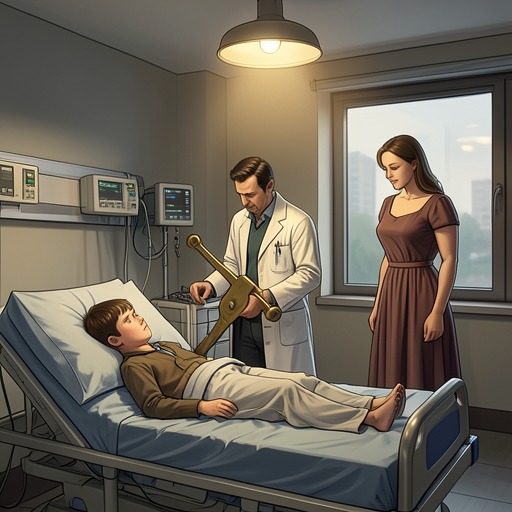
Mike’s confidence in her is unusually decisive: when asked which doctor he would choose if his own child were sick, he names Ilene. He considers her the best surgeon he knows. That confidence shapes Lucas’s care. Although Mike is himself one of the country’s leading kidney-transplant surgeons and knows Lucas personally, he gives Ilene the lead and takes second chair. The decision reflects both his respect for her ability and the emotional difficulty of treating a child who has spent time around his family.
Lucas is ten and has focal segmental glomerulosclerosis, or FSGS, and urgently needs a kidney transplant. Mike remembers him as a sweet, bespectacled child who loves sports despite not being able to play them well. When Mike practices hockey shots with his son Adam, Lucas sometimes joins them as a commentator rather than taking a stick. This personal familiarity helps explain why Mike’s concern for Lucas is especially intense, while Ilene remains the surgeon responsible for assessing the medical options.
Lucas’s Care and the Question of Donorship
Ilene explains that donor suitability depends on HLA typing. The ideal is a six-antigen match, and Dante Loriman’s results do not make him a good candidate. Susan Loriman is a better match than her husband, though not a perfect one. Ilene also explains why a sibling could offer a promising possibility: each child inherits half of their antigens from each parent, producing a twenty-five percent chance of an identical match, a fifty percent chance of a half match, and a twenty-five percent chance of no match.
The medical assessment disrupts the family’s apparent understanding of Lucas’s parentage. Ilene tells Mike that Dante is not Lucas’s biological father, a disclosure that leaves him stunned. The distinction matters immediately in the transplant search: the person understood as Lucas’s father is not a suitable genetic match, and the possibility of another biological parent becomes relevant to finding a donor. Ilene’s work makes the family secret consequential in clinical terms without making biology and caregiving interchangeable.
Mike presses her to consider what a physician owes someone who is not the patient. He asks whether she would tell Dante about a serious medical problem found in his tests, such as lymphoma, even though Dante is not her patient. The analogy challenges a narrow boundary between patient care and information that may affect another person. Ilene acknowledges the force of Mike’s appeal to the principle of doing no harm, while insisting that Lucas still lacks a good donor and that the search must continue.
Susan Loriman and the Limits of the Doctor’s Role
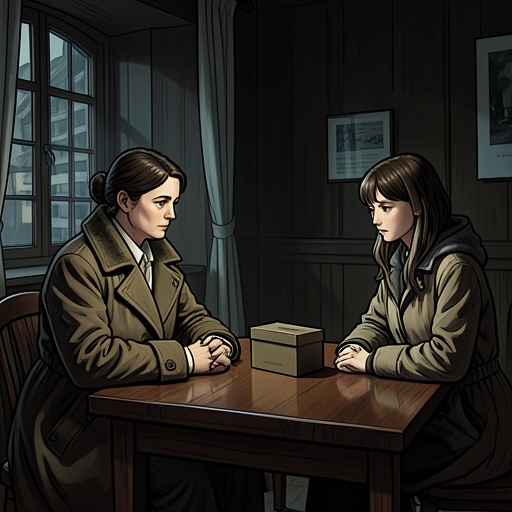
Susan contacts Ilene because she does not want to discuss the donor search with Mike, and asks to meet that day. Ilene initially has little desire to help Susan with the trouble surrounding her private life, but reminds herself that Lucas is her patient. When they meet at a diner, Ilene has rejected the idea of going out of town: to observers, the two women would simply appear to be having lunch. The ordinary setting contrasts with the difficult subject they have come to address.
Susan asks whether there is anything new from the donor banks. There is not. She and Dante are preparing a donor drive at Lucas’s elementary school, where Mike’s daughter Jill also attends. Teachers support the idea, and the couple plan to ask people to register with the donor bank the following Saturday. The effort gives the search a practical, community-based direction, even as the question of Lucas’s biological father remains unresolved.
Ilene pushes Susan to identify the father, arguing that possible candidates could be brought in for testing. She draws a firm line around her role: she is Lucas’s doctor, not Susan’s therapist or spiritual adviser, and she will not provide absolution or spend the meeting affirming Dante as a husband. When Susan finally says she does not know who Lucas’s biological father is, Ilene is taken aback. The answer leaves no simple name to pursue; she responds by proposing that each possible partner be brought in, keeping the conversation focused on the donor problem rather than the emotional comfort Susan may be seeking.
Private Life and Professional Pressure
Ilene’s life outside the hospital is presented through a rare quiet morning. She gets the paper after making coffee while her husband, Herschel, remains in bed. Their son Hal, in his final year of high school, has been out late; he has already been accepted to Princeton, Ilene’s alma mater. At home, Ilene sits with her coffee and medical journals, a small pause in a life organized around demanding work and family responsibilities.
She thinks about the years she and Herschel spent together through medical school, internship, residency, surgical fellowships, and work. Her feelings have settled into something comforting, but Herschel has recently suggested a trial separation as Hal prepares to leave home. The prospect unsettles the picture of effortless balance between career, motherhood, and marriage. Ilene’s own family life is therefore not a stable counterweight to the Lorimans’ crisis: the routines she has built are also entering a period of change.
Her professional standing faces pressure as well. Mike is questioned about a prescription for OxyContin made out to William Brannum, printed with both doctors’ names and their NewYork-Presbyterian address and license number, but signed by Mike. The investigators say they have asked Ilene about Brannum and that she does not remember him. The evidence does not establish that she was involved in the prescription; it places her name and partnership within an inquiry that could threaten the career she has spent years building. When she later calls Mike, she tells him she has spoken with Susan about Lucas’s biological father, connecting the medical case to the same uncertainty he is trying to understand at home.
Character and Narrative Significance
Ilene’s defining tension is between rigorous professional boundaries and the recognition that medical decisions reach beyond the person formally designated as the patient. She evaluates compatibility by antigens, but those results expose a family truth with emotional consequences. Her insistence that she is Lucas’s doctor protects the focus of the consultation; her willingness to meet Susan and press for information shows that this boundary does not mean indifference.
Her relationship with Mike gives the transplant plot a structure of professional reliance: he knows Lucas and feels the case personally, yet trusts Ilene enough to defer to her. Her own domestic uncertainty and the investigation surrounding the prescription complicate the image of a surgeon whose life is fully under control. Across these pressures, she continues to return to the concrete question before her: how to find Lucas a donor. Her narrative significance lies in holding that urgent medical task steady while parentage, marriage, and professional security all prove less settled than they first appear.