Joe Lewiston
Hold TightJoe Lewiston is a fifth-grade teacher whose gift for holding a classroom’s attention has made him widely admired, but that public confidence does not shield him from the harm he causes or the strain that follows at home. His story places the pleasures of teaching—humor, enthusiasm, the daily rituals of a classroom—beside a child’s hurt, a troubled marriage, and an increasingly urgent dependence on Nash.
Identity and Teaching
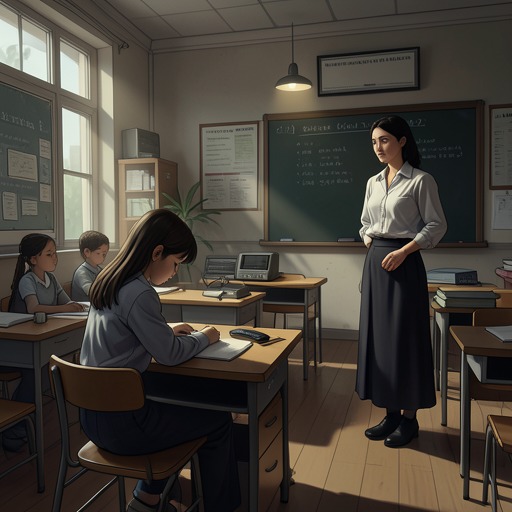
Joe’s professional identity rests on more than authority at the front of a classroom. He is described as passionate: he tells jokes, sometimes crosses the line into inappropriateness, and keeps students listening. Children love him, and many parents defend his style. Although some have been mildly upset by his antics, the large majority want their children assigned to him because he makes school enjoyable and seems genuinely invested in teaching rather than merely going through the motions. His reputation is therefore both earned and precarious: the qualities that engage students can also carry him past a boundary.
The contrast with Dolly sharpens that portrait. Joe’s enthusiasm distinguishes him from her, as she sees it, and helps explain why his professional standing matters to him. Yet admiration is not the same as protection from consequences. When Joe recognizes that he has hurt a girl, the popularity that usually surrounds him cannot make the harm disappear. The episode exposes the risk within his favored method: the joke that wins a classroom’s attention can make a child its target.
The Child He Hurt and the Strain at Home
Joe acknowledges that he has seriously hurt the girl. The confrontation over what he did identifies her as an eleven-year-old and makes clear that his conduct involved making fun of her. Dolly calls it a mistake and points to the continuing affection of students and parents, trying to reassure him; Joe does not answer. Her defense may soften the judgment of the incident, but his silence leaves his own recognition of the injury intact. The scene refuses to let professional popularity serve as a complete excuse.
The fallout also reaches beyond the classroom. Dolly sees a car pass their house repeatedly, slowing as it had on earlier occasions, and tells Joe that it has returned. He keeps correcting papers with conspicuous concentration and snaps back when she asks whether he heard her. The passage does not identify the driver or establish the car’s purpose, but its recurrence makes it an unsettled presence in the household. Joe’s absorption in his work, and his sharp reply, show how little ease there is between the spouses at that moment.
Their marriage has changed in other ways too. Joe had generally been the sexual aggressor, while Dolly used a familiar refusal when she was not in the mood. In recent months, following what the narrative calls a slip of the tongue, Joe has become different even in that pattern. When he asks whether they can postpone intimacy, Dolly accepts and turns away. The brief exchange marks a reversal in a once-established marital rhythm without explaining the underlying change; the distance is registered in the altered roles and the unelaborated departure.
Family Responsibilities and Self-Interest
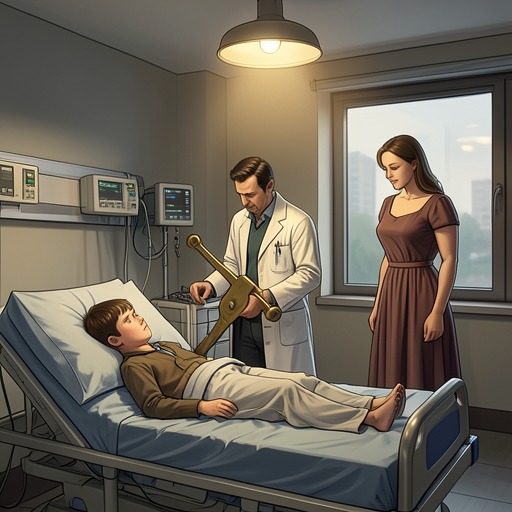
Joe’s concern for another family is complicated by his awareness of himself. Susan Loriman appeals to him to help find a donor for Lucas, her seriously ill son, although Joe has never taught any of her children. She invokes his standing as a leader in the school. Joe feels terrible for the Lorimans, imagines his own young daughter, Allie, ill in a hospital, and recognizes that the comparison should put his problems in perspective. It does not. He also admits to himself that helping might improve his standing after the XY-Yasmin controversy, or at least ease his guilt. Compassion and self-interest occupy the same thought rather than neatly replacing one another.
The episode gives Joe a concrete family measure for the appeal: he imagines Allie in pain and understands why a parent would work feverishly to save a child. Yet he cannot turn another family’s greater suffering into comfort for himself. The scene makes his response neither purely noble nor simply calculating. He feels the Lorimans’ need, but also notices how their request touches his reputation and his own sense of guilt.
Nash and the Lewiston Family History
When Joe needs someone he believes may understand him, he thinks of Nash. Joe has three older brothers still alive, but he relies on Nash more than on any of them. Nash is his former brother-in-law, the youngest and favorite of Cassandra Lewiston’s five brothers. Joe remembers Cassandra and Nash as an unusually close pair, seeming almost like one person together, a unity he says he has never experienced with Dolly.
That bond was shaped by loss. When their oldest brother, Curtis, was murdered more than a decade earlier, Cassandra grieved intensely, crying for days and at times unable to get out of bed. Nash later wondered whether the anguish might have weakened her while illness took hold. He had promised Cassandra that he would protect the people she loved and never let them suffer the same pain again. Joe’s reliance on Nash thus sits within a history of grief and promises: the man he turns to is not simply a trusted relative but someone whose idea of protection was forged by losses in the family.
The Classroom and the Unresolved Crisis
Joe’s attachment to teaching appears in the room itself. Though whiteboards had replaced green chalkboards in many classrooms, he kept the older board. The dust, the sound of chalk, and the work of cleaning with a sponge connected him to earlier generations and reminded him of who he was and what he did. In one scene, the sponge is too wet; water runs down the board as he tries to follow it in straight strokes. The simple task almost lets him lose himself in the work, but not quite. The familiar ritual offers a temporary refuge, not a solution.
Elsewhere, Joe sits cross-legged on the classroom floor with papers in his hands and tears in his eyes when Nash arrives. Joe tells him that the effort is not working because she is still sending the emails. The sender and the full nature of the problem are not established here, but the scene makes the pressure ongoing and shows Joe asking Nash for help rather than containing it alone. His professional space, usually associated with his control of a lively room, has become the place where his distress is visible.
A further crisis brings the same dependence into action. Joe does not know what to do and does not want to tell Dolly, in part because they have a young daughter and he does not want to jeopardize the family. At the same time, he cannot simply let a man die. Thinking of Nash, he says he has to go and runs for the door. The person at risk and the circumstances are not specified in this passage, but Joe’s choice is clear: concern for his family does not cancel his sense of responsibility to someone else. Across these scenes, he remains a devoted teacher and a family man, but neither role offers an easy answer when his actions have caused harm or another person’s life is at stake.