Lucas Loriman
Hold TightLucas Loriman is a ten-year-old boy whose need for a kidney transplant makes an undisclosed fact about his parentage medically consequential. He is cherished by the family that raised him, especially Dante, whom Lucas understands as his father, while tests show that Dante is not his biological father. As possible donors are assessed and the search spreads beyond the household, Lucas’s illness brings two different meanings of kinship into sharp relief: the bonds built through years of care and the genetic ties that may help save his life.
Identity and Background
Lucas has focal segmental glomerulosclerosis, or FSGS, and is described as being in desperate need of a kidney transplant. At the time his case is discussed, he is ten. Mike Baye, a leading kidney transplant surgeon, knows him personally and remembers him as a sweet, somewhat nerdy child. He wears glasses that tend to slide down his nose, and his hair is difficult to keep in place. Those details give Lucas a recognizable presence beyond the medical file: he is not only a patient with a serious disease, but a boy whom Mike has encountered in ordinary family life.
Lucas loves sports, although he is not good at playing them. When Mike practices shots with his son Adam Baye in the driveway, Lucas comes over to watch. He declines Mike’s offer of a stick and instead provides an enthusiastic running commentary, narrating Adam’s attempts as if they were a game. The contrast between Lucas’s love of sport and his own inability to play gives the scene its warmth without making his illness the whole of his identity. He is an observer with a lively interest of his own, included in the Baye family’s everyday routine even when he is not taking part in the play.
Illness and the Search for a Donor
The urgency of Lucas’s condition shapes the decisions around him. Mike has passed the case to his partner, Ilene Goldfarb, who heads transplant surgery at NewYork-Presbyterian and whom Mike considers the best surgeon he knows. He takes a secondary role partly because he knows Lucas and the case is personal to him. Before the tissue-typing results are available, Mike tells Susan that the family will have to wait until morning. His reassurance that they will do everything they can is professional language, but the narration makes clear that the stakes reach him personally.
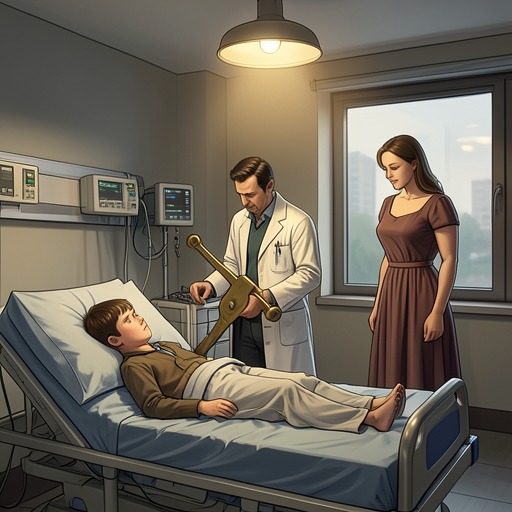
The transplant assessment turns genetic compatibility into a precise and distressing calculation. Ilene explains that an ideal donor would provide a six-antigen HLA match. Dante’s typing makes him a poor candidate, while Susan is a better match but has a match of only two. Ilene explains that closer matching can reduce the likelihood of rejection and the need for lifelong medication and constant dialysis. A cadaver-donor bank is another possibility, but Ilene considers finding a better candidate there unlikely. The family is therefore left with a difficult gap between the available donor and the match Lucas needs.
Lucas’s younger brother, Tom, is also considered. Ilene explains that a sibling has a twenty-five percent chance of being an identical match, a fifty percent chance of being a half match, and a twenty-five percent chance of not matching. Yet the news about Tom is not encouraging, and Susan remains the best match identified so far. The discussion makes clear that having a close family does not guarantee a medically suitable donor: each relationship carries hope, but the test results determine which hopes can be acted on.
The search then expands beyond individual family testing. Susan asks Ilene to meet without Mike because she does not want to discuss finding Lucas a donor with him. Although Ilene is reluctant to help Susan amid the trouble surrounding her, she agrees because Lucas is her patient. Later, Susan and Dante organize a donor drive, enlist support from teachers at Lucas’s elementary school, and plan to sign people up for the donor bank. A flyer circulated at the school announces blood testing by a medical professional. These efforts turn a private medical emergency into a community appeal, while Ilene refuses to disguise the uncertainty: when Susan asks whether the search is still hopeful, Ilene answers that it is not.
Family and the Question of Paternity
The news that Dante is not Lucas’s biological father first emerges through Ilene’s conversation with Mike. It changes the meaning of the transplant search because the person Lucas’s family might naturally expect to donate is not genetically related to him. In a later consultation, Ilene explains Dante’s poor tissue match in front of the family. Dante’s response shows that he had assumed a biological relationship; Susan, meanwhile, keeps her expression controlled. The clinical discussion thus exposes a family secret in the same setting where the doctors must explain antigen compatibility.
Dante’s place in Lucas’s life is not defined by that test result. Ilene describes him as a devoted, hands-on father: he bathed Lucas when he was small, changed his diapers, and coached his soccer team. These acts establish a history of care that stands alongside, rather than being erased by, the distinction between social and biological fatherhood. The test can identify a genetic mismatch; it cannot undo the years of parenting that made Dante Lucas’s father in the lived sense of the word.
When Ilene presses Susan to identify the biological father, Susan first says she does not know. Ilene assumes there may have been multiple partners, but Susan denies having had a lover and reveals that she was raped. The disclosure explains why the identity cannot simply be resolved by asking her to name a former partner, while leaving Lucas’s biological father unknown. The story does not supply a confirmed identity. Instead, the uncertainty remains both an intimate family fact and a practical obstacle in the donor search.
Community, Consequences, and Significance
The donor effort eventually reaches Joe Lewiston through the school. He has seen several appeals from the Loriman family, including a note asking people to help save Lucas’s life and an announcement of blood testing. Susan later approaches Joe with a donor nurse present and asks him to consider giving blood. She hopes to persuade him through an appeal to help her child, but she is also prepared to explain that Lucas is ten and that Joe’s brother Curtis died eleven years earlier, nine months before Lucas’s birth. She believes that a genetic uncle may offer the best remaining odds of finding a suitable donor. This possibility suggests a family connection that could matter medically, but it does not establish Curtis as Lucas’s biological father; Susan has said she does not know who the father is.
Lucas’s storyline makes the limits of medical classification visible without reducing family life to biology. Tissue typing divides possible donors into degrees of compatibility, and the search increasingly draws on relationships that had not previously been framed as medical resources. Yet the narrative also insists on what such tests cannot measure: Dante’s daily care, Mike’s personal concern, and Susan’s determination to keep searching. Lucas’s illness gives the biological question immediate force, but the family’s response shows that genetic connection and parenthood are not interchangeable measures of belonging.