Lucas Loriman's biological father is revealed
Hold TightLucas Loriman’s paternity revelation makes a private family secret medically urgent. When tests show that Dante Loriman is not Lucas’s biological father, the discovery changes the search for a kidney donor: the closest genetic relative may offer the best chance of a match, but Susan cannot identify that person. The event therefore exposes not a settled identity but a consequential absence—one that complicates the meanings of fatherhood, responsibility, and medical care.
The Medical Problem Behind the Revelation
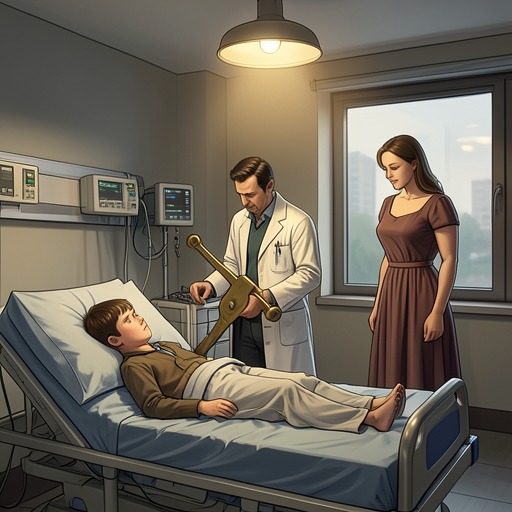
Lucas needs a kidney transplant, and the available donor options are poor. At a consultation, Ilene Goldfarb explains that the medical team has performed tissue typing and compares possible donors by their HLA antigens. A six-antigen match is ideal; the closer the match, the less likely Lucas’s body is to reject the new kidney and the lower the chance that he will face a lifetime of medication and constant dialysis.
Dante volunteers to be tested as a donor, evidently assuming that being Lucas’s father makes him the natural candidate. The results overturn that assumption: Dante is not a good match. Susan is a better match, but her match is only two, and Ilene does not consider her an ideal donor. Lucas’s younger brother Tom is also considered, but the news about him is unfavorable. The team will place Lucas on the cadaver kidney transplant bank, though Ilene warns that finding a better candidate there is unlikely. The revelation thus arrives within a narrowing set of medical possibilities, not as abstract family history.
From Nonpaternity to an Unknown Father
The disclosure begins when Ilene tells Mike that a neighboring family has a serious problem. At the consultation, she states plainly that Dante is not Lucas’s biological father. Mike is stunned, but the implication quickly becomes practical: if Dante cannot offer a strong match, the biological father is the most obvious person to test. Mike and Ilene recognize that they cannot simply bury the result while Lucas still needs a donor. They make testing that biological relative their first priority.
That priority does not mean the family already knows whom to approach. When Mike later explains to Susan that Lucas’s closest biological relatives need testing, she immediately understands that Dante is not the person in question. Mike confirms it. Susan closes her eyes, and then asks whether he intends to tell Dante. Mike says he does not think so, but his hesitation leaves the decision unsettled. The conversation makes clear that the medical team has discovered a disqualifying fact about Dante without discovering the identity of Lucas’s biological father.
The distinction matters throughout the revelation. Biology gives the doctors a potentially useful category—a close relative whose tissue might match—while Susan cannot supply a name. Later, when Ilene asks who Lucas’s father is, Susan answers that she does not know. The reply leaves the problem unresolved rather than turning the paternity discovery into a complete account of Lucas’s origins.
The Limits of Disclosure
Mike frames his approach to Susan around Lucas’s health. He says the purpose is not to pry or break up a family, but to find the best possible transplant donor. For him, the order of priorities is explicit: Lucas’s health comes first, and that makes testing the biological father necessary. Susan’s distress registers in her lowered head, wet eyes, and bitten lip, but Mike does not treat her pain as permission to abandon the medical question.
The discussion also tests the boundaries of a physician’s concern. Mike asks Ilene to consider whether she would inform Dante if a test revealed a serious medical problem in him, even though Dante is not her patient. Ilene initially emphasizes that such information is irrelevant to Lucas’s health. Mike’s hypothetical presses on the difference between what the clinic needs to know for treatment and what another person may have reason to know about himself. The scene does not resolve every ethical consequence of disclosure; instead, it shows the tension created when information about biological kinship becomes relevant to a patient’s chance of survival.
Care Beyond the Genetic Match
The search does not stop with the revelation. Susan and Dante plan a donor drive at Lucas’s elementary school, where Susan has spoken with teachers who support the idea. They intend to hold it the following Saturday and encourage people to register with the donor bank. The effort shifts the search outward: if the family cannot identify a suitable biological donor, a wider community may still produce one.
Later, Susan approaches Mr. Lewiston with a donor nurse present and asks whether he will give blood. She says that he had called the police after realizing what his former brother-in-law was doing, and urges him to take a step toward rebuilding his life by helping Lucas. The scene offers a possible avenue of assistance, but it does not confirm that Mr. Lewiston is Lucas’s biological father or that his blood will make him a suitable kidney donor. That distinction preserves the event’s central uncertainty: the revelation has made genetic connection urgent, while the identity and usefulness of a particular donor remain open.
Significance
The paternity revelation separates biological fatherhood from the care already given to Lucas. Dante’s willingness to volunteer does not make him a good genetic match, while the person who might be biologically closest remains unidentified. The transplant process gives that difference immediate consequences: tissue typing turns kinship into measurable compatibility, but those measurements cannot by themselves establish a family’s history or settle what should be disclosed.
Susan’s uncertainty and the family’s donor efforts keep the event from resolving into a simple secret exposed. The truth changes the medical strategy, complicates the question of what Dante should be told, and sends the search beyond the household—from an unknown biological relative to a donor bank and a community drive. The revelation’s decisive force lies in this combination of discovery and incompletion: the doctors learn who Lucas’s father is not, but the family still has no answer to the question of who he is.